Learning to Swim as an Adult: Why It’s Harder Than It Looks
Why learning to swim as an adult is harder than it looks: fear, technique and the unlearning problem — plus how UK adults actually succeed. Dive in today.
For a child, water is a playground. For an adult who never learned, it is a place of quiet dread — deep, cold and public, with everyone else gliding past as if born to it. That dread is the real subject of this article, more than strokes or breathing. Adults do not fail to learn because they lack strength or fitness. They fail because fear, old movement habits and the embarrassment of starting out in a crowded pool all arrive together, and each one needs a different answer. The good news is that every one of those answers exists, and they work better with a patient instructor than with any amount of video watching.
The difficulty is rarely about fitness or coordination. Adults who cannot swim are usually strong enough and coordinated enough; what stops them is a tangle of fear, old habits and embarrassment, and each strand needs its own answer. Many adults also worry about the water itself before they ever get in, its quality as much as its temperature, and it is worth knowing something about understanding water pollution on a tight budget so that the pool and the open water you might swim in later are both understood rather than feared. What follows is a plain account of why grown-ups find swimming hard, and what actually works.
The Fear Problem Is Real
Ask adults who cannot swim what holds them back and the answer is almost never that they never got round to it. It is fear: of deep water, of sinking, of losing control, of looking foolish in front of strangers. A frightening experience in childhood, even a mild one, can lodge deep and stay there for decades. The adult mind is also very good at catastrophic thinking. A pool that is only chest deep can feel, in the imagination, like open sea.
No amount of reasoning dissolves that fear, because it does not sit in the logical part of the mind. It has to be worn down through experience, gradually, in modest steps that show the nervous system the water means no harm. Sound adult courses start at the shallow end with floating, breath control and just standing in the water, leaving strokes for later. The aim of those opening lessons is not swimming at all. It is teaching the body that nothing dreadful happens when the water rises to shoulder height.
Adults who jump past that early stage and head straight for stroke technique nearly always get stuck, because a body braced for calamity cannot take in new skills. When the fear runs deep, mention it in the opening session. Teachers who work with grown-up beginners have heard it countless times, and naming the fear lets them set a gentler pace. A handful of one-to-one lessons at the outset can repay nervous learners many times over: no onlookers, no measuring yourself against quicker classmates, no pressure to keep up.
The Unlearning Problem Adults Bring
Youngsters turn up at the pool with no ingrained habits to undo. Grown-ups turn up carrying decades of movement patterns, and most of those patterns are wrong in water. On dry land you hold your head high, breathe whenever you please, and stay vertical. In the pool, each of those habits fights you. Picking up swimming later in life means shedding land based reflexes first, which is far tougher on the mind than starting with a clean slate.
Breathing causes the most grief. On dry land you draw breath in and out without a second thought. In the pool you must breathe to a rhythm, breathing out under the surface and turning to draw breath in, which feels profoundly strange at first. Grown-ups tend to hold their breath, then snatch at air, then panic when water splashes their face. The remedy is dull yet dependable: stand where the water is shallow, dip your face under, blow bubbles, turn to breathe, and repeat until the whole thing bores you. Boredom means the skill has bedded in, and most grown-up learners need a run of sessions doing only that before strokes begin to make sense.
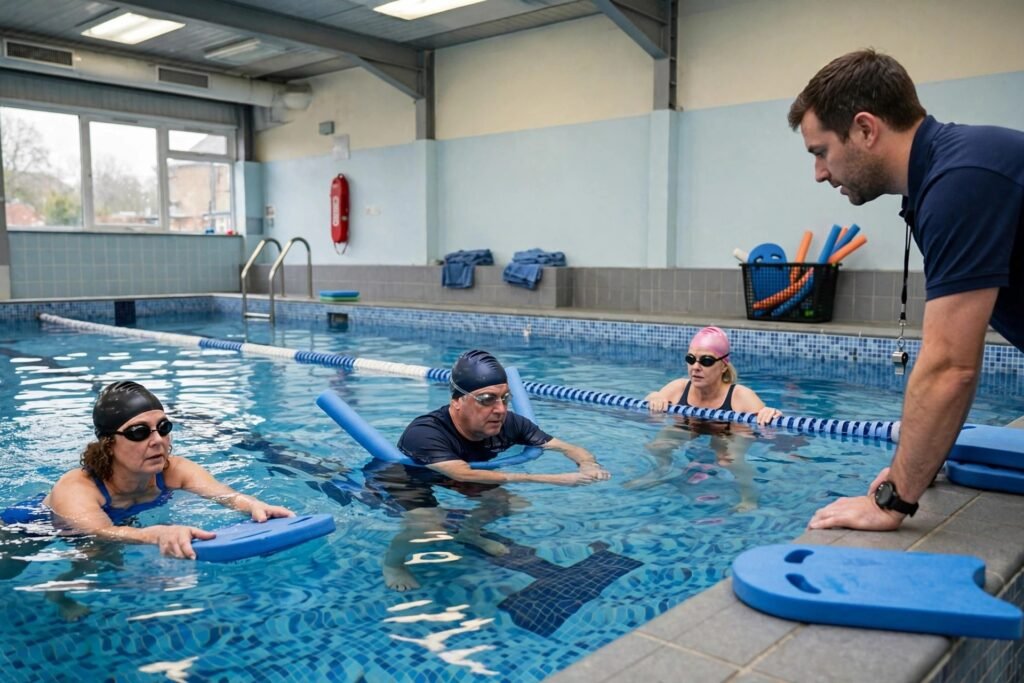
Body position is the next hurdle. Grown-ups try to remain upright in the water, kicking their legs and keeping their heads high, because upright feels secure. Yet upright is what pulls you under, and lying flat is what keeps you afloat. Trusting the level, face down posture feels deeply wrong right up to the moment it falls into place. Exercises using floats and foam noodles are not beneath an adult. They retrain your sense of where your body sits in the water, and every capable grown-up learner relies on them, whether they own up to it or not.
The Social Barrier of Learning in Public
Youngsters learn beside others their own age. Grown-ups learn in pools crowded with assured swimmers sliding past while they hold on to the wall. The embarrassment runs deep, and it explains why plenty of adults quit after a couple of sessions, rather than the swimming itself beating them. Standing out as a novice in swimwear, in full view of strangers, is a social trial that youngsters simply never meet in the same form.
There are practical ways around it. Most leisure centres run adult only beginner sessions, where everyone is in the same position and nobody is watching anyone else. Going at quiet times helps too, when the lanes are emptier and the pool feels less like a stage. And it is worth remembering that experienced swimmers genuinely do not care what you are doing. They are counting their own lengths, nursing their own aches, and thinking about their own day.
Seeing the embarrassment differently helps too. Each assured swimmer in that pool once stood exactly where you stand now, even if it happened so long ago that the feeling has faded from memory. The awkwardness is a modest price for the ticket, and it wears off quickly once the lessons get going. After a few sessions, the pool stops feeling like a crowd watching you and starts feeling like somewhere you happen to be picking up a useful skill.
The Adult Learner’s Playbook
Professional instruction matters more for adults than for children, because an instructor spots in seconds what you would practise wrongly for months. Practising a stroke wrongly cements a bad pattern that takes twice as long to unlearn, so getting the foundations right early saves a great deal of frustration. Look for programmes built for adult learners, where the teacher understands fear and unlearning rather than simply running a children’s class with taller pupils.
Going often beats going for a long stretch, every time. A pair of brief sessions each week moves you forward far quicker than a single lengthy one, because the feel of the water slips away fast between visits. Brief, steady contact keeps the nerves settled and the muscles retaining what they learned. The dull basics deserve respect too: floating, gliding and timed breathing bear no resemblance to swimming, yet they form the whole base. Leave them out and whatever you build on top wobbles sooner or later.
The equipment is straightforward, and sorting it removes one more distraction. Goggles that stay watertight, a swimsuit you forget about once you are in the water, and a cap when the pool asks for one. Nothing more is needed. Aim for process targets instead of outcome targets: working on breathing exercises a couple of times this week sits within your control, while covering a full length by a set date does not. Pile up enough small processes and the results turn up by themselves, often without warning, in a session where everything falls into place.
Why the Effort Pays for Itself
Swimming ranks among the fullest forms of exercise on offer, and it treats the body with unusual gentleness. It engages the whole body together, develops heart and lung fitness, and firms muscles without hammering the joints. For grown-ups with aching knees, a troublesome back, or extra weight that turns running into a punishment, swimming is frequently the finest choice rather than simply a passable one. The water bears your weight as you work, a pairing no exercise on dry land can equal.
The rewards also last a long while. Taking it up in your thirties, fifties or seventies secures decades of gentle-on-the-joints fitness, and it opens the door to holidays, family outings and open water that used to be out of reach. A swimmer can keep moving gently into great old age, which holds for almost no other demanding activity. The hours spent at the shallow end as a novice are paid back many times over by the years of easy, pleasurable movement that come after.
There is a quieter payoff too. Conquering a fear you have carried since childhood changes how you see yourself, and that confidence spills into other things. Adults who learn to swim often describe it as one of the most satisfying things they have ever done, not because the swimming itself is remarkable, but because they finally stopped letting an old fear decide what they could and could not do.
Starting Where You Are
The hardest part of the whole business is the first step, and it is smaller than it looks. It is not signing up for a course or buying kit. It is walking into a leisure centre and asking what adult beginner sessions they run. That single question is the whole beginning, and the staff have heard it many times before. Nobody will laugh, nobody will be surprised, and you will almost certainly not be the only adult asking it that week.
Once you have started, protect the habit the way you would protect anything valuable. Book the sessions into your week as fixed appointments, go even on the days you feel reluctant, and judge yourself on attendance rather than progress. Some sessions will feel like leaps forward and some will feel like nothing happened at all. Both kinds count, because the learning is happening underneath, in the nervous system, even when the surface shows nothing.
Grown-ups carry genuine strengths into the pool that youngsters lack. You can grasp why a method works, which makes deliberate practice easier. You own the patience to repeat a tedious exercise until it beds in. And you picked this up of your own free will, which drives you harder than any lesson handed down by a parent or a school. Honour the fear, welcome the dull exercises, seek sound teaching, and turn up regularly. The water pays no attention to your age, and neither should you.