Understanding the Offside Rule Simply: The Biggest Misconceptions
The biggest risks of getting understanding the offside rule simply wrong: the misconceptions that ruin debates, plus the rule explained plainly and simply. Read on.
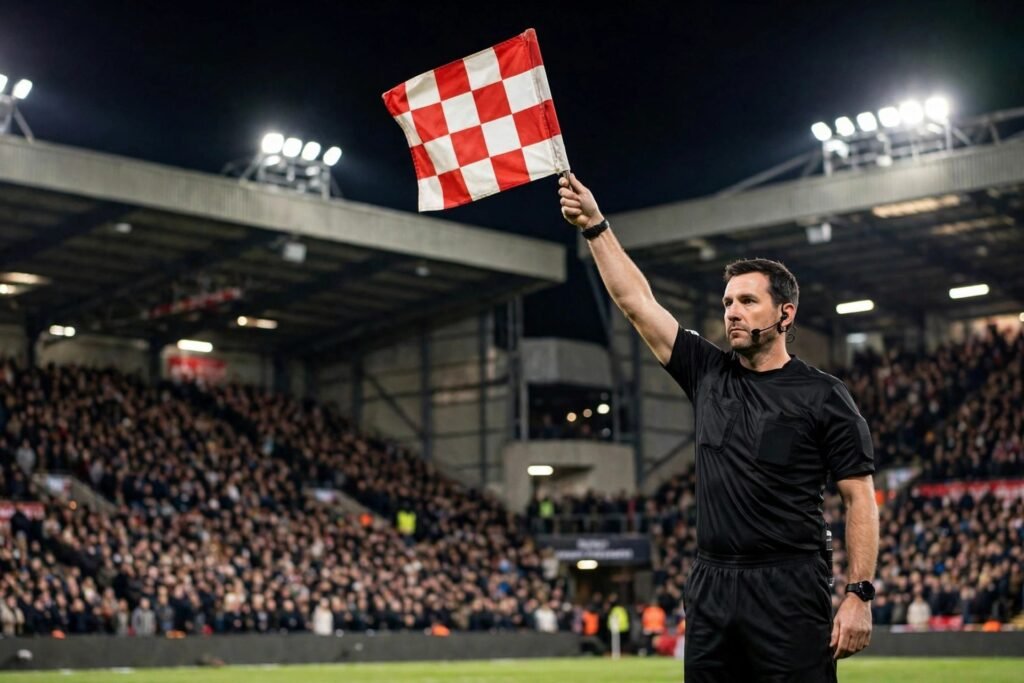
The offside rule causes more arguments in pubs and living rooms than any other part of football, and most of those arguments start from the same simple misunderstanding about what the rule actually punishes.
Strip the rule to its core and it reads plainly, though the arguments all gather round the fine print. A forward counts as offside when, as a team-mate sends the ball on, he stands closer to the opposing goal than the ball and the penultimate defender, yet standing there only draws the whistle once he takes part in the move. If you want to rewatch a contentious decision and test your understanding against the footage, knowing how to watch football highlights free and legally in the UK means you can replay the moment as often as the debate demands.
What Does Offside Actually Mean?
Offside makes most sense as two notions that people keep folding into one. The opening notion is position: a forward sits offside when he stands past the penultimate defender, with the ball also behind him, at the instant a team-mate sends the ball forward. The next notion is offence: that standing only turns into an offence once the forward takes part in the move, which covers touching the ball himself, stopping an opponent from reaching it, screening the keeper’s view, or profiting from a rebound off the frame or a defender. A striker may stand past the defence all afternoon without breaking any rule, so long as he stays clear of the move, and that explains why attackers sometimes linger beyond the back line while a colleague strikes from range, deliberately keeping clear of the action.
The reason the rule exists is to stop attackers from camping beside the goalkeeper and waiting for a simple tap-in, which would destroy the game as a contest. By requiring attackers to stay level with at least two opponents, or behind the ball, the rule forces them to time their runs and keeps the defence honest. Once you grasp that the rule punishes involvement rather than position, most baffling decisions start to make sense.
When Is a Player Judged: the Pass or the Touch?
The timing point breeds the most confusion, since it runs against instinct. Offside gets called on the instant a team-mate releases the pass, not on the instant the receiver gathers it. A striker who starts in line with the deepest defender as the pass leaves the boot may race clear of everyone, collect the ball deep inside the area and finish within the rules, since the call rests on the release, not the collection. A forward in line when the pass goes stays in line even when he drifts past the defence ahead of the ball arriving. The finest forwards build whole careers on timing runs in exactly that way.
That timing point also explains why video review halts the picture at the kick instead of at the finish, and why the moan that a scorer stood plainly past the defence as he scored counts for nothing when he stood in line as the pass left the boot. Learn to watch the passer first, and calls grow far simpler to read live.
Which Parts of the Body Count?
Not each part of the body counts when offside gets called, and this is where the fiercest modern rows start. A forward is caught out when any part of the head, torso or feet sits past the penultimate defender, while hands and arms count for nobody, attacker or defender alike, which keeps the rule in step with how handball gets defined. That explains the habit of measuring shoulders and toes on review, never fingertips.
The other half of the point is that in line counts as legal. A forward has to stand plainly past the penultimate defender before the whistle goes, and when the two stand level, the forward stays legal. Ahead of video review, that principle handed forwards the benefit of the doubt on borderline calls. Video review has altered that, since cameras can measure what the human eye misses, and the upshot is the famous marginal calls where a toe or a shoulder settles a goal. The rule itself stands unchanged: in line means legal, arms count for nothing, and the furthest forward point of head, torso or feet is what settles it.
Why Do Some Offsides Look Obvious and Others Not?
Some offside decisions look obvious because the gap between attacker and defender is large enough to see from the stands, and nobody in the ground needs a replay to confirm them. The difficult ones are those where the players are level or nearly level, where the pass is played at speed, and where the eye has to judge two things at once, namely the moment of the kick and the position of the players. Human vision is not built for that combination, which is why even experienced officials get tight calls wrong in real time, and why supporters in different parts of the ground can watch the same moment and reach opposite conclusions with complete confidence.
The angle of view makes the problem worse. A supporter sitting in line with the defence sees the offside line clearly, while a supporter behind the goal sees a flattened picture in which everyone looks level. Television replays help, yet they can mislead too, because a freeze frame taken a fraction of a second early or late changes the positions completely, and a camera angle that is not level with play distorts the apparent gap. At full sprint, a forward covers several yards in a blink, which is why the rule causes so much argument. Obvious decisions have large gaps; rows come from tiny ones, where human judgement is least reliable.
What Changed With Video Review?
Video review turned offside from a call made by eye in an instant into a measurement made by camera and computer, and that change has split supporters ever since. The system pinpoints the precise frame where the boot meets the ball, then draws measured guides against the attacker’s furthest forward point and the penultimate defender, leaving arms out, and checks whether any part of the attacker sits past the line. The method is exact, and its backers say the rule is binary, meaning a forward is offside or he is not, and technology merely enforces it rightly where the human eye falls short.
The critics take the opposite view, namely that the rule was framed for human eyes, with doubt favouring the attacker, and that measuring toenails and armpits betrays its spirit. A suggested daylight rule, where any overlap means legal, would end marginal calls yet breed fresh borderline cases of its own. Whatever lies ahead, the written law stays the written law, and officials enforce it as worded instead of as imagined. Video review has also shifted attacker habits: forwards hold their runs to stay plainly in line, and full-backs hold crosses back by a fraction.
How Can You Spot Offside Quickly While Watching?
Spotting offside quickly is a skill that improves with practice, and it starts with watching the passer rather than the runner. When an attack builds, keep your eye on the player about to play the forward pass, and glance at the defensive line at the moment the pass is struck. If the runner is level with the second-last opponent at that instant, the run is legal no matter how far beyond the defence they end up, and if they are beyond the line at that instant, the flag should come. Watching the kick rather than the finish matches how the rule is judged.
The second habit is to watch the defensive line as a unit rather than individual defenders. Good defences step up together in a straight line, which makes the offside line easy to read, while disorganised defences leave one player deeper than the rest, which plays everyone onside. When a defence steps up and the flag stays down, the attacker was level; when it goes up, the run was mistimed. The third habit is patience: on a tight call, wait for the replay rather than trusting the first impression, because the eye is unreliable at full speed. With those three habits, you will read offside better than most people shouting around you.
Frequently Asked Questions
What does the offside rule mean in plain words? Simply put, a forward gets punished when, as a team-mate sends the ball on, he stands past the penultimate defender and the ball, and then takes part in the move. Merely standing past the line breaks no rule, and a forward who stays clear of the move breaks no rule at all.
When does offside get called, at the kick or at the collection? Offside gets called when a team-mate releases the pass, not when the receiver gathers it. A run timed to perfection starts in line with the defence and ends past it lawfully, since the call rests on the release.
Does offside apply at a corner or a throw-in? No, since throw-ins, goal kicks and corners sit outside offside altogether by the written law. Free kicks sit inside it, and a forward may be caught out by the phase after an exempt restart once the ball has been touched again.
Why do video review offside calls drag on so long? Officials have to pinpoint the precise frame where the boot meets the ball, then set measured guides against the furthest forward point of attacker and penultimate defender, arms left out. Marginal calls on a leaning shoulder or a stretched toe need time to confirm.
Does standing in line count as offside? No, in line counts as legal. A forward has to stand plainly past the penultimate defender, and any overlap under the present reading favours the forward, though video review gauges that overlap with extreme care.
Can a forward be offside inside his own half? No, a forward inside his own half cannot be caught out, however far forward he finishes once the ball has gone. Runs that begin behind the halfway line stay exempt.