
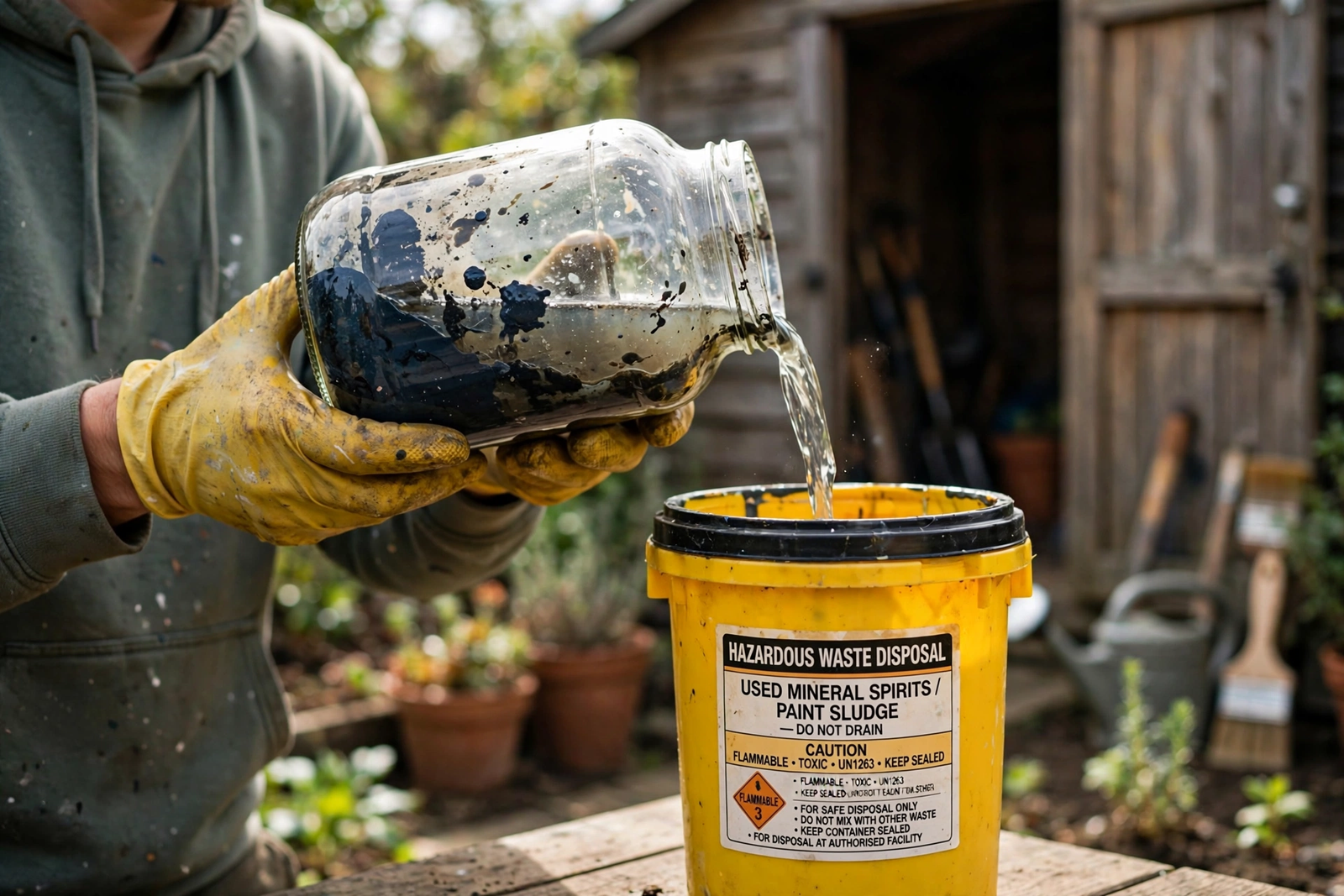
How to Dispose of Mineral Spirits: Step-by-Step Guide (2026)
Mineral spirits — known as white spirit in the UK — is the workhorse solvent of DIY painting: it thins oil-based paints, cleans brushes, and degreases surfaces. It is also a petroleum distillate that is toxic to aquatic life, harmful if swallowed, and flammable. A litre tipped down the drain can contaminate thousands of litres of groundwater, and a bin bag of soaked rags can quite literally set your garage on fire. Disposing of it properly is not difficult, but it does require knowing the rules, because the convenient options are all wrong.
What NOT to Do With Mineral Spirits
Let us clear the dangerous misconceptions first, because these are the mistakes people actually make:
- Never pour it down any drain — sink, toilet, or outdoor drain. It passes straight through most sewage treatment, poisons waterways, and can create explosive vapour build-ups in pipework and septic systems.
- Never pour it on the ground or into soil. It leaches into groundwater and kills soil biology. One careless pour can render a patch of garden barren for years.
- Never put liquid spirits in your household rubbish bin. It leaks in the lorry, endangers collection crews, and is illegal in most areas.
- Never “evaporate it away” in an open container indoors. The fumes are harmful to breathe and create a serious fire and explosion risk. Controlled outdoor evaporation of tiny residues is sometimes acceptable (see below); a bucket of it in the garage is not.
- Never mix it with other chemicals — especially bleach, which can react dangerously with petroleum solvents.
Step 1: Reuse It Before You Dispose of It
The most environmentally friendly disposal is no disposal at all. Used mineral spirits can usually be cleaned and reused several times with a simple settling method:
- Pour the dirty spirits into a clear glass jar or bottle and seal it.
- Leave it undisturbed for 24–48 hours. Paint solids and contaminants sink to the bottom, leaving clearer solvent on top.
- Carefully decant (pour off) the clear liquid into a clean, labelled container. Stop before you disturb the sludge layer.
- Use the reclaimed spirits for first-pass brush cleaning or degreasing — save fresh solvent for final rinses.
Each cycle recovers 70–90% of the solvent. Only when the liquid stays murky after settling, or smells strongly rancid, is it truly spent. Filtering through a coffee filter or paint strainer between uses extends its life further. This habit alone can cut a busy DIYer’s solvent waste to a fraction — and it saves real money, since white spirit costs £5–£10 for 2 litres.
Step 2: Take the Waste to a Hazardous Waste Facility
Spent mineral spirits, the settled sludge, and contaminated filters are all classified as hazardous waste and must go to a proper collection point.
In the UK
Every local council operates household waste recycling centres (“the tip”) that accept white spirit and other solvents — look for the hazardous waste or chemicals bay. It is free for householders in most council areas, though some require booking a slot online first. Keep the waste in its original container or a clearly labelled sealed bottle, and never decant it into unlabelled containers for transport. If you are unsure where your nearest site is, check your council’s website — search “hazardous waste” plus your council name. National guidance on dealing with household chemicals is published at GOV.UK, which links through to local authority services.
In the US
Most counties run household hazardous waste (HHW) collection events or permanent drop-off sites — search your county name plus “hazardous waste disposal.” The US Environmental Protection Agency publishes guidance on household hazardous waste explaining what qualifies and why it must be kept out of landfills and drains. Many areas also hold periodic amnesty collection days where you can drop off solvents, paints, and old chemicals free of charge.
Transport tip: keep containers upright in a box or crate in the boot, ensure lids are tight, and never transport solvents in the passenger compartment — vapour build-up in a closed car is a genuine hazard.
The Rag Problem: Spontaneous Combustion Is Real
This deserves its own section because it injures people every year. Rags, paper towels, and steel wool soaked in mineral spirits — or in the oil-based paints and finishes the spirits were used with — can spontaneously combust. As the oil oxidises it generates heat; a crumpled rag insulates that heat, the temperature climbs, and the rag ignites with no spark or flame needed. Bins, garages, and workshops have burned down this way.
Safe handling is simple but non-negotiable:
- Best practice: lay used rags flat outdoors on concrete or hang them individually on a line until completely dry and stiff (24–48 hours). Once fully cured and dry, most areas allow them in regular rubbish — but check local rules.
- Alternative: submerge rags fully in water inside a sealed metal container with a tight lid, and take the container to the hazardous waste facility.
- Never: crumple damp solvent rags into a bin, pile them in a corner, or leave them in a plastic bag. That is exactly the geometry that starts fires.
The same caution applies to the sludge left after settling your spirits — treat it as hazardous waste, not general rubbish.
Small Residues: When Evaporation Is Acceptable
For truly tiny amounts — the last tablespoon coating the bottom of a brush-cleaning jar, a dribble on a drop cloth — controlled outdoor evaporation is widely accepted: leave the container open outdoors, away from buildings, children, and pets, until the residue dries completely, then dispose of the container normally. This is for residues, not volumes. If you can pour it, it is not a residue — take it to the hazardous waste facility.
Reducing Solvent Waste in the First Place
The cleanest disposal is the one you never need. A few habits from professional decorators:
- Use the two-stage brush cleaning method: first wash in reclaimed (settled) spirits, then a quick final rinse in fresh. It halves fresh solvent use.
- Wrap brushes tightly in cling film or foil between coats instead of cleaning them daily — a brush kept airtight stays usable for days.
- Choose water-based paints where the finish allows. Modern acrylics now match oil-based performance in most interior applications, and brushes wash out in the sink with no solvent at all. (For context on project timing with different finishes, see how long does it take for stain to dry“>how long wood finishes take to dry.)
- Buy only what you need. A half-used 5-litre can that sits in the shed for a decade eventually becomes someone’s disposal problem.
If you are stripping or refinishing rather than just cleaning up, how to dispose of paint thinner“>our guide to disposing of paint thinner covers the closely related solvents with their own quirks.
Frequently Asked Questions
Is white spirit the same as mineral spirits?
Essentially, yes. “Mineral spirits” is the American term and “white spirit” the British term for the same family of petroleum-distillate solvents. UK white spirit comes in standard and low-odour varieties; both are disposed of identically as hazardous waste.
Can I pour mineral spirits down the drain if I dilute it with water?
No. Dilution does not make it safe — the solvent does not truly dissolve, it still harms treatment systems and waterways, and the mixture can still produce dangerous vapours in drains. There is no dilution loophole.
How long does it take for mineral spirits to evaporate?
A thin film outdoors evaporates in a few hours on a warm, breezy day; a shallow puddle in a container can take 24–48 hours. Indoors it evaporates more slowly and the fumes accumulate — which is exactly why indoor evaporation of anything beyond trace residues is unsafe.
Can I put dried paint sludge in the regular bin?
Rules vary by council, but fully dried, solid paint sludge is generally accepted in household waste in many UK areas, while liquid solvent waste never is. When in doubt, take it to the hazardous waste bay — the staff will tell you on the spot, and it costs nothing to ask.
What should I do with old, unopened cans of white spirit?
Take them to the hazardous waste facility as-is. Do not open old cans “to let them dry out” — aged solvents can form peroxides and the fumes are unpleasant. Transport them upright with lids tight, exactly as you bought them.
Are there genuinely safer alternatives to mineral spirits?
For brush cleaning with water-based paints, warm soapy water is all you need — which is the strongest argument for choosing water-based finishes. For oil-based work, citrus-based solvents exist but are slower and still require proper disposal. The honest answer: reduce solvent use first, dispose of the rest properly.