
How can I Refresh my Wardrobe without Buying New Clothes
Your wardrobe is full, your bank account says no, and you’re bored of everything you own. The answer isn’t a shopping spree — it’s seeing your existing clothes with fresh eyes. Refreshing your wardrobe without buying new clothes is part creativity, part organisation, and part remembering what you actually own (most of us wear the same 20% on rotation while the rest gathers dust). Here’s how to fall back in love with your wardrobe without spending a penny.
Step 1: The Full Audit (2 Hours That Change Everything)
Take everything out — yes, everything — and sort into four piles:
- Love & wear regularly: back in the wardrobe immediately. These are your core.
- Like but never wear: the interesting pile. For each item, ask why you don’t wear it — wrong size? Needs tailoring? Nothing to pair it with? Doesn’t suit you anymore? The “why” determines the fix.
- Repair/alter: great pieces with fixable issues — missing button, too long, small stain, broken zip. Bag these for action, not the back of the wardrobe.
- Donate/sell: wrong size, damaged beyond repair, or you simply don’t like it anymore. Let it go — it’s clutter, not potential. (If selling, see how to sell unwanted clothes online.)
Most people rediscover 5–10 “new” outfits in the “like but never wear” pile alone. The audit is the highest-ROI two hours in fashion.
Step 2: Shop Your Own Wardrobe
Now the fun part — treat your wardrobe like a shop you’re browsing for the first time:
- Try on “forgotten” combinations: that top you always wear with jeans — try it with the midi skirt. The blazer you wear for work — try it over a dress for evening. Photograph combinations that work; you’ll forget them otherwise.
- Break your formulas: we all have outfit ruts (same jeans + same top + same shoes). Deliberately ban your top 3 combinations for a month and force new ones.
- Layer unexpectedly: shirts under jumpers, dresses over trousers, turtlenecks under slip dresses — layering creates “new” outfits from familiar pieces.
- Accessorise differently: the same dress with different shoes, bag, belt, and jewellery is three different outfits. Accessories are the cheapest refresh available — and you already own them.
Step 3: Restyle, Repair, and Alter
Free restyling tricks
- The front tuck: tucking just the front of a shirt transforms proportions instantly.
- Sleeve rolling/pushing: shows the wrist, looks intentional, updates any shirt or blazer.
- Belting: a belt over a dress, blazer, or oversized shirt creates shape and a “new” silhouette.
- Knot it: knotting an oversized tee or shirt at the waist updates it completely.
- Cuffing jeans/trousers: a single cuff changes the whole leg line.
Small repairs, big impact
- Replace missing buttons (check inside seams — spares are often sewn there).
- Fix hems with iron-on hem tape (£2) — no sewing required.
- De-pill knitwear with a fabric comb — instantly renews jumpers.
- Polish shoes and bags — transforms tired accessories.
- Dye faded black clothes with fabric dye (£5) — genuinely effective for cotton.
Alterations (small spend, big return)
If you have a tiny budget (even £20), spend it on alterations, not new clothes. Hemming, taking in waists, and shortening sleeves convert “almost” items into favourites. Our capsule wardrobe on a budget guide treats alterations as a core strategy, not an afterthought.
Step 4: Organise for Visibility
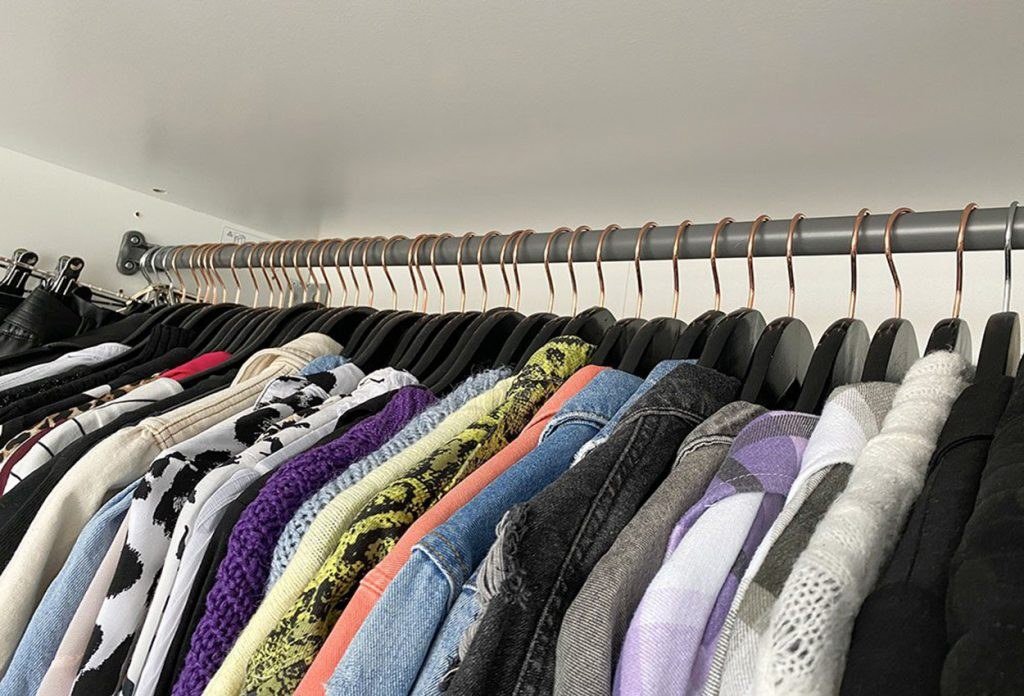
You can’t wear what you can’t see. If your wardrobe is crammed and dark, you wear the front 20% on rotation:
- Hang everything visible, grouped by type and colour.
- Store out-of-season clothes elsewhere — they obscure what’s wearable now.
- Try the hanger trick: turn all hangers backwards; after wearing something, hang it normally. In three months, the backwards hangers show what you never wear.
- Our small wardrobe organisation guide has space-specific tactics.
Step 5: Borrow, Swap, and Restyle Challenges
- Clothes swaps: organise one with friends — everyone’s “bored of it” is someone else’s “new favourite.” Free, social, sustainable.
- Borrow for occasions: need something for one event? Borrow from a friend or family member rather than buying.
- 30-day style challenges: “no repeat outfits for 30 days using only what I own” — forces creativity and reveals the true versatility of your wardrobe.
- Follow restyling accounts: stylists who specialise in “shop your wardrobe” content are more useful than haul videos.
When You Actually Need Something New
Sometimes the audit reveals genuine gaps — no interview outfit, shoes that are actually broken, underwear that’s seen better days. That’s fine; the point isn’t never shopping, it’s shopping intentionally. Fill the specific gap (ideally secondhand — see finding quality secondhand clothes online), and get back to enjoying what you have.
The 30-Day No-Buy Challenge
Want to prove to yourself that your wardrobe is enough? Try 30 days of no new clothes:
- The rules: no buying clothes, shoes, or accessories for 30 days. Essentials replacements (worn-out underwear, broken shoes with no backup) are allowed — whims are not.
- The method: each morning, create an outfit from what you own. Photograph it. By day 30 you will have 30 documented outfits — visual proof of abundance.
- What happens: week one is hard (the urge to shop is habitual). Week two gets creative (new combinations emerge). Week three is liberating (getting dressed becomes play). Week four is the revelation: you did not need anything.
- The side effects: most people discover their actual style (freed from trend-chasing), identify genuine gaps (useful for future intentional shopping), and save £100–£300.
- After the 30 days: you do not have to continue forever — but most people shop completely differently afterwards. The urge weakens; the intentionality sticks.
The no-buy month pairs naturally with sustainable habits — Hampshire County Council’s sustainable fashion guide frames buying less as the highest-impact choice, above even buying “sustainable” new. Thirty days, zero spending, a rediscovered wardrobe. The hardest part is starting.
A refreshed wardrobe isn’t about new clothes — it’s about new eyes. Audit, experiment, alter, organise, and accessorise. In a weekend, without spending anything, you can rediscover a wardrobe you actually enjoy wearing. The clothes were never the problem; the rut was.