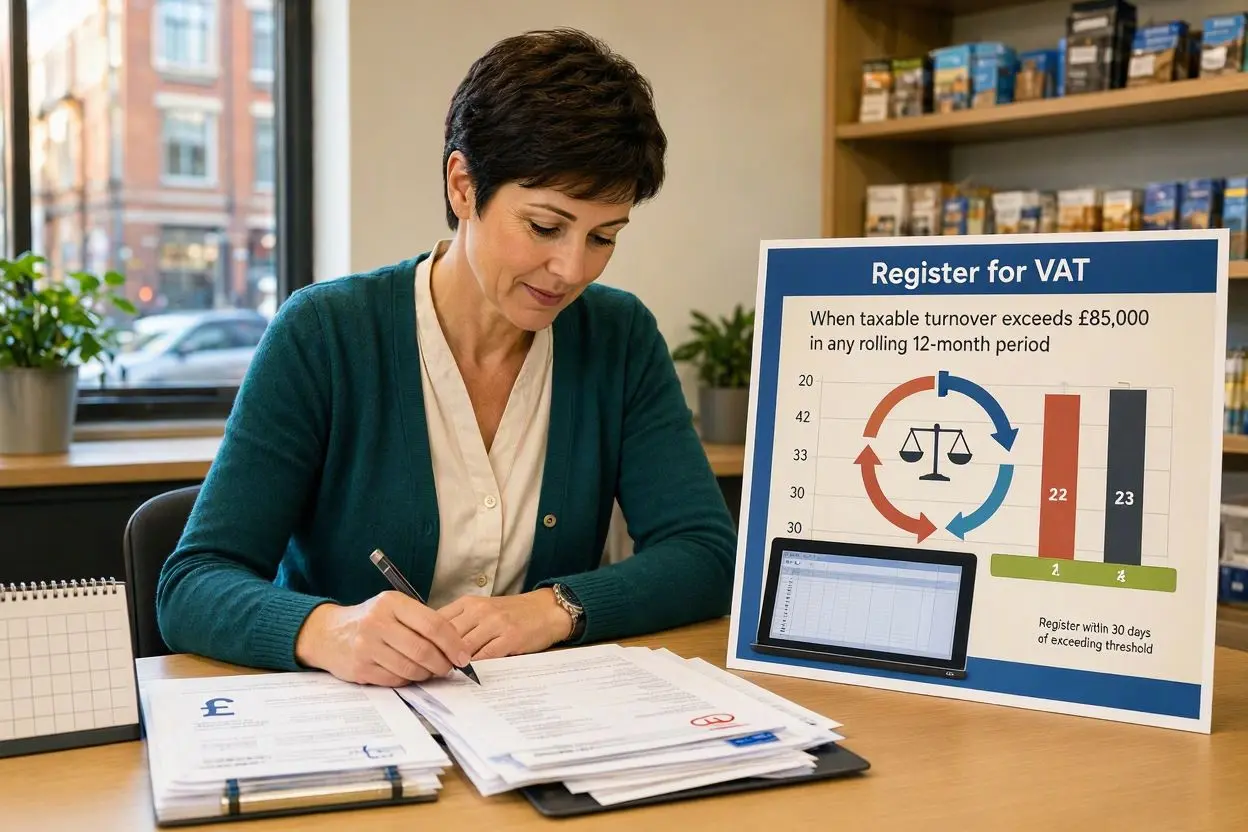
When to Register for VAT as a Small Business in the UK
If you run a small business, VAT tends to sit at the back of your mind until one day your sales start climbing and a nagging question appears: do I need to register yet?
Get it right and VAT is just another bit of admin. Get it wrong and you could end up paying VAT out of your own pocket on sales you’ve already made. This guide walks you through exactly when registration becomes compulsory, when it might be worth doing early, and how to avoid the mistakes that catch people out.
The Short Answer
You must register for VAT when your VAT-taxable turnover goes over £90,000 in any rolling 12-month period. That figure has been in place since 1 April 2024. You can also register earlier if you choose to, and sometimes that’s a smart move.
Keep one thing in mind: the rules can change, so it’s worth checking GOV.UK for the current figure before you act.
What Counts Towards the £90,000?
This is where many small business owners trip up. The threshold is based on taxable turnover, not profit. It’s the total value of everything you sell that is subject to VAT, whether at the standard rate, the reduced rate or the zero rate.
What this means in practice:
- Counts: sales of goods and services at 20%, 5% and 0%.
- Doesn’t count: VAT-exempt sales (certain education, finance and insurance services, for example), and sales that are outside the scope of UK VAT.
- Not about profit: if you sell £95,000 of products and make £10,000 profit, you’ve still crossed the line.
If you sell a mix of taxable and exempt items, add up only the taxable ones when you check your total.
The Two Tests HMRC Uses
There isn’t just one way to cross the threshold. HMRC looks at it from two angles, and you need to watch both.
1. The Backward-Looking Test
At the end of every month, add up your taxable turnover for the last 12 months. If the total is over £90,000, you must register.
Importantly, this is a rolling period. It isn’t tied to the tax year or the calendar year. A strong run of sales in, say, October to March could push you over even if your “official” year looks quiet.
You have 30 days from the end of the month in which you went over to tell HMRC. Your registration then takes effect from the first day of the second month after you crossed the threshold.
Example: You pass £90,000 during June. You need to notify HMRC by 30 July, and your VAT registration date would be 1 August. From that date, you charge VAT on your sales.
2. The Forward-Looking Test
This one surprises people. You also need to register if you expect your taxable turnover to go over £90,000 within the next 30 days alone.
Say you’ve just landed one large contract worth £95,000. Even if your last 12 months have been modest, you’d need to register straight away. You must notify HMRC by the end of that 30-day period, and your registration is effective from the date you realised you’d go over.
What Happens If You Register Late?
Missing the deadline is expensive, and the cost isn’t just a fine.
HMRC will treat you as VAT-registered from the date you should have registered. That means you owe VAT on every sale since then, even though you never charged it to your customers. You’ll either have to absorb that cost from your margin or go back to customers and ask for it, which rarely goes down well.
On top of that, you may face a financial penalty, which depends on how late you are and how much tax was due. Registering as soon as you realise your mistake generally leads to a better outcome than waiting to be found out.
Can You Register for VAT Before You Reach the Threshold?
Yes. This is called voluntary registration, and any business can do it, even with very low turnover.
When voluntary registration can make sense
- Your customers are mostly VAT-registered businesses. They can reclaim the VAT you charge, so it costs them nothing, and you get to reclaim VAT on your own purchases.
- You have big start-up costs. Buying equipment, stock or software? Registering lets you reclaim the VAT on those purchases.
- You sell mainly zero-rated items. You charge 0% VAT but can still reclaim VAT on your costs, which can leave you better off.
- You want to look established. Some larger clients prefer working with VAT-registered suppliers.
You may also be able to reclaim VAT on certain items bought before you registered: generally goods bought up to four years earlier (if you still have them) and services bought up to six months earlier.
When it can work against you
- Your customers are mostly the general public. Consumers can’t reclaim VAT, so adding 20% to your prices either makes you more expensive or squeezes your margin.
- You’re a very small operation. The extra paperwork and quarterly returns can be a lot for a one-person business with low costs.
A simple rule of thumb: if most of your customers are other VAT-registered businesses, registering early often pays off. If most are everyday consumers, it usually doesn’t.
How to Register for VAT
Registration is done online and it’s more straightforward than most people expect.
- Sign in to (or create) your Government Gateway account via GOV.UK.
- Enter your business details, including your National Insurance number if you’re a sole trader or your company registration number if you’re a limited company.
- Give your expected or actual taxable turnover and the date you want registration to start.
- Choose a VAT scheme, if one suits you (see below).
- Submit the application.
Once approved, HMRC sends you a VAT registration certificate with your VAT number, your effective date and your first return deadline. Processing times vary, so don’t leave it until the last minute.
VAT Schemes That Can Help Small Businesses
Once registered, you don’t have to use the standard method. These schemes were designed to make life easier:
- Flat Rate Scheme: you pay HMRC a fixed percentage of your turnover instead of working out VAT on every sale and purchase. Available if your expected taxable turnover is £150,000 or less (excluding VAT). Simple, but it’s not always cheaper, so run the numbers.
- Cash Accounting Scheme: you only pay VAT when your customers actually pay you. Helpful if you often wait on late invoices.
- Annual Accounting Scheme: you make advance payments through the year and file one return annually, rather than quarterly.
Making Tax Digital for VAT
Once you’re registered, you must keep digital VAT records and submit your returns using Making Tax Digital (MTD) compatible software. Spreadsheets on their own don’t meet the requirement unless they’re linked to compatible software. If you’re getting close to the threshold, it’s smart to pick your software early so you’re not scrambling later.
What Changes After You Register?
Here’s what to expect once you’re VAT-registered:
- You add VAT to your invoices (usually 20%) and show your VAT number.
- You file VAT returns, usually every three months, and pay HMRC what you owe.
- You can reclaim VAT on business purchases.
- You keep proper digital records.
Many owners find the biggest adjustment isn’t the tax itself but the habit of tracking turnover and setting money aside for it.
Can You Leave VAT Later?
Yes. If your taxable turnover drops, you can ask HMRC to cancel your registration. The test is whether your turnover in the next 12 months is expected to fall below the deregistration threshold of £88,000. It sits slightly below the registration threshold on purpose, so businesses aren’t flipping in and out each year.
Practical Tips to Stay Ahead
- Check your rolling total every month. Put it in your calendar. Don’t wait for year end.
- Watch for big one-off jobs. A single large order can trigger the forward-looking test overnight.
- Don’t split your business to dodge VAT. HMRC has rules against artificially separating a business to stay under the threshold.
- Talk to an accountant when you’re at around 80% of the limit. That gives you time to plan pricing and cash flow.
- Set aside the VAT you’ll owe. Treat it as money that was never yours.
Final Thoughts
For most small businesses the rule is simple: once your taxable sales pass £90,000 in any 12 months, or you expect to pass it within 30 days, you need to register. Beyond that, the real decision is whether registering earlier helps or hurts, and that depends mostly on who your customers are.
If you’re unsure where you stand, a quick chat with an accountant is usually money well spent, and always confirm current figures on GOV.UK.
Frequently Asked Questions
What is the VAT threshold for small businesses in the UK?
The compulsory registration threshold is £90,000 of VAT-taxable turnover in any rolling 12-month period.
Do I have to register for VAT if I’m a sole trader?
Yes, if your taxable turnover goes over the threshold. The rules apply to sole traders, partnerships and limited companies alike.
Is the VAT threshold based on profit or turnover?
Turnover. It’s the total value of your taxable sales, not what’s left after costs.
How long do I have to register after crossing the threshold?
You must notify HMRC within 30 days of the end of the month in which you went over. Registration takes effect from the first day of the second month after that.
What if I expect a big sale that will push me over the limit?
If you expect taxable turnover to exceed £90,000 within the next 30 days alone, you need to register straight away.
Can I register for VAT voluntarily?
Yes. You can register at any time, even with turnover well below the threshold.
Is it worth registering for VAT early?
It can be if your customers are VAT-registered businesses or you have large costs to reclaim VAT on. It’s usually less attractive if you sell mainly to consumers.
What happens if I register late?
You’ll owe VAT from the date you should have registered, even if you didn’t charge customers, and you may also face a penalty.
What is the VAT deregistration threshold?
£88,000. If your expected turnover for the next 12 months is below this, you can apply to cancel your registration.
Do I need special software for VAT returns?
Yes. VAT-registered businesses must follow Making Tax Digital rules and submit returns through compatible software.
Disclaimer: This article is general information, not tax advice. Check GOV.UK or speak to a qualified accountant for your situation.