
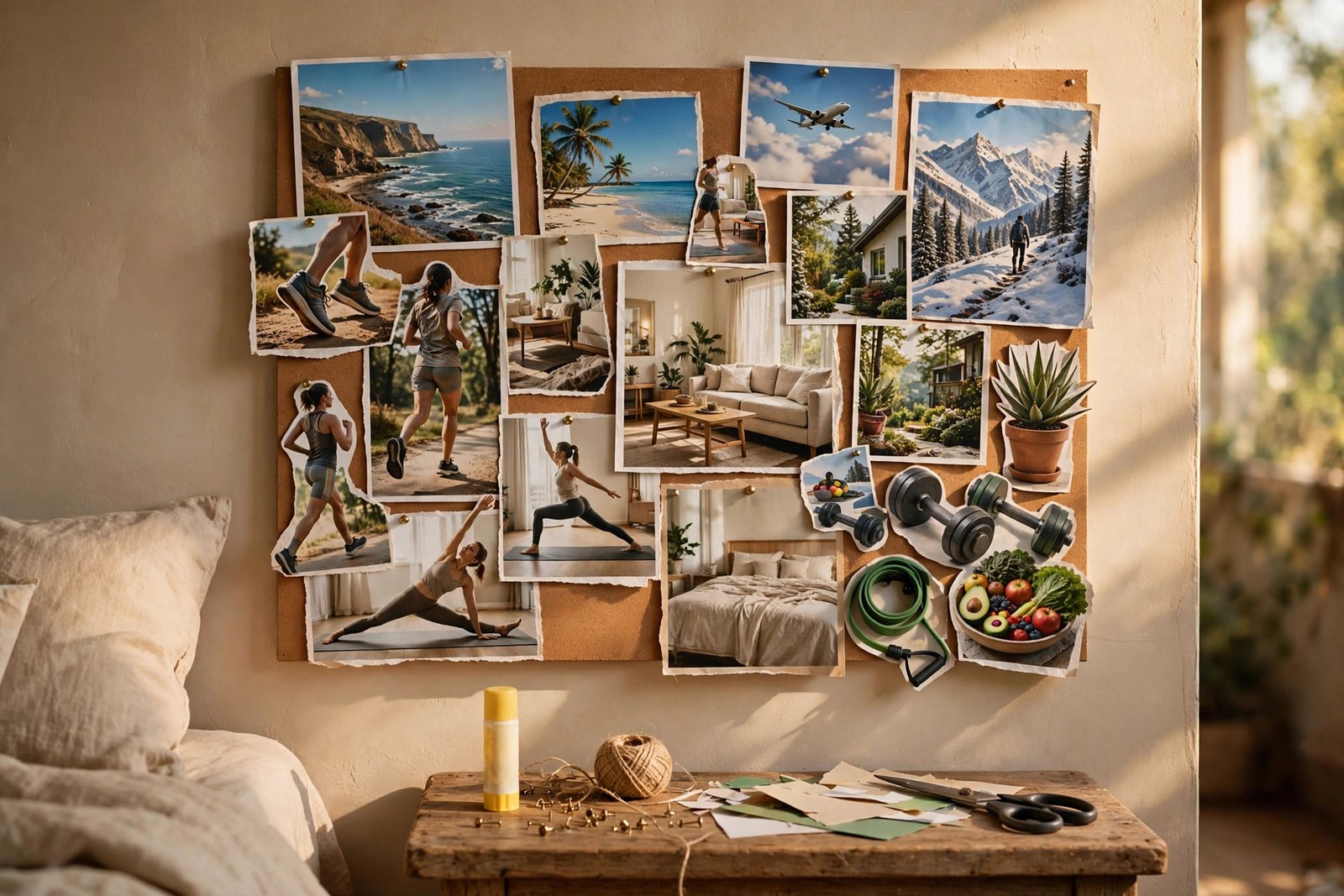
Create a Vision Board That Works on a Tight Budget in Kent
Vision boards have a credibility problem. Too often they are sold as manifesting magic: stick a Ferrari on some card and the universe delivers. Strip away the mysticism, though, and something genuinely useful remains. Psychologists have studied mental imagery and goal priming for decades, and the evidence says that visualising your goals, done correctly, changes behaviour in measurable ways. The board is not magic; it is a daily attention filter.
This article shows how to create a vision board that actually works on a tight budget in Kent, for under a fiver. You will get the psychology without the woo, a practical method using free and nearly-free materials, and goal ideas rooted in real Kent life rather than stock-photo fantasy.
What Vision Boards Actually Do (According to Research)
The mechanism is not attraction but attention. Psychologists call it selective attention and priming: what you repeatedly expose yourself to becomes what you notice and act on. Visualisation research, from sports psychology to rehabilitation, shows that mental rehearsal of actions improves performance, because the brain strengthens the same neural pathways used in real execution. A vision board works when it functions as a daily rehearsal cue, keeping your goals in working memory so that opportunities register and small daily choices align.
Crucially, the research distinguishes process visualisation from outcome visualisation. Picturing the mansion does little; picturing yourself studying for the qualification, running the training miles, or saving the deposit changes behaviour. This is the line between a board that works and a board that decorates. Your Kent vision board should therefore depict actions and milestones, not just prizes, a principle that also underpins weekly routines that actually stick, where systems beat dreams every time.
Vision Boards for Couples, Families and Housemates
A vision board need not be solitary. Couples building a shared board often discover misaligned assumptions early, which is the point: finding out in January that one of you pictures a countryside move and the other a city-centre flat is vastly cheaper than finding out during a house purchase. Build shared boards with three columns, mine, yours, ours, and negotiate the overlap honestly. The conversation the board forces is worth more than the board itself.
Families can adapt the method too. A kitchen pinboard where everyone adds one image a month, the holiday, the skill, the thing they are saving for, turns abstract family goals into something children can see and discuss. Housemates might share a board for the flat itself: the garden project, the deposit timeline, the trip. The psychology is identical at every scale: shared visual goals create shared attention, and shared attention creates the small coordinated actions that move households forward. Research on goal-setting summarised by the American Psychological Association consistently finds that specific, visualised, socially-shared goals outperform vague private ones, and the British Psychological Society notes the same priming effects in workplace studies.
The £5 Method: Materials and Build
You need: a large sheet of card or a corkboard (Poundland, charity shops and Kent’s excellent car boot sales, £1-2), old magazines (free from libraries, dentists’ waiting rooms and Freecycle), scissors and glue you already own, and a marker pen (£1). Total: under £5, often under £2. Digital alternatives are free, Canva or even a phone wallpaper collage, but physical boards win on one metric: they live in your visual field without requiring you to open an app.
Build it in one focused hour. Divide the board into three to five life areas, career, health, money, relationships, place, and place three to five images per area. Add words, but sparingly: a board that is all text is a to-do list with pictures. Include at least one image representing a process (“running shoes by the door” beats “marathon medal”) and one representing a near-term milestone, something achievable within three months, because early wins fuel the long game. Hang it where you will genuinely see it daily: bedroom wall, hallway, inside a wardrobe door if housemates mock you.
Kent-Specific Goals Worth Picturing
Generic boards fail because generic goals do not motivate. Root yours in Kent. Career: the qualification that unlocks the next pay band, pictured as the certificate or the job title. Health: the Whitstable-to-Herne Bay walk, the Leeds Castle grounds run, the swim at Walpole Bay tidal pool, pictured as the route map or the trainers. Money: the deposit for a first flat in Maidstone or Medway, pictured as a savings thermometer with real numbers. Place: the garden office, the allotment, the weekend in Rye, pictured specifically.
Specificity is the whole game. “Travel more” is wallpaper; “the Eurostar from Ashford to Paris in June, £89 return booked by March” is a plan wearing a picture’s clothes. Kent’s transport links, coastline and countryside give you unusually concrete material; use it. And pair the board with behaviour: each image should answer “what is the smallest next action?”, because a board without actions is just hoping with scissors. Parents fitting goals around school runs will find morning routines for busy parents a natural companion system.
Keeping It Alive Past January
Most vision boards die by February, pinned up and ignored. The fix is a monthly five-minute review: which images still energise you, which feel stale, what moved forward? Replace ruthlessly. A board is a living document, not a time capsule; goals legitimately change, and a board that cannot change becomes guilt wallpaper.
Pair the review with one measurable action per goal area. The board holds the vision; a notebook holds the numbers. This two-layer system, inspiration plus tracking, is what separates boards that work from boards that decorate. Review on the first Sunday of each month, ten minutes, cup of tea. That is the entire maintenance cost, and it is what makes the £5 investment compound.
What Vision Boards Cannot Do
Honesty requires the limits. No board overcomes structural barriers, and visualising a promotion does not substitute for the difficult conversation or the extra qualification. Boards amplify effort; they do not replace it. They also risk toxic positivity if they crowd out legitimate negative emotions; it is fine, even necessary, to have a page in your journal for what is going wrong alongside the board of what could go right.
Treat the board as one tool in a kit, alongside planning, habit design and rest. Used that way, on a tight budget, in a real Kent life, it earns its wall space many times over.
Conclusion
You can absolutely create a vision board that works on a tight budget in Kent, because the mechanism was never money. Spend under £5 on card and glue, fill it with specific process images rooted in your real life, hang it where you will see it, and review it monthly with honest actions attached. The universe will not deliver a Ferrari. But your own attention, aimed daily at what matters, delivers something better: a year of small aligned choices.
Frequently Asked Questions
Do vision boards really work or is it pseudoscience?
The “law of attraction” framing is pseudoscience, but the underlying mechanisms, goal priming, selective attention and process visualisation, are well-supported. Boards work as attention tools, not magic.
What is the cheapest way to make a vision board?
Card from a pound shop or charity shop (£1-2), free magazines from libraries or Freecycle, and glue you own. Under £5 total; a digital collage as phone wallpaper is free.
Should a vision board show outcomes or processes?
Both, but weight it toward processes. Research shows visualising the actions (studying, training, saving) changes behaviour more than visualising the prizes alone.
How often should I update my vision board?
Review monthly and replace stale images ruthlessly. Goals change, and a board that cannot change becomes decoration rather than a tool.