
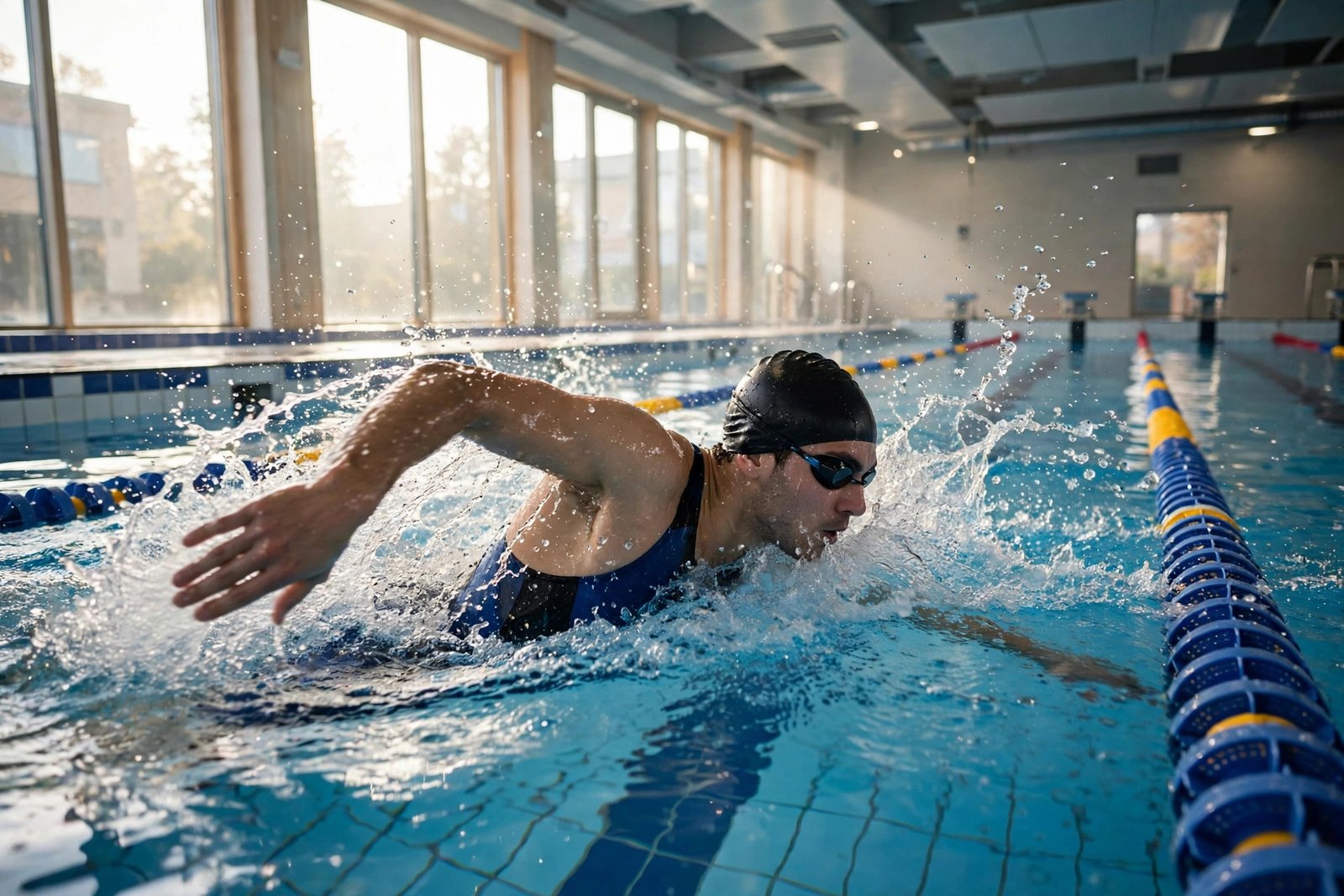
Swimming for Fitness Twice a Week: Is It Worth It?
Twice a week. Not five, not every day — twice. For a beginner wondering whether swimming for fitness is worth the effort, the question is really: is that enough to matter? The answer, backed by decades of exercise research, is an emphatic yes — two proper swim sessions a week deliver most of the health benefits of far more demanding routines, with a joint-friendly, full-body workout that few other exercises match. But “worth it” also depends on costs, logistics, and whether you’ll actually keep going. This guide covers the real benefits, the honest costs, and how to make twice-weekly swimming stick.
What Twice a Week Actually Does for You
The headline benefits arrive fast. Cardiovascular fitness: swimming is elite cardio — water’s resistance means your heart works hard while your joints rest. Studies consistently show regular swimmers have lower resting heart rates, better blood pressure, and markedly lower cardiovascular mortality than sedentary peers — and the dose-response curve is kind: the jump from zero to twice weekly captures most of the benefit. Full-body strength: every stroke works arms, shoulders, back, core, glutes, and legs against constant resistance — it’s strength training disguised as cardio. Mental health: the rhythmic breathing, the sensory calm of water, the enforced disconnection from phones — swimmers report the meditative effect rivaling formal mindfulness practice, and the evidence for exercise against anxiety and depression is robust.
Weight management: an hour of moderate swimming burns 400–600 calories — comparable to running, without the impact. Longevity: large cohort studies associate regular swimming with significantly reduced all-cause mortality. And the timeline: most beginners feel fitter within 3–4 weeks, see visible body-composition changes by 8–12 weeks, and hit a satisfying competence (“I can swim 1km without stopping”) around month 3–4. Twice a week is the sweet spot where adaptation outpaces forgetting — once a week, you spend each session re-learning; twice, you build.
The Honest Costs and Frictions
Money: UK public pool sessions run £4–£8 pay-as-you-go; monthly swim memberships £20–£40. Twice weekly PAYG: ~£50/month — membership usually wins. Kit is minimal: goggles (£10–£20 — buy decent ones; leaking goggles ruin sessions), swimsuit (£20–£40), towel you own. Total startup under £60. Time: the real cost — 45–60 minutes swimming plus changing, travel, and the infamous wet-hair logistics. Budget 1.5–2 hours per session door-to-door. Frictions: lane etiquette anxiety (every beginner fears the fast lane — start in slow/medium, you’ll be fine), crowded peak times (swim off-peak: lunchtimes and late evenings are blissfully empty), and the learning curve if your technique is shaky.
The technique point matters: bad technique makes swimming exhausting rather than enjoyable. If you can’t swim 4 lengths comfortably, invest in 3–4 adult beginner lessons (£30–£60 total at most leisure centres) before judging the sport — the difference between thrashing and gliding is instruction, not fitness. This is the single highest-ROI spend in beginner swimming.
Technique Basics That Change Everything
Most adult beginners swim with two technique flaws that make every length twice as hard as it needs to be: head position (looking forward instead of down — which drops the hips and turns you into a plough) and breath timing (holding breath then gasping, instead of continuous exhalation underwater). Fix these two and swimming transforms from struggle to glide. The drills: catch-up drill (one hand waits for the other — teaches long strokes and balance), fingertip drag (drag fingertips along the water on recovery — teaches high elbows), and bilateral breathing practice (breathing every 3 strokes — balances the stroke and prepares you for open water). YouTube’s swimming channels demonstrate all of these clearly — 10 minutes of drill work per session for a month rebuilds most beginners’ strokes. And the golden rule of swim improvement: technique before fitness. A fit person with bad technique exhausts themselves; an unfit person with good technique glides. The pool rewards skill more than effort — which is exactly why those few beginner lessons pay for themselves forever.
Making Twice a Week Actually Happen
1. Fix the slots
Same days, same times, in the calendar like appointments. “Tuesday and Saturday mornings” beats “twice sometime”. Habit research is clear: fixed cues beat intentions.
2. Have a simple session structure
Beginners drown in aimlessness (pun intended). Use: 5 min easy warm-up, 20–30 min main set (e.g., 4×100m with rests, or pyramid lengths), 5 min cool-down. One structure, repeated — progress is measurable when the session is constant.
3. Track one metric
Total lengths, or time for 20 lengths — one number, logged on your phone. Watching it improve is the motivation engine. Most beginners double their continuous distance within two months.
4. Solve the logistics once
Pack the bag the night before. Keep a dedicated swim bag (goggles, suit, towel, shampoo) so there’s zero friction. The session you skip is almost always lost to logistics, not laziness.
Build the supporting habits: twice-weekly swimming plus daily walking comfortably exceeds activity guidelines; fuel the sessions properly (swimming hungry is miserable; swimming stuffed is worse — time it right); and the NHS activity guidance confirms you’re doing exactly what the evidence recommends — Swim England lists pools and adult programmes nationwide.
Twice vs More: Is It Enough?
For health, absolutely — twice weekly moderate swimming meets the cardio guidelines when sessions are 45+ minutes, and the strength/mobility benefits come free. For skill progression (learning butterfly, getting fast), three times helps — but that’s sport, not health. The beginner’s trap is assuming more is better and burning out by week three; the twice-weekly swimmer still going in year two laps the five-times-weekly swimmer who quit in February. Consistency beats intensity so completely it’s not a contest. Start with two, protect those two like appointments, and add a third only when two feels easy and you want more.
So is swimming twice a week worth it for a beginner? It’s one of the highest-value exercise commitments available: full-body, joint-friendly, mentally restorative, cheap to start, and twice weekly is precisely the dose where benefits compound and habit sticks. Fix the slots, learn the basics properly, track one metric — and enjoy the rare exercise that gets better the longer you do it. A year from now, the swimmer who started with two shaky sessions a week will be gliding through a kilometre while the would-be gym-goer is still paying for an unused membership. The water is waiting; the only bad session is the one you skip.
Frequently Asked Questions
Is swimming twice a week enough exercise?
For general health, yes — two 45-minute moderate sessions meet the cardiovascular guidelines, with full-body strength and mobility benefits included. Add daily walking and you’re comprehensively covered.
How long until I see results from swimming?
Fitness improvements in 3–4 weeks, visible body changes in 8–12 weeks, and comfortable 1km continuous swimming around month 3–4 for most beginners.
Do I need lessons as an adult beginner?
If you can’t swim 4 lengths comfortably, yes — 3–4 lessons transform the experience from exhausting to enjoyable. Good technique is the difference between dreading and loving it, and the investment pays off in every session for years.
What should I eat before swimming?
A light meal 1–2 hours before (banana, toast, porridge) — enough fuel without heaviness. Avoid swimming on completely empty or very full stomachs; both are miserable.