
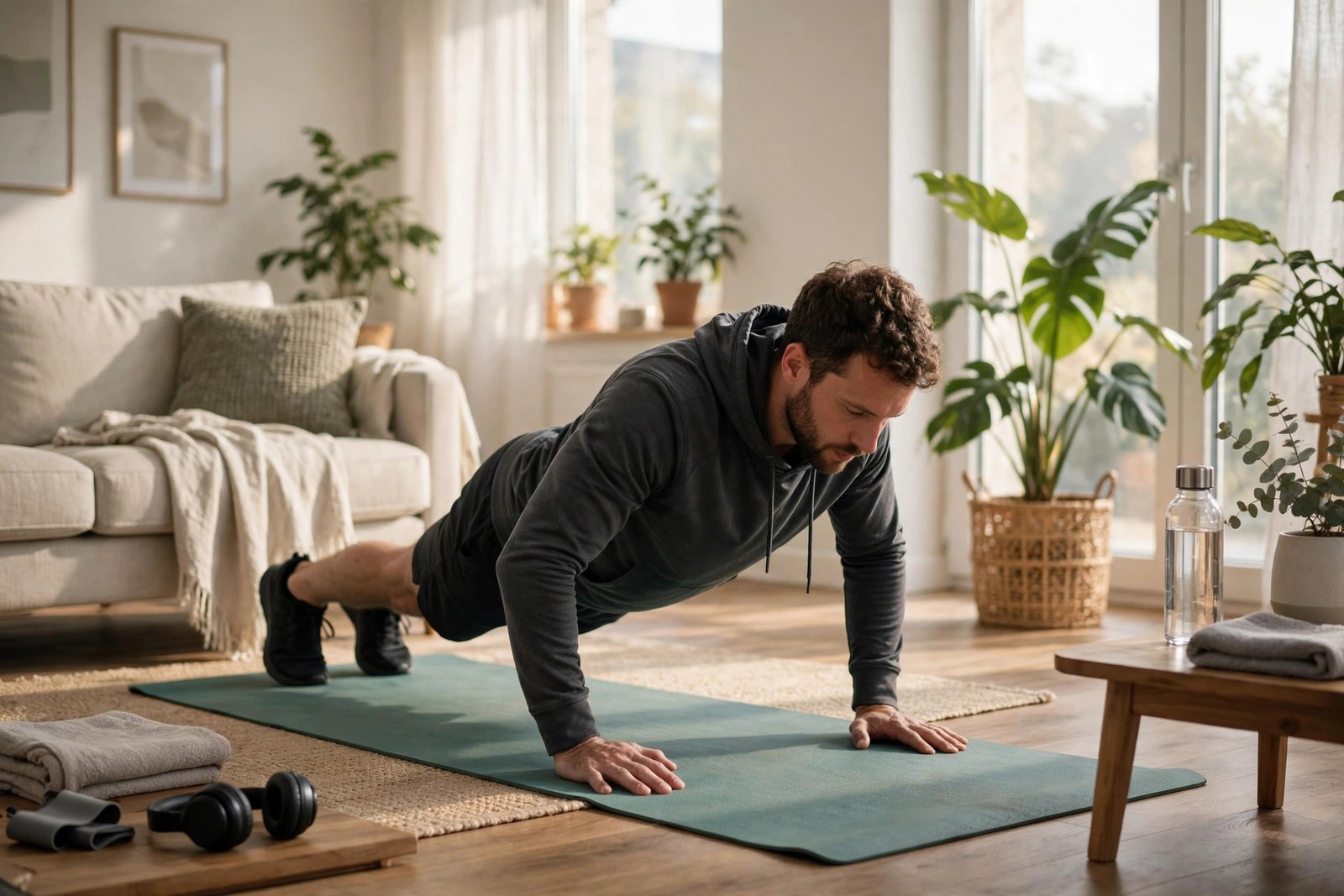
Strength Training Without Weights: When Is the Right Time to Start?
Strength training has an image problem: clanking gyms, complicated machines, the fear of looking foolish. Bodyweight training sidesteps all of it. Push-ups, squats, lunges, planks: the oldest resistance equipment ever made is your own mass, and the science is increasingly clear that it builds real strength, muscle and bone density with no gym required. The timing question has the simplest answer in this entire series: now. Today. This evening, in your living room.
This article covers why bodyweight training works, the right way to start whatever your age or fitness, the beginner programme, and how to progress for years without ever touching a weight.
Why Bodyweight Works: The Science
Muscles do not know what resistance is; they know tension. Studies comparing bodyweight and weighted training find comparable muscle and strength gains in beginners, provided the exercises are challenging and progressed. Bodyweight training also builds the stabiliser muscles and movement quality that machines neglect, improves bone density through impact loading (jump squats, plyometric push-ups at advanced levels), and carries a lower injury risk for beginners because the loads are self-limiting.
The longevity angle is compelling: grip strength, push-up capacity and sit-to-stand ability are among the strongest predictors of healthy ageing in large cohort studies, stronger than many blood markers. These are bodyweight capacities, trainable in a living room, free. The weekly exercise targets are fully achievable this way, and proper fuelling supports the adaptation. The NHS strength guidance explicitly includes bodyweight exercises in its recommendations for all adults.
Starting Right: The First Two Weeks
The right start is embarrassingly easy, which is the point. Week one: learn the five foundational movements with perfect form at low volume, wall push-ups (or incline), bodyweight squats to a chair, glute bridges, dead bugs, and a 20-second plank. Two sessions, 15 minutes each, video yourself once to check form. Soreness is normal; sharp pain is not, and any joint pain means regressing the movement, not pushing through.
Week two: add a third session and slightly more volume. The goal of the first fortnight is not fitness but habit and motor learning: teaching your nervous system the movement patterns that everything else builds on. Most beginners try to do too much too soon and spend week three injured or demoralised; the patient starter is doing push-ups in month six while the hero is on the sofa. Which? fitness assessments of home workout programmes consistently favour progressive, form-first approaches over intense ones for beginners.
The Beginner Programme: Months 1-6
Three full-body sessions weekly, 30-40 minutes. A session: squats 3×10, push-ups 3×8 (or incline variation), reverse lunges 3×8 per leg, glute bridges 3×12, plank 3×30 seconds, dead bugs 3×10. Rest 60-90 seconds between sets. When you can complete all sets with two reps in reserve, progress the movement: incline push-ups to floor push-ups, squats to split squats, planks to longer holds or shoulder taps.
Progression without weights uses leverage, range and tempo: elevate feet for push-ups, slow the eccentric (lowering) phase to 3-4 seconds, add pauses, move to single-leg variants. These variables provide years of progression; the advanced practitioner doing one-arm push-up progressions and pistol squat progressions is training at an elite level with zero equipment. Track every session in a notebook; the numbers going up is the motivation that sustains the habit. A sample week: Monday, full-body session A; Tuesday, walk or rest; Wednesday, session B (same movements, slightly more volume); Thursday, rest; Friday, session A again; weekend, one longer walk or active hobby. Deload every fourth week (halve the volume) to let joints and connective tissue catch up with muscles; beginners who skip deloads stall or get injured just as progress compounds. After six months, consider adding a fourth day or splitting into upper/lower sessions, but only if recovery allows. The programme that respects recovery outperforms the ambitious one that does not, every single time, without exception, for every beginner who respects recovery, trains smart, stays patient, never skips the warm-up, always tracks progress, respects rest days, eats enough protein, sleeps well, and stays consistent for many months in a row without fail, rain or shine, all year long, no excuses, ever at all.
Strength Training After 50: It’s Not Too Late
The fastest-growing strength-training demographic is the over-50s, and the science says they are the ones who need it most. After 40, adults lose 1-2% of muscle mass yearly (sarcopenia), accelerating after 60; strength training is the only intervention proven to reverse it, and studies show significant gains even in 80- and 90-year-olds. Bodyweight training is the ideal entry: self-limiting loads, no intimidating gym, progress at your own pace.
The over-50 protocol differs mainly in patience: longer warm-ups (10 minutes), slower progression (add volume before difficulty), extra attention to balance (single-leg stands, heel-to-toe walks), and medical clearance if you have cardiovascular conditions, joint replacements or osteoporosis. Protein intake matters more with age (around 1.2g per kilo daily for active older adults), and recovery takes longer, so two full-body sessions weekly beats three rushed ones. The payoff is independence: the strength to rise from the floor, carry shopping, climb stairs, the capacities that define autonomous living. It is never too late to start; it is only too late to have started earlier, which is an argument for today, not regret.
Common Mistakes and How to Avoid Them
Mistake one: skipping warm-up. Five minutes of joint circles, leg swings and easy reps prevents the strains that derail beginners. Mistake two: training to failure constantly; leaving 1-2 reps in reserve builds strength faster with less injury risk and less crippling soreness. Mistake three: neglecting pulling movements; push-ups without rows or pull-up progressions creates imbalances, so include doorframe rows (using a sturdy table) or invest in the £20 pull-up bar.
Mistake four: programme-hopping; the beginner who switches routines monthly never accumulates the progressive overload that drives adaptation. Mistake five: ignoring recovery; muscles grow between sessions, so sleep and rest days are training, not laziness. And the meta-mistake: waiting for the “right time”. The right time is the next 30 free minutes, because the best programme is the one you actually start.
Conclusion
The right time to start strength training without weights is now: the science supports it, the equipment costs nothing, the injury risk is low, and the longevity benefits are profound. Learn five movements well, follow the simple programme three times weekly, progress via leverage and tempo, and track everything. In six months, you will be stronger, more capable and more resilient, built entirely from your own bodyweight and consistency.
Frequently Asked Questions
Can you build muscle with bodyweight only?
Yes, especially as a beginner. Studies show comparable gains to weighted training when exercises are challenging and progressed via leverage, tempo and volume.
How often should beginners do bodyweight training?
Three full-body sessions weekly, 30-40 minutes, with rest days between. Muscles adapt between sessions, so recovery days are part of training.
What if I cannot do a single push-up?
Start with wall or incline push-ups and progress downward as strength builds. Every advanced movement has a beginner regression; use them without shame.
Do I need any equipment at all?
Strictly, no. A £20 doorframe pull-up bar is the single worthwhile addition for pulling movements; everything else is optional.