
Recovering From a Sports Injury: Start Now or Wait?
You’ve done something to your knee/ankle/shoulder — it’s swollen, it’s sore, and the internet is giving you seventeen contradictory opinions. The big question isn’t just how to recover, but when to start: is now the right time to begin active recovery, or should you wait? Rest it completely? Push through? See someone? Get this decision wrong and you either waste weeks of unnecessary rest or turn a minor injury into a chronic one. This guide gives you the framework sports medicine actually uses: what to do in the first 48 hours, when to start moving again, when to get professional help, and the realistic recovery timelines for common injuries.
The First 48 Hours: What the Science Says Now
Forget everything you learned about RICE (rest, ice, compression, elevation) as gospel — sports medicine has moved on. The current framework is PEACE & LOVE (yes, really): Protect (avoid what hurts, 1–3 days), Elevate, Avoid anti-inflammatories (inflammation is part of healing — suppressing it aggressively may slow recovery), Compress, Educate (learn what’s actually injured); then Load (gradually!), Optimism, Vascularisation (gentle pain-free cardio), Exercise.
The practical translation: protect the injury briefly, don’t nuke inflammation with ibuprofen on day one unless pain demands it, and — crucially — start gentle loading far earlier than old advice suggested. Complete rest beyond a few days is now known to delay healing for most soft-tissue injuries: tendons, ligaments, and muscles heal better with progressive mechanical load than with immobilisation. “Now or wait?” — for starting gentle, pain-guided movement, the answer is almost always now, not weeks from now. Waiting means stiffness, weakness, and a longer road back.
The Red Flags: When “Wait and See” Is Wrong
Some injuries need professional assessment promptly — don’t self-manage these. See a GP or physio urgently if: you heard a pop followed by immediate swelling (possible ligament rupture); the joint looks deformed or you can’t bear weight; numbness, tingling, or colour changes in the limb; pain that worsens after 48–72 hours instead of improving; recurrent giving-way or locking; or any head injury (different rules entirely — the NHS sports injury guidance covers concussion protocols). For ankle sprains specifically, most grade I–II sprains are home-manageable, but inability to walk four steps means get it imaged.
The general rule: improving after 3–5 days = keep going; plateaued or worsening = get assessed. A physiotherapist’s assessment (£40–£70 privately, or NHS referral via GP) is the highest-value spend in sports injury — a correct diagnosis in week one saves months of mistargeted rehab. Don’t be the person who “rests” a torn ligament for six weeks and wonders why it’s not better.
The Recovery Timeline: What’s Realistic
Calibrate expectations — impatience causes re-injury, the classic recovery-killer. Rough guides for common injuries (assuming proper rehab): mild muscle strain: 1–3 weeks; ankle sprain (grade II): 3–6 weeks; tendonitis (e.g., tennis elbow, Achilles): 6–12+ weeks — tendons heal infuriatingly slowly; ligament sprain (knee): 6–12 weeks; stress fracture: 6–8 weeks minimum. These are return-to-sport timelines, not pain-free timelines — pain often resolves weeks before the tissue is ready for full load, which is exactly when re-injuries happen.
The principle throughout: relative rest, not absolute rest. Rest the injured structure, train everything else. A knee injury is an upper-body training opportunity; an ankle sprain is a swimming opportunity (once cleared). Athletes who maintain fitness around the injury return faster and happier than those who cocoon. General activity guidelines still apply — adapt them, don’t abandon them — and even small details like meal timing matter when you’re training around an injury and every session counts.
The Rehab Framework: Load It Like You Mean It
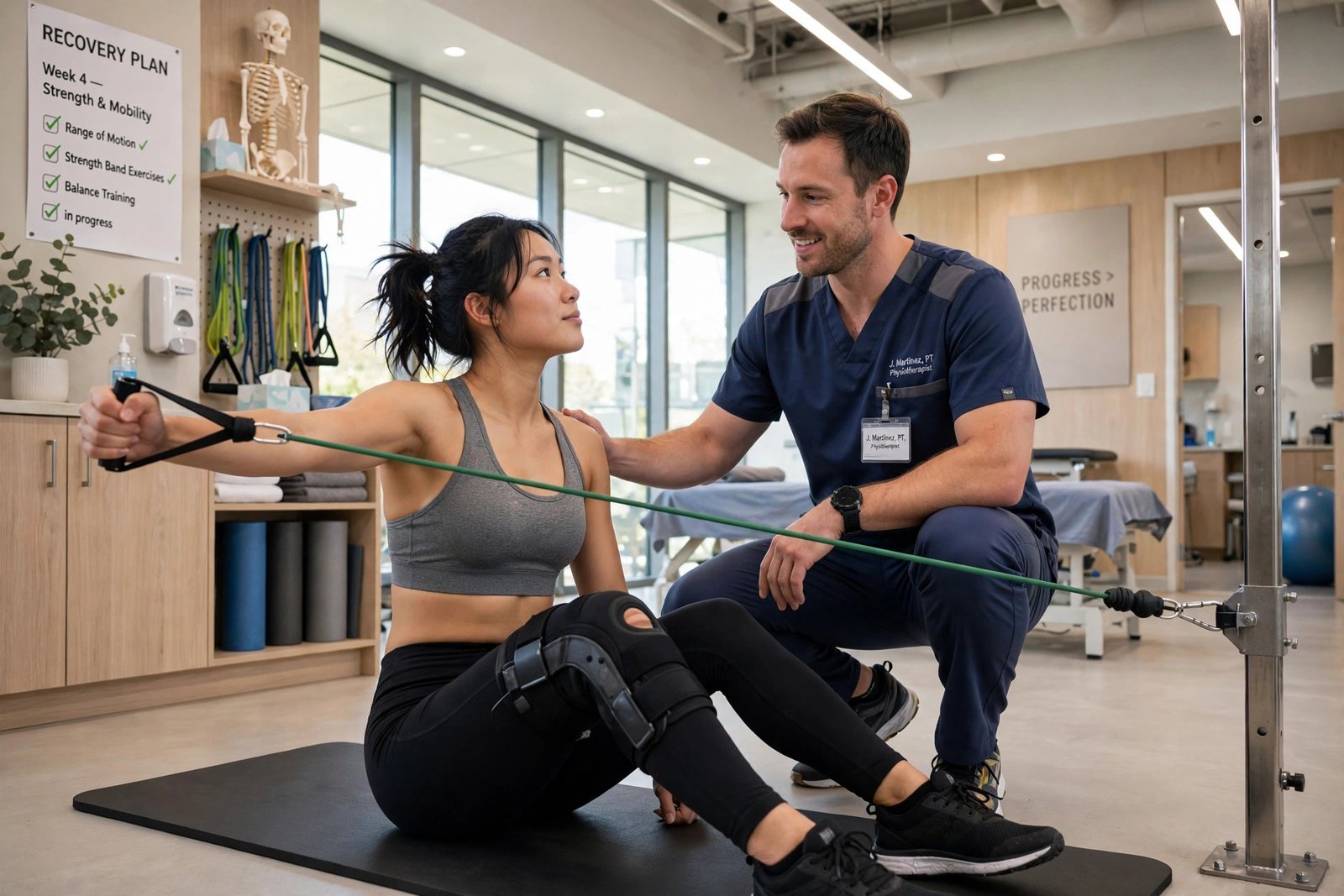
Modern rehab is progressive loading, structured in phases. Phase 1 (days 1–7): calm it down — protection, gentle pain-free movement, swelling management. Phase 2 (weeks 1–4): rebuild — progressive strengthening of the injured area, starting embarrassingly light (bodyweight, bands), increasing as pain allows. Pain is your guide: mild discomfort during rehab (3–4/10) that settles within 24 hours is fine; sharp pain or next-day worsening means back off. Phase 3 (weeks 4+): return to sport — sport-specific drills, then partial training, then full training, then competition. The classic error is jumping from phase 1 to phase 3 because “it feels okay” — tissue healing lags pain resolution by weeks.
Two force multipliers: sleep (tissue repair happens overnight — 8+ hours isn’t luxury, it’s treatment) and nutrition (adequate protein ~1.6–2g/kg/day during rehab; the body can’t rebuild tendon on a deficit). The Chartered Society of Physiotherapy has excellent self-management resources, and your GP can refer to NHS physio — waiting lists vary, so ask about self-referral options in your area, which many trusts now offer.
The Comeback: Returning to Sport Safely
The return is where recoveries are won or lost — most re-injuries happen in the first month back, almost always from doing too much too soon. Use objective criteria, not feelings: the injured side should be within ~90% of the uninjured side for strength and hop/balance tests (a physio can measure this in one session), you should complete a full week of sport-specific training pain-free, and you should have a graded return plan — 50% intensity week one, 75% week two, full week three, competition week four. The psychological side is real too: fear of re-injury (kinesiophobia) is normal and measurable, and pushing through terror often means compensatory movement patterns that injure something else. Tell your coach/training partners you’re on a return plan — the social permission to hold back is what stops ego from overriding the protocol. A successful comeback isn’t the first game back; it’s the tenth, with the injury a memory rather than a limiter.
Now or Wait? The Final Answer
Start now: protection, education, gentle pain-free movement, professional assessment if red flags or no improvement in days. Wait on: aggressive loading, returning to full sport, and “pushing through” significant pain — impatience here is how 3-week injuries become 3-month ones. The old instinct (“rest it completely for weeks”) is outdated; the new instinct (“move it gently, load it progressively, get it diagnosed early”) gets you back months sooner. Recovery isn’t passive — it’s a skill, and starting it correctly now is the skill’s first lesson.
Recovering from a sports injury isn’t about waiting until it feels perfect — it’s about starting the right things immediately: brief protection, early gentle movement, prompt professional diagnosis when needed, and progressive loading guided by pain. Respect the timelines, train around the injury, sleep and eat like it matters (it does), and you’ll be back sooner — and stronger — than the rest-and-hope approach ever delivers.
Frequently Asked Questions
Should I use ice or heat on a new injury?
Ice (15–20 min) for the first 48–72 hours to manage pain and swelling; heat later for stiffness once acute swelling settles. Current guidance is less ice-obsessed than old advice — it’s for comfort, not healing acceleration.
How do I know if I need a physio or just rest?
Get assessed if: you can’t bear weight, heard a pop with immediate swelling, see deformity, have numbness, or aren’t clearly improving after 3–5 days. When in doubt, one physio assessment beats weeks of guessing.
Can I exercise with an injury?
Usually yes — train around it. Upper-body injury? Train legs. Knee injury? Swim or do upper body. Complete inactivity slows healing and tanks fitness; relative rest is the modern standard.
Why does my injury keep coming back?
Almost always: returning to full load before tissue healing finished (pain resolves before strength does), or never doing the strengthening rehab — just resting until pain faded. Proper progressive loading is the cure for recurrence.