
How to Start Passing Your Driving Theory Test as a Beginner
The driving theory test stops more learners than the practical test — nearly half of candidates fail it on the first attempt. For a complete beginner, the 50 multiple-choice questions and the hazard perception clips can feel like an entirely separate subject from the driving you imagined. But here is the encouraging truth: the theory test is one of the most passable exams in British life, because every question comes from a published bank and every skill is trainable. This guide takes you from zero to test-ready.
Whether you are seventeen and fresh from your provisional licence or an adult learner finally getting round to it, here is exactly how to start, what to study, and how to walk in confident.
What the Test Actually Involves
The UK car theory test has two parts, and you must pass both in the same sitting. Part one: 50 multiple-choice questions covering the Highway Code, road signs, safety, vehicle handling and the environment. You need 43 out of 50. Part two: hazard perception — 14 video clips where you click when you spot developing hazards, scoring up to 5 points per hazard. You need 44 out of 75.
The test costs £23, booked through the official GOV.UK theory test booking service — beware copycat sites charging inflated fees. You will take it at a Pearson test centre (there are centres across the UK, including throughout Yorkshire and Norfolk), and you need your provisional licence to book. Most learners are test-ready after 20–40 hours of study spread over 4–8 weeks.
Starting From Zero: Your First Two Weeks
Week 1: Learn the language of the road. Before touching mock tests, read the Highway Code’s core sections — signs, markings, right of way, speed limits. Do not try to memorise all 300+ pages; focus on understanding principles. The official DVSA theory test app (£4.99) contains every revision question and is the single best investment you will make.
Week 2: Start practising in layers. Do topic-by-topic question sets rather than full mocks — ten questions on signs, ten on safety margins, ten on vulnerable road users. This builds understanding instead of pattern-matching. For hazard perception, watch the official DVSA clips and learn the rhythm: click when you see something that might become a hazard, click again as it develops. The scoring rewards early, measured responses — frantic clicking scores zero.
Beginners often find that the discipline of regular short sessions beats weekend cramming, as our guide to weekly routines that actually stick explains — the same consistency principles apply to theory prep.
The Topics That Trip Up Beginners
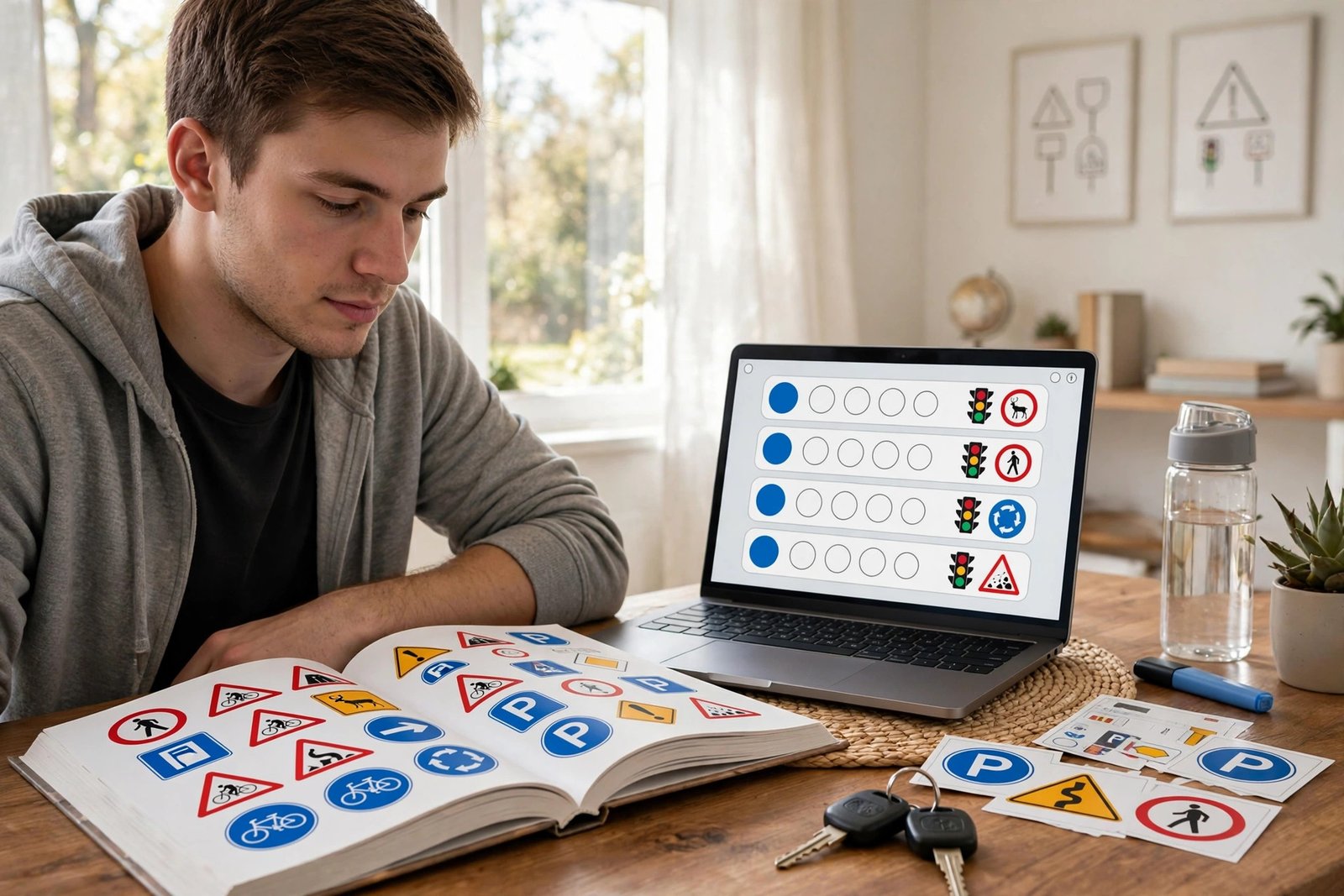
Certain questions fail learners disproportionately. Stopping distances — learn the thinking-distance-plus-braking-distance figures for key speeds, and more importantly the principle that they roughly double in wet conditions. Road signs — triangular signs warn, circular signs order, rectangular signs inform; blue circles give positive instruction, red circles prohibit. Vulnerable road users — the test is heavy on cyclists, motorcyclists, pedestrians and horse riders; the Highway Code’s hierarchy of road users is examinable. Vehicle safety — tyre tread depth (1.6mm minimum), fluid checks, and what to do when warning lights appear.
For hazard perception, the classic beginner errors are clicking too late (waiting until the hazard is obvious, when the high scores have gone), clicking in a rhythmic pattern (detected as cheating — instant zero for the clip), and missing the second hazard in clips that contain two. Practice until early clicking feels natural.
Weeks 3–6: From Practising to Passing
Once topic scores are consistently above 90%, switch to full mock tests under exam conditions: 57 minutes, no phone, no pausing. Your target is not just passing but passing comfortably — 46+/50 on questions and 55+/75 on hazard perception — because test-day nerves shave points off everyone.
Keep an error log: every question you get wrong, write down why — misread, didn’t know, second-guessed. Patterns emerge fast, and the last two weeks should target your three weakest topics exclusively. The night before the test: no cramming. Light review, early bed. The morning of: arrive 15 minutes early with your provisional licence, and remember you get a 15-minute practice session before the real thing — use it to settle in.
Common Mistakes on Test Day
Even well-prepared learners lose marks to avoidable errors. Rushing the questions: you get 57 minutes for 50 questions — more than a minute each. Read every question twice; many failures come from misreading, not ignorance. Changing answers: your first instinct is usually right — only change an answer if you spot a definite misread. Second-guessing hazard perception: learners who’ve practised the clicking rhythm sometimes freeze on test day and click late. Trust your training: click when you see the potential hazard developing, then again as it materialises. Forgetting documents: no provisional licence, no test — and no refund. Put it by the front door the night before. Finally, use the 15-minute practice session properly: it’s not just a demo, it’s your chance to settle nerves and get comfortable with the mouse and screen before the clock starts. The Highway Code is the ultimate reference if any question surprises you — and once you’ve passed, a dashcam for your first car is the smart next investment for a new driver.
After You Pass: What Next
Your theory certificate lasts two years — you must pass the practical test within that window or retake the theory. Most learners start practical lessons alongside or immediately after theory study; the theory knowledge makes early lessons dramatically more productive, because you already understand signs, priorities and hazard awareness.
Budget-wise, the full journey from beginner to licence typically costs £1,200–£2,000 including lessons and tests — and when you eventually buy your first car, comparing quotes carefully matters more than brand loyalty for keeping insurance affordable.
Conclusion
Passing the driving theory test as a complete beginner is a solved problem: get the official DVSA materials, study in short consistent sessions over 4–8 weeks, master the high-failure topics, and practise full mocks until you are passing comfortably. Nearly half of candidates fail first time — but they are overwhelmingly the underprepared, not the incapable. Start this week, book the test for six weeks out to create your deadline, and join the majority who pass with room to spare.
Frequently Asked Questions
How long should I study for the theory test?
Most beginners need 20–40 hours over 4–8 weeks. If you are consistently scoring 46+/50 on mocks and 55+/75 on hazard perception, you are ready — regardless of how many weeks it took.
What is the hardest part of the theory test?
Hazard perception fails more confident learners, because the clicking rhythm is unintuitive. Multiple choice fails more under-prepared learners, particularly on stopping distances, signs and vulnerable road users.
Can I take the theory test before starting driving lessons?
Yes — you only need a provisional licence. Many learners do the theory first, and instructors generally prefer it, since you arrive at lesson one already understanding the rules of the road.
How much does the theory test cost?
£23 for cars, booked through GOV.UK. Avoid third-party booking sites that charge markups — the official service is the cheapest and the only one that guarantees your booking.
What happens if I fail?
You can rebook after three working days. Analyse what went wrong — most failures are a few marks short in one section — target the weak area for two weeks, and go again. Failing once is normal and says nothing about your driving ability.