
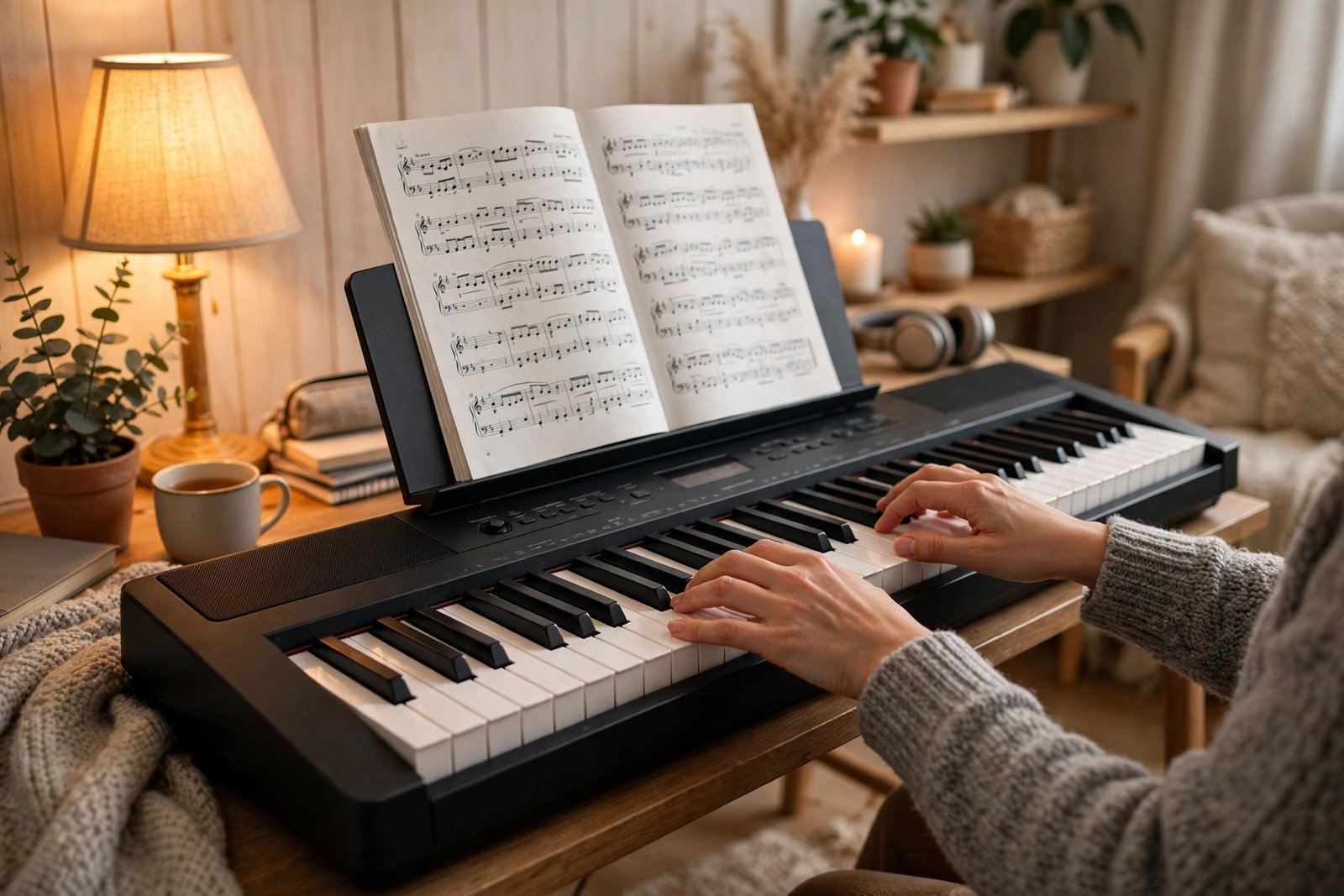
Learn Piano From Scratch: The Adult Beginner’s Guide
Learning piano from scratch as an adult feels like standing at the bottom of a mountain in flip-flops: everyone else seems to have started at age six, the jargon is impenetrable, and decent lessons cost 30 to 50 pounds an hour. But here is what the piano industry will not tell you: adult beginners who practise smartly often progress faster than children, free resources now rival paid ones, and you do not need a 3,000-pound piano to start. Here is how to learn piano from scratch without wasting money.
What You Actually Need to Start
The instrument: keyboard vs piano
You do not need an acoustic piano. What you need is 88 weighted keys (or at minimum 61 touch-sensitive keys to start). Weighted keys build the finger strength and dynamics real piano technique requires; unweighted toy keyboards build bad habits. A decent secondhand 88-key weighted digital piano costs 150 to 300 pounds on Facebook Marketplace or Gumtree. Digital pianos depreciate fast, so the used market is a buyer paradise. Check all keys work, pedals function and speakers are not blown before paying. New budget options from reputable brands start around 300 to 450 pounds. Once you can play a few simple melodies, our guide to the best karaoke songs for shy singers gives you fun, easy material to practise with.
The non-negotiables
A proper stand or table at the right height (kitchen tables are usually too high, and bad posture creates tension that limits progress), a sustain pedal (15 to 25 pounds, essential from surprisingly early on), and a metronome (free apps are perfect). That is the complete starter kit: instrument, stand, pedal, metronome app. Everything else is optional.
The Learning Path That Actually Works
Months 1-2: foundations
Learn proper posture, hand position (curved fingers, relaxed wrists, since tension is the beginner curse), the musical alphabet, and simple five-finger patterns in C major. Play slowly. Speed is a byproduct of accuracy, not a goal. Fifteen to thirty minutes daily beats three hours on Sunday; consistency builds the neural pathways, marathons build frustration. Free YouTube channels from qualified teachers cover this phase brilliantly. You do not need paid lessons yet.
Months 3-6: reading and repertoire
Start reading simple notation (it is easier than it looks, more map than code), learn major scales one octave hands separately, and build a small repertoire of pieces you actually enjoy. This is where motivation lives or dies: the method book tunes played for the fortieth time kill adults; a simplified version of a song you love sustains you. Free sheet music abounds (IMSLP for classical, countless sites for popular arrangements). Never pay for beginner sheet music.
Months 6-12: technique and musicality
Hands together, dynamics (loud and soft, the difference between playing notes and making music), pedalling, and slightly harder pieces. This is the phase where many adult beginners consider a teacher, and it is the right time: a monthly 30-pound lesson to check technique and set direction is far better value than weekly lessons from day one. One lesson a month plus daily practice outperforms weekly lessons with no practice, at a quarter of the cost.
Free and Cheap Resources Worth Using
YouTube teachers: several conservatoire-trained pianists teach complete beginner courses free. Find one whose style suits you and follow their sequence rather than hopping between channels. Apps: free tiers of piano-learning apps are genuinely useful for the first months; only pay when you have outgrown the free content. IMSLP: the free public-domain sheet music library, centuries of music for nothing. Library method books: classic tutor books are in most libraries; the best adult ones cost 10 to 15 pounds new if you prefer owning. Online communities: piano forums answer technique questions free, with video feedback if you post clips.
What not to buy yet: expensive method book collections (one good book suffices), piano-learning gadgets (light-up keys teach dependency, not reading), and premium app subscriptions before you have finished the free tiers. Building general musicality helps too; our guide to finding cheap live music gigs near you is a great way to train your ear for free.
The Practice Method (More Important Than the Resources)
Slow practice: if you cannot play it slowly, you cannot play it. Halve the tempo until it is clean, then creep up. Hands separate first: master each hand alone before combining; the brain learns the parts before the coordination. Small sections: practise two-bar chunks, not whole pieces; join them once each is solid. Daily, not marathon: 20 focused minutes daily beats 2 hours weekly, every time, confirmed by every serious study of skill acquisition. Record yourself monthly: progress is invisible day-to-day and obvious month-to-month; recordings prove it and sustain motivation through plateaus.
The plateau protocol
Around month 4-6, progress stalls and quitting tempts. This is normal neurological consolidation, not failure. Push through with: a new piece you love (motivation fuel), a single monthly lesson (expert diagnosis of what is stuck), and easier repertoire alongside the hard stuff (remind your brain it can play). Nearly everyone who quits piano quits at a plateau; nearly everyone who pushes through one reaches the other side playing noticeably better.
Staying Motivated for the Long Haul
Motivation management is the real curriculum of adult piano learning. Track visibly: a practice calendar with X marks creates a chain you will not want to break. Perform early: play for family or friends from month three — low-stakes performances focus practice wonderfully. Join something: adult learner groups, online recitals and local music societies turn solitary practice into shared joy. Vary the diet: keep three pieces going — one you love, one that stretches you, one easy win. Forgive bad weeks: life happens; the only failed practice routine is the one you abandon entirely. Return, do not restart — you lose less than you fear. Adults who treat motivation as a system, not a mood, are the ones still playing in year three.
Conclusion
Learning piano from scratch without wasting money means buying a used 88-key weighted digital piano (150 to 300 pounds), learning free for the first six months via YouTube and free apps, practising 20 focused minutes daily with slow hands-separate methods, and adding a monthly teacher only when technique needs checking. Total first-year cost: 200 to 400 pounds, not thousands. The piano does not care what you paid for it; it cares that you show up daily. Adults learn faster than they expect — the mountain is smaller than it looks from the bottom.
Worth bookmarking: ABRSM’s guidance on learning piano and the Musicians’ Union’s advice on finding a teacher.
Frequently Asked Questions
Can adults learn piano from scratch?
Yes, and often faster than children in the early stages. Adults bring discipline, pattern recognition and genuine motivation. Consistent daily practice matters far more than starting age.
How much does it cost to start learning piano?
Around 200 to 400 pounds for the first year: a used weighted digital piano (150 to 300), a sustain pedal, and free learning resources. Monthly lessons (30 pounds) can be added after six months.
Do I need an acoustic piano to learn properly?
No. An 88-key weighted digital piano develops the same technique for beginners and intermediates. Acoustics matter for advanced players, not for the first years.
How long before I can play a song?
Simple melodies within weeks; satisfying full pieces within 3 to 6 months of daily practice. Choose songs you love — motivation is the real accelerator.