
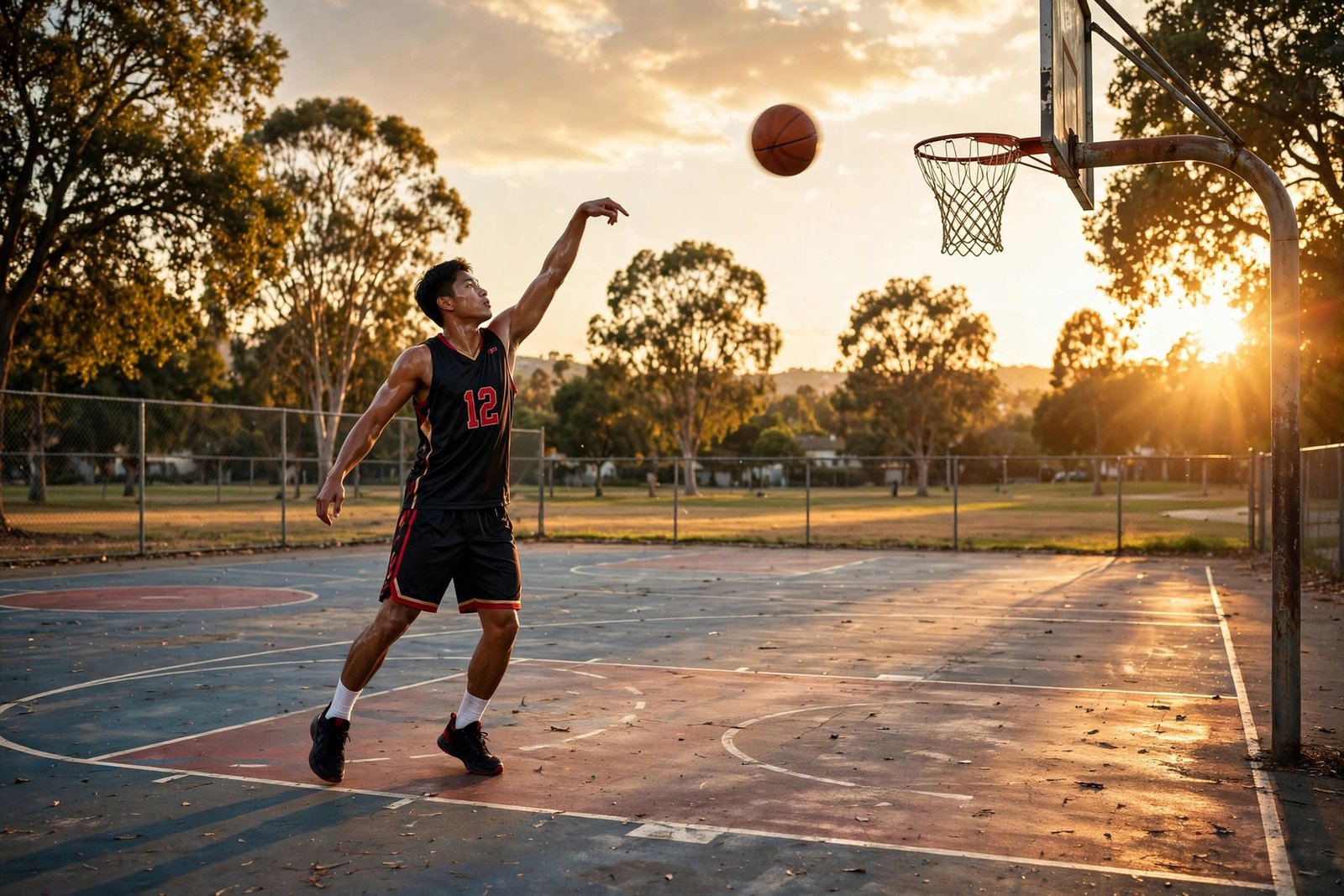
How to Improve Your Free Throw Shooting (Free Practice Plan)
The free throw is basketball’s cruellest paradox: nobody is guarding you, you have all the time in the world, and yet it is the shot players miss most when it matters. The difference between a 60% free-throw shooter and an 85% one is rarely talent — it is routine, mechanics and the mental game. Whether you play five-a-side at the local leisure centre or just shoot around at the park, here is how to genuinely improve your free throw shooting without spending a penny on coaching.
Fix the Mechanics First (They Are Probably Wrong)
The shooting pocket and alignment
Most poor free-throw shooters start from a different position every time. Fix yours: feet shoulder-width apart, shooting foot slightly ahead, knees soft. The ball should sit in your “shooting pocket” — roughly hip to chest height on your shooting side — with your shooting elbow tucked under the ball, not flared out. Your guide hand is exactly that: a guide. It steadies the ball and leaves at release; it never pushes. Film yourself from the side on your phone for ten shots and compare against any slow-motion clip of a great free-throw shooter. The differences will be obvious and free to identify.
One motion, no hitches
Watch bad free-throw shooters and you will see hitches: a pause at the top, a double-clutch, a little hop. Every hitch is a variable, and variables miss. Your shot should be one smooth motion from pocket to follow-through — knees and elbow extending together, wrist snapping down like you are reaching into a biscuit tin on a high shelf. The classic coaching cue “elbow to eyebrow, wrist to the floor” in the follow-through is old because it works.
Bend, do not muscle
Power comes from the legs, not the arms. Shooters who arm the ball — pushing it flat from the chest — get the line-drive misses that clank off the front rim. Bend your knees, let the legs lift the shot, and aim for a soft arc. The ideal entry angle is around 45–52 degrees; if your misses consistently hit front rim, you are flat — bend more, aim higher.
Build a Routine and Never Deviate
Every great free-throw shooter has a ritual, and it is not superstition — it is a focus mechanism. Yours should take 5–8 seconds and be identical every time: two dribbles, a deep breath, spin the ball, eyes on the rim, shoot. Or three dribbles and a knee bend. The content does not matter; the consistency does. The routine tells your brain “we have done this ten thousand times,” which is exactly what you want your brain to believe at the end of a tight game.
Practice the routine, not just the shot. In training, walk to the line, do the full routine, shoot, then walk away and come back — replicating game conditions rather than standing at the line rattling off fifty in a row. Fifty consecutive free throws teach you nothing about shooting the one that matters. Ten sets of “walk up, routine, two shots” teaches you everything.
The Mental Game (Where Games Are Actually Lost)
Shrink the moment
Players miss clutch free throws because the moment expands — suddenly it is not a free throw, it is THE free throw, with the score, the crowd and the consequences attached. The fix is deliberate shrinking: during your routine, think only about the next physical cue (elbow under, breath out, follow through). You cannot think about the score and your mechanics simultaneously, so crowd out the score with mechanics.
Practice pressure
You cannot replicate real pressure, but you can approximate it: shoot free throws when exhausted at the end of a session, set consequences in practice games (ten press-ups for a miss), and track your percentage over weeks. A simple notebook log — date, attempts, makes — turns vague “I think I’m improving” into data. Watching the number climb from 62% to 74% over two months is the cheapest motivation in sport. Building that kind of consistent practice habit is a skill in itself; our guide to planning a weekly routine that actually sticks shows how to lock training into a busy week.
Forget the last one
The best free-throw shooters in history have identical routines after makes and misses. No extra dribble after a miss, no rushed shot after a make. Train this deliberately: when you miss in practice, force yourself through the exact same routine for the next one. Emotional neutrality is a trained skill, not a personality trait.
Common mechanical faults to check on film
When you review your phone footage, look for these specific faults in order: elbow flaring out to the side (the most common), the guide hand pushing the ball (watch for the off-hand thumb flicking at release), shooting from the chest instead of the pocket (a flat, rushed motion), and inconsistent knee bend (deep one shot, stiff the next). Fix them one at a time, starting with the elbow — tucking it under the ball aligns everything downstream. Give each fix two weeks before judging it; mechanics rewiring feels awkward before it feels automatic, and abandoning a correction after three days is the classic reason film study fails to translate into results.
A Practice Plan That Costs Nothing
Weeks 1–2: mechanics. 100 shots a day, close range, focusing only on form — film yourself twice a week. Weeks 3–4: routine. Full routine on every shot, game-simulation sets. Weeks 5–8: pressure. Add consequences, track percentages, shoot tired. Fifteen to twenty minutes a day is enough; free throws reward frequency over marathon sessions. All you need is a ball, a hoop and a phone camera — the local park court is free, and the exercise counts toward your weekly activity too. Stick with the plan through the awkward early weeks, and the results will follow.
Conclusion
Improving your free throw shooting without spending money comes down to three things: clean, repeatable mechanics (elbow under, legs powering, soft arc); an unchanging 5–8 second routine that you practice under simulated pressure; and a mental approach that shrinks big moments into small physical cues. Film yourself, track your percentage, and give it eight weeks of fifteen minutes a day. The free throw is the only shot in basketball where the defence cannot touch you — which means every miss is fixable, and every fix is free.
For the official side of the game, see Basketball England’s coaching resources and FIBA’s official rules of basketball.
Frequently Asked Questions
What is a good free throw percentage?
Recreational players should aim for 70%+, good club players 80%+, and elite shooters exceed 90%. Track yours over at least 100 attempts for a meaningful number.
Should I jump on a free throw?
No — keep your feet grounded (a small heel lift is fine). Jumping adds variables; the power should come from a knee bend, not a leap.
How many free throws should I practice daily?
Quality over quantity: 50–100 focused shots with your full routine beats 300 mindless ones. Fifteen to twenty minutes daily for eight weeks produces visible improvement.
Why do I miss free throws in games but make them in practice?
Almost always the mental game — the moment expands under pressure. Practice with consequences, shoot when tired, and use a fixed routine to crowd out thoughts of the score.