
How Many Pounds of Propane in a 100 Gallon Tank?
Propane tanks are never filled to 100% — the 80% rule leaves room for the liquid to expand in warm weather. Here’s how the maths works and what it means for delivery, placement, and safety.
The Calculation
- Tank capacity: 100 gallons (this is the “water capacity” — total volume)
- Fill limit: 80% = 80 gallons of propane
- Propane weight: 4.24 lb per gallon
- Propane weight total: 80 × 4.24 = 339 lb
Wait — that gives 339 lb, not 420. The discrepancy: many sources quote the full 100 gallons × 4.24 = 424 lb as the theoretical maximum, but you should never see this in practice because of the 80% fill rule. The realistic figure is ~340 lb of propane plus ~170 lb for the steel tank = ~510 lb total for a full 100-gallon tank.
The National Propane Gas Association publishes safety standards including fill limits.
Why Only 80%? The Expansion Rule
Propane is stored as a liquid under pressure. Like all liquids, it expands when warmed — about 1.5% per 10°F rise. A tank filled to 100% on a cool morning could become dangerously over-pressurised by afternoon. The 20% vapour space (ullage) absorbs this expansion safely.
This is enforced by the OPD (Overfill Protection Device) — a float valve that stops filling at 80%. Every tank manufactured since 1998 has one. If a delivery driver ever bypasses it, that’s a serious safety violation.
What Does a 100-Gallon Tank Look Like?
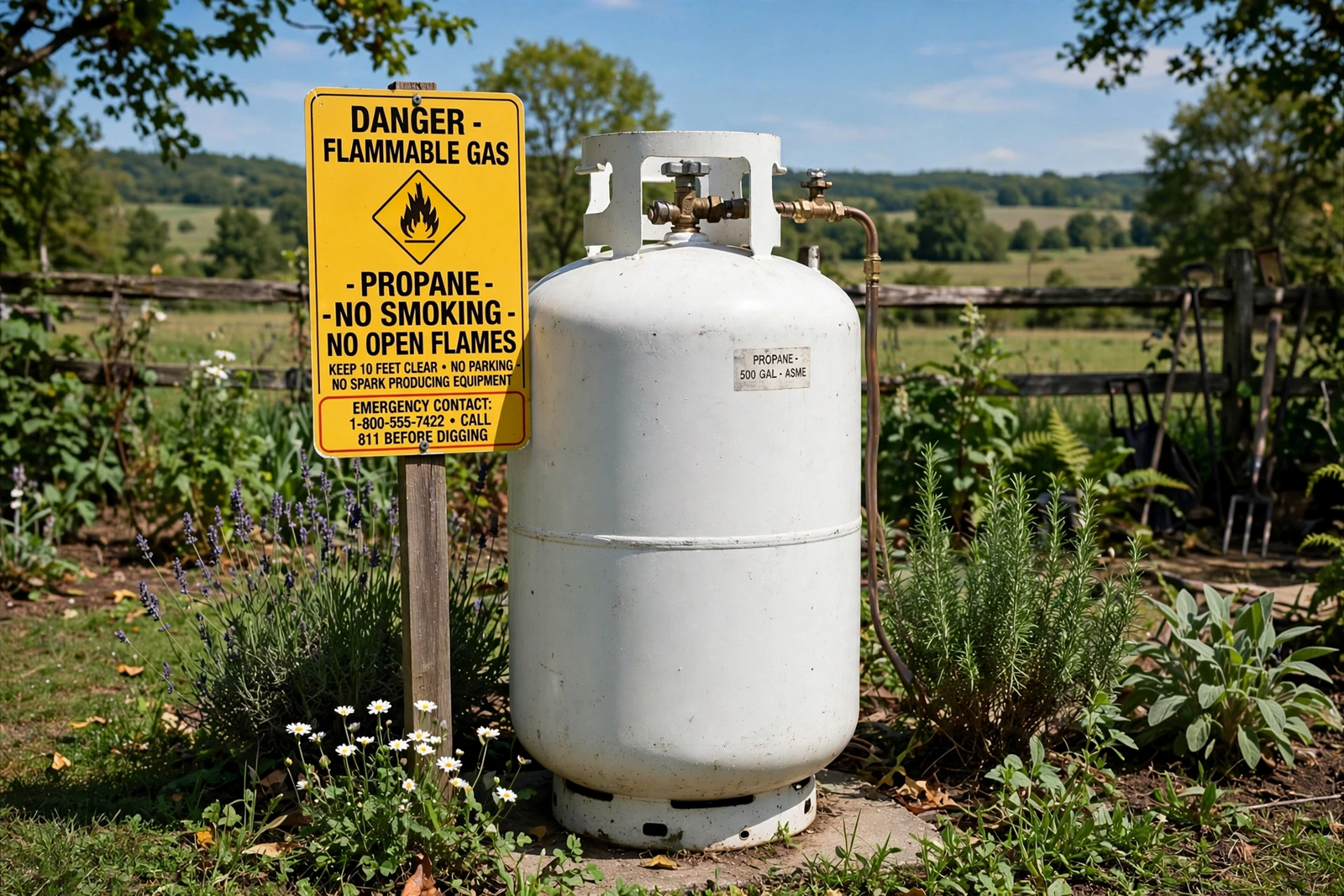
Despite the name, a “100-gallon” propane tank is about 4 feet tall and 3 feet in diameter — roughly the size of a large water heater. Common residential sizes:
- 100 gallons: ~340 lb of propane — supplemental heating, fireplaces
- 250 gallons: ~850 lb — small homes
- 500 gallons: ~1,700 lb — standard whole-house (most common)
- 1,000 gallons: ~3,400 lb — large homes, farms
How Long Does 100 Gallons Last?
It depends entirely on usage. Propane contains ~91,500 BTU per gallon:
- Fireplace only (30,000 BTU/hr): ~240 hours of burn time
- Supplemental heating: 1–3 months in winter
- Cooking only: many months — a gas hob sips propane
- Whole-house heating: a 100-gallon tank is undersized; you’d refill constantly
Most homes with propane heating use 500–1,000 gallon tanks precisely because 100 gallons goes quickly in cold weather. For UK readers: propane (LPG) heating is common in rural homes off the gas grid. The Ofgem website covers off-grid heating options and consumer protections.
Placement and Safety Rules
- Distance from buildings: typically 10 feet minimum for 100-gallon tanks (check local codes)
- Surface: level concrete pad or compacted gravel — 500+ lb needs solid footing
- Ventilation: never in enclosed spaces; propane is heavier than air and pools in low spots
- Inspection: tanks need periodic recertification (usually every 10 years)
Propane has an excellent safety record when handled properly, but it demands respect. The distinctive “rotten egg” smell is added ethyl mercaptan — if you ever smell it strongly, leave the area and call emergency services. Our propane vs natural gas comparison covers the fuel choice in more depth.
Propane Tank Sizes: Full Comparison
- 20 lb (BBQ tank): ~4.7 gallons — the familiar barbecue bottle
- 100 lb: ~23.6 gallons — tall cylinder, popular for temporary heating
- 100 gallons: ~80 gallons usable — supplemental home use
- 250 gallons: ~200 gallons usable — small homes, hot water + cooking
- 500 gallons: ~400 gallons usable — the standard whole-house tank
- 1,000 gallons: ~800 gallons usable — large homes, farms, commercial
Don’t confuse “100 lb” and “100 gallon” tanks — the naming is a notorious trap. A 100 lb tank holds about 24 gallons; a 100-gallon tank holds about 80 usable gallons. Always clarify which unit a supplier means.
Buying vs Renting Your Tank
- Renting (common): the propane company owns the tank, handles maintenance and recertification. Monthly rental £30–£60/year equivalent. Downside: you’re usually locked to that supplier.
- Buying: a 100-gallon tank costs £400–£800 new. You own it, can shop suppliers for the best per-litre price, but handle maintenance yourself.
If you use significant propane, owning usually pays off within a few years through supplier competition. For minimal use (fireplace only), renting avoids the hassle.
Reading Your Propane Gauge
Tank gauges show percentage of capacity, not gallons. A “100-gallon” tank reading 50% holds ~40 gallons of propane (50% of the 80-gallon usable fill). Order a refill at 20–30% — never let it hit zero, as running dry requires a system pressure test and pilot relighting before reuse, often with a callout fee.
Many suppliers offer automatic delivery (they monitor and top up) versus will-call (you watch the gauge). Automatic costs slightly more per litre but eliminates run-out risk in midwinter — worth considering for heating-dependent homes.
Related: propane tank duration guide.
Frequently Asked Questions
How many pounds of propane in a 100 gallon tank?
~340 lb at the standard 80% fill (80 gallons × 4.24 lb/gallon).
Why can’t propane tanks be filled to 100%?
Liquid propane expands with heat; the 20% vapour space prevents dangerous over-pressurisation.
How much does an empty 100-gallon propane tank weigh?
Roughly 150–180 lb (the “tare weight” stamped on the tank).
How long will 100 gallons of propane last?
Weeks to months depending on use — fireplace-only lasts longest; whole-house heating depletes it fast.
What’s the difference between a 100 lb and 100 gallon tank?
A 100 lb tank holds ~23.6 gallons of propane; a 100-gallon tank holds ~80 gallons at 80% fill. Confusingly named!