
How Many Amps does a Fridge Use? Complete Answer
Fridges are the quiet workhorses of the kitchen — always on, rarely thought about, until the breaker trips or the electricity bill arrives. Understanding how many amps your fridge actually uses matters for three practical reasons: sizing the circuit correctly, estimating running costs, and spotting when something’s wrong before your food spoils.
The headline number is reassuringly small. The details, as always, are where it gets interesting.
Typical Amperage by Fridge Type
Running amperage (what the fridge draws in normal operation on a 120V supply):
- Compact/mini fridge: 1–2 amps running (100–250W)
- Standard top-freezer (18–22 cu ft): 3–5 amps running (300–600W)
- Side-by-side / French door: 5–8 amps running (500–800W)
- Old fridge (15+ years): 6–10 amps running — worn compressors and degraded insulation work harder
- Chest freezer: 2–4 amps running
These are running figures. Every compressor fridge also has a startup (inrush) surge when the compressor kicks on — typically 2–3 times the running current, lasting a fraction of a second. A fridge that runs at 4 amps might momentarily pull 10–12 amps at startup. Breakers tolerate this brief surge, which is why a 15-amp breaker handles a 4-amp fridge without nuisance tripping.
UK readers: UK mains run at 230V, so the same fridge draws roughly half the amperage — a typical UK fridge-freezer runs at about 0.5–1.5 amps. The wattage is identical; only the current differs. UK fridge circuits are usually part of the kitchen ring final circuit rather than dedicated, though many electricians still recommend a dedicated feed for American-style side-by-side models.
What Makes a Fridge Draw More Power
- Ambient temperature. A fridge in a hot garage works dramatically harder than one in a cool kitchen. Every degree of surrounding heat means longer compressor cycles.
- Age and condition. Worn door seals, dusty condenser coils, and tired compressors all push amperage up. Cleaning the coils twice a year is the single best maintenance you can do.
- Defrost cycles. Frost-free models run a heating element periodically to melt ice — this can draw 5–8 amps during the cycle, the highest sustained draw in normal operation.
- Ice makers and water dispensers. Through-the-door ice and water add both running load and defrost complexity.
- How full it is. A reasonably full fridge holds temperature better than an empty one (thermal mass), so the compressor cycles less often. Don’t overpack it to the point air can’t circulate, though.
- Door openings. Every long door-open session dumps cold air and triggers a recovery cycle. Households with teenagers know this cost intimately.
How to Measure Your Fridge’s Actual Draw
Manufacturer labels give you the maximum rating, not real-world draw. To measure what’s actually happening:
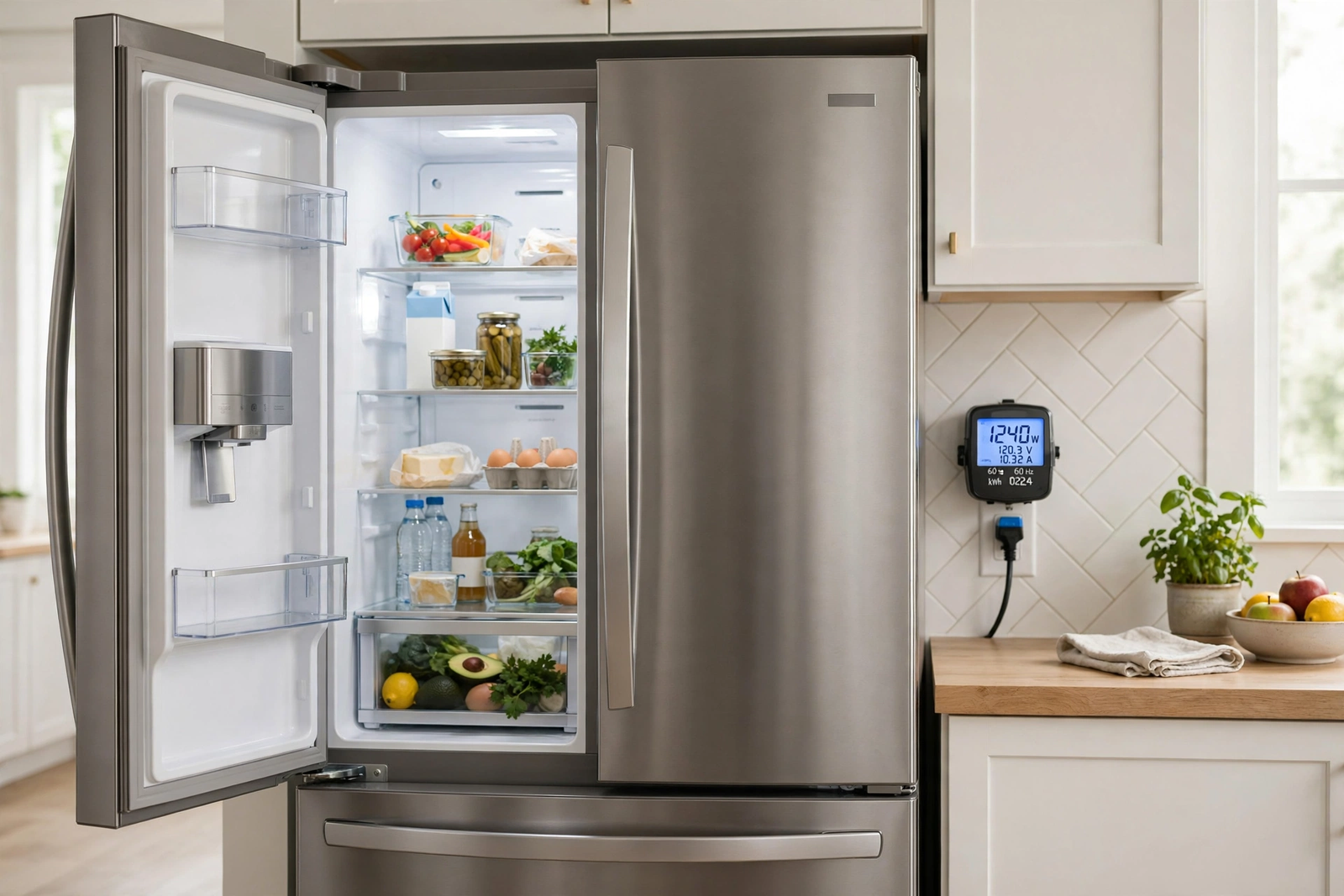
- Plug-in power meter (like a Kill A Watt, around £20–£25). Plug the fridge into it for 24–48 hours. It shows running watts, and better models log total kilowatt-hours so you can see the true daily consumption including cycles.
- Clamp meter around the hot conductor. This shows instantaneous amps — great for catching the startup surge, but it only shows a moment in time.
- The nameplate. Inside the fridge (usually on the wall of the fresh-food compartment) there’s a label with rated amps and watts. Treat this as the maximum, not the average.
If the meter reveals the fridge shares a heavily loaded circuit, our walkthrough of planning loads on a 15-amp circuit“>planning loads on a 15-amp circuit will help you rebalance it. For most people, the plug-in meter is the revelation. A fridge rated at 6 amps might average the equivalent of 1.5–2 amps over a day because the compressor only runs 30–40% of the time. That’s why a 150W-rated fridge costs far less to run than 150W × 24 hours would suggest.
What It Costs to Run
Take your fridge’s annual kWh from the energy label (or your meter reading × 365), then multiply by your electricity rate. A modern efficient fridge uses 300–500 kWh per year; an old energy-hog can exceed 1,000 kWh.
- At a US average of $0.17/kWh: 400 kWh/year ≈ $68/year (about $5.70/month)
- At a UK average of ~£0.27/kWh: 400 kWh/year ≈ £108/year (about £9/month)
An ancient second fridge in the garage can easily cost double that while keeping little more than beer cold — the classic candidate for retirement. The Energy Star programme and the US Department of Energy’s appliance guidance both have calculators for comparing old versus new models.
Why Your Fridge Needs a Dedicated Circuit
The NEC calls for refrigerators to be on their own 15- or 20-amp circuit, and for good reason. A fridge shares badly: if it’s on a general kitchen circuit and someone runs the microwave, the breaker trips — and unlike the microwave, the fridge won’t beep to tell you it’s off. Food sits warming silently for hours.
If your fridge is currently sharing a circuit and you get occasional trips, don’t just reset and forget. Our guide to how many receptacles on a 15 amp circuit“>how many receptacles belong on a 15-amp circuit explains the 80% loading rule and why heat-producing appliances need their own circuits.
Warning Signs Your Fridge Is Drawing Too Much
- The breaker trips repeatedly — the circuit is overloaded or the compressor is failing.
- The plug or outlet feels warm — stop using it and call an electrician; this is a fire risk.
- The compressor runs constantly without cycling off — check door seals, coil cleanliness, and thermostat setting (37–40°F / 3–4°C for the fridge, 0°F / −18°C for the freezer).
- Electricity bills jump with no other explanation — an ageing fridge is a prime suspect.
- Buzzing, clicking, or humming louder than usual — the start relay or compressor may be struggling.
Electrical safety note: never bypass a tripping breaker with a larger one, never run a fridge on a long extension lead as a permanent setup, and always unplug (or switch off at the breaker and verify) before cleaning coils or moving the appliance.
Frequently Asked Questions
How many amps does a fridge use when starting up?
The startup (inrush) surge is typically 2–3 times the running current — so a fridge that runs at 4 amps may briefly draw 10–12 amps for a fraction of a second. Standard breakers tolerate this. If the breaker trips exactly when the compressor kicks on, the compressor or start relay may be failing.
Can a fridge and freezer share one circuit?
A 15-amp circuit can technically handle a fridge plus a small chest freezer if their combined running load stays well under 12 amps continuous, but it’s not ideal. Best practice is one dedicated circuit per major appliance, so a fault or trip on one doesn’t take out the other.
How many watts does a fridge use per day?
Despite ratings of 100–800W, the compressor cycles on and off, so daily consumption is typically 1–2 kWh for a modern fridge (about 400–700 kWh per year). Check the energy label or measure with a plug-in meter for your exact model.
Does an old fridge use more electricity?
Yes, significantly. A 20-year-old fridge can use 2–3 times the electricity of a modern equivalent — often 1,000+ kWh per year versus 300–500. If your fridge predates modern efficiency standards, replacing it can pay for itself in a few years through lower bills.
What size breaker does a fridge need?
A dedicated 15-amp breaker is the minimum; many electricians prefer 20-amp for larger French-door or side-by-side models to comfortably handle the startup surge. Never upsize a breaker without confirming the wire gauge supports it.
Can I run a fridge on an extension lead?
Only as a very temporary measure, with a short, heavy-duty lead rated for the load — never a cheap multi-way strip, and never permanently. Voltage drop over long thin leads makes the compressor work harder and can damage it. Get a proper outlet installed where the fridge lives.