
How does a Mini Split Work: What You Need to Know
Mini splits — properly called ductless mini-split heat pumps — are one of the fastest-growing heating and cooling technologies in UK homes. If you have ever wondered how a single outdoor box can heat your living room in January and cool your bedroom in July without any ductwork, this guide explains exactly how they work, when they make sense, and what they cost to run.
The Basic Idea: Moving Heat, Not Making It
Every heater you have ever owned — radiators, storage heaters, fan heaters — makes heat by converting electricity (or gas) into warmth, at best turning 1 kWh of energy into 1 kWh of heat. A heat pump does something cleverer: it moves existing heat from one place to another using a refrigeration cycle.
Even cold outdoor air contains heat energy. A mini split extracts that energy, concentrates it, and delivers it indoors. Because moving heat takes far less energy than creating it, a mini split typically delivers 3–4 kWh of heating for every 1 kWh of electricity consumed — an efficiency (COP) of 300–400%. The US Department of Energy’s guide to ductless mini-splits confirms these efficiency figures and explains why they outperform window units and portable heaters so dramatically.
The Components
Outdoor unit (condenser/compressor)
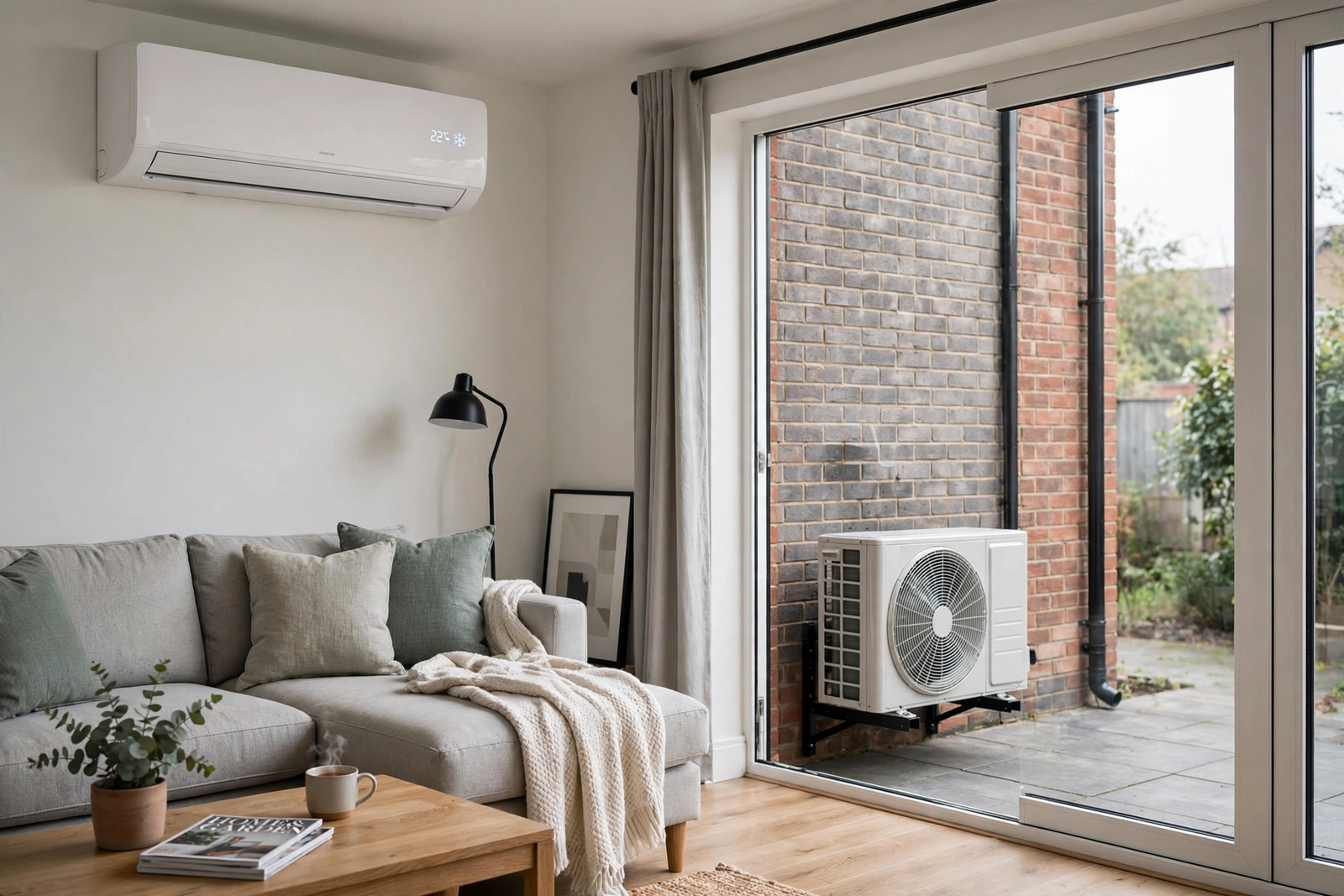
A weatherproof box containing the compressor, outdoor heat-exchange coil and fan. It sits on a wall bracket or ground pad outside, connected to the indoor units by a small bundle: two insulated copper refrigerant lines, a power cable and a condensate drain — usually run through a single 75 mm hole in the wall.
Indoor unit(s) (air handlers)
Slim wall-mounted cassettes containing the indoor coil, fan and air filters. Each indoor unit has its own thermostat, so different rooms can be different temperatures — true zoning without any dampers or ductwork. Multi-split systems connect two to five indoor units to one outdoor unit.
Refrigerant lines
The sealed copper pipework carrying refrigerant between the units. This is the part that must be installed by an F-Gas certified engineer in the UK — handling refrigerant is legally restricted, so mini splits are not a DIY install.
Controller
Infrared remote as standard; most modern units add Wi-Fi and smartphone apps with scheduling, geofencing and energy monitoring.
The Refrigeration Cycle, Step by Step
Heating mode (winter)
- Evaporation: cold, low-pressure liquid refrigerant flows through the outdoor coil. The outdoor fan blows outside air across it, and the refrigerant absorbs heat from that air — even at -10°C — and boils into a gas.
- Compression: the compressor squeezes that gas, which dramatically raises its temperature (compressing a gas heats it — the same physics as a bicycle pump getting warm).
- Condensation: the hot, high-pressure gas flows to the indoor coil, where the indoor fan blows room air across it. The refrigerant releases its heat into the room and condenses back to liquid.
- Expansion: the liquid passes through an expansion valve, dropping in pressure and temperature, ready to absorb heat outdoors again.
Cooling mode (summer)
A reversing valve flips the cycle: the indoor coil becomes the evaporator (absorbing room heat) and the outdoor coil becomes the condenser (dumping it outside). Same hardware, reversed flow. The indoor unit also dehumidifies as warm room air condenses moisture on the cold coil — the water drains away through the condensate pipe.
Efficiency: What the Numbers Mean
- COP (Coefficient of Performance): heating efficiency at a given moment — 3.5 means 3.5 kW of heat per 1 kW of electricity.
- SCOP: seasonal average COP across a heating season — the honest number for comparing systems (look for 3.5–5.0).
- SEER: seasonal cooling efficiency — higher is better; 6–8 is typical for good units.
- Energy label: UK/EU labels rate heating and cooling separately (A+++ to D).
Efficiency falls as it gets colder outside — there is less heat to harvest. Quality cold-climate units maintain useful output down to -15°C or lower, but below about -5°C the COP drops toward 2. In most of lowland Britain, where winters hover around 0–7°C, mini splits spend the heating season in their efficiency sweet spot.
Mini Split vs the Alternatives
Vs gas boiler + radiators
At current UK energy prices, a mini split heating at SCOP 3.5+ is roughly cost-competitive with a modern gas boiler per kWh of heat — and far cheaper than direct electric heating. It will not directly replace a wet radiator system economically in every home, but for heating individual rooms, extensions, garden offices and homes off the gas grid, it is often the cheapest option to run.
Vs portable air conditioning
No contest. Portable units are inefficient (much of their cooling is undone by the hot exhaust hose radiating in the room), noisy and expensive to run. A mini split uses a fraction of the electricity for far better cooling.
Vs full ducted heat pump system
Ducted air-source heat pumps suit whole-house wet systems; mini splits suit zoned, room-by-room comfort without ripping up floors for pipework. Installation is days, not weeks, and there is no ductwork to clean. If you are adding a new room to heat, our extension cost guide helps with budgeting.
Installation: What to Expect in the UK
A single-room mini split typically costs £1,800–£3,000 installed; a multi-split serving three to four rooms runs £4,000–£7,000. Installation takes one to two days: mount the outdoor unit, drill the wall penetration, hang indoor units, run and pressure-test the refrigerant lines, vacuum the system, commission and demonstrate.
UK specifics to know:
- F-Gas certification is legally required for anyone handling the refrigerant — verify your installer’s credentials.
- Planning: the outdoor unit usually falls under permitted development, but check noise limits and conservation-area rules; keep it away from neighbours’ windows.
- Electrics: most single splits run on a standard 13A supply, but the circuit should be dedicated — an electrician’s input is normal.
- Running costs: heating a well-insulated room might cost 30–60p per hour at current tariffs; cooling is cheaper still.
The Energy Saving Trust’s heat pump advice is a solid starting point for understanding heat pumps in UK homes. For servicing diagnostics, see how to calculate superheat. how heat pumps fit into UK homes and what grants may apply.
Maintenance
Mini splits are low-maintenance: wash or vacuum the indoor filters monthly in heavy-use seasons, keep the outdoor coil clear of leaves and debris, and have the system serviced every 2–3 years (refrigerant check, drain flush, electrical inspection). A well-maintained unit lasts 15–20 years.
Frequently Asked Questions
Do mini splits work in cold UK winters?
Yes — cold-climate models heat effectively down to -15°C. Efficiency dips in the coldest snaps, but for typical UK winter temperatures (0–7°C) they run at excellent efficiency.
How much does a mini split cost to run?
Roughly a third of the cost of direct electric heating for the same warmth, thanks to 300–400% efficiency. A single room might cost £30–£60/month in deep winter depending on insulation and tariffs.
Can I install a mini split myself?
No — not legally in the UK. Refrigerant handling requires F-Gas certification, and the system must be pressure-tested, vacuumed and commissioned properly. DIY kits exist elsewhere but are not compliant here.
Are mini splits noisy?
Indoor units are whisper-quiet (often 19–25 dB on low — quieter than a library). Outdoor units hum at 45–55 dB; position them thoughtfully relative to bedrooms and neighbours.
Do they also dehumidify?
Yes, in cooling mode — moisture condenses on the cold indoor coil and drains away. Many units have a dedicated dry/dehumidify mode for clammy days when you do not want full cooling.
How long do mini splits last?
15–20 years with basic maintenance — comparable to a good boiler. The compressor is the hardest-working part; inverter-driven compressors (standard now) last longer than old on/off types by avoiding constant stop-start cycling.