
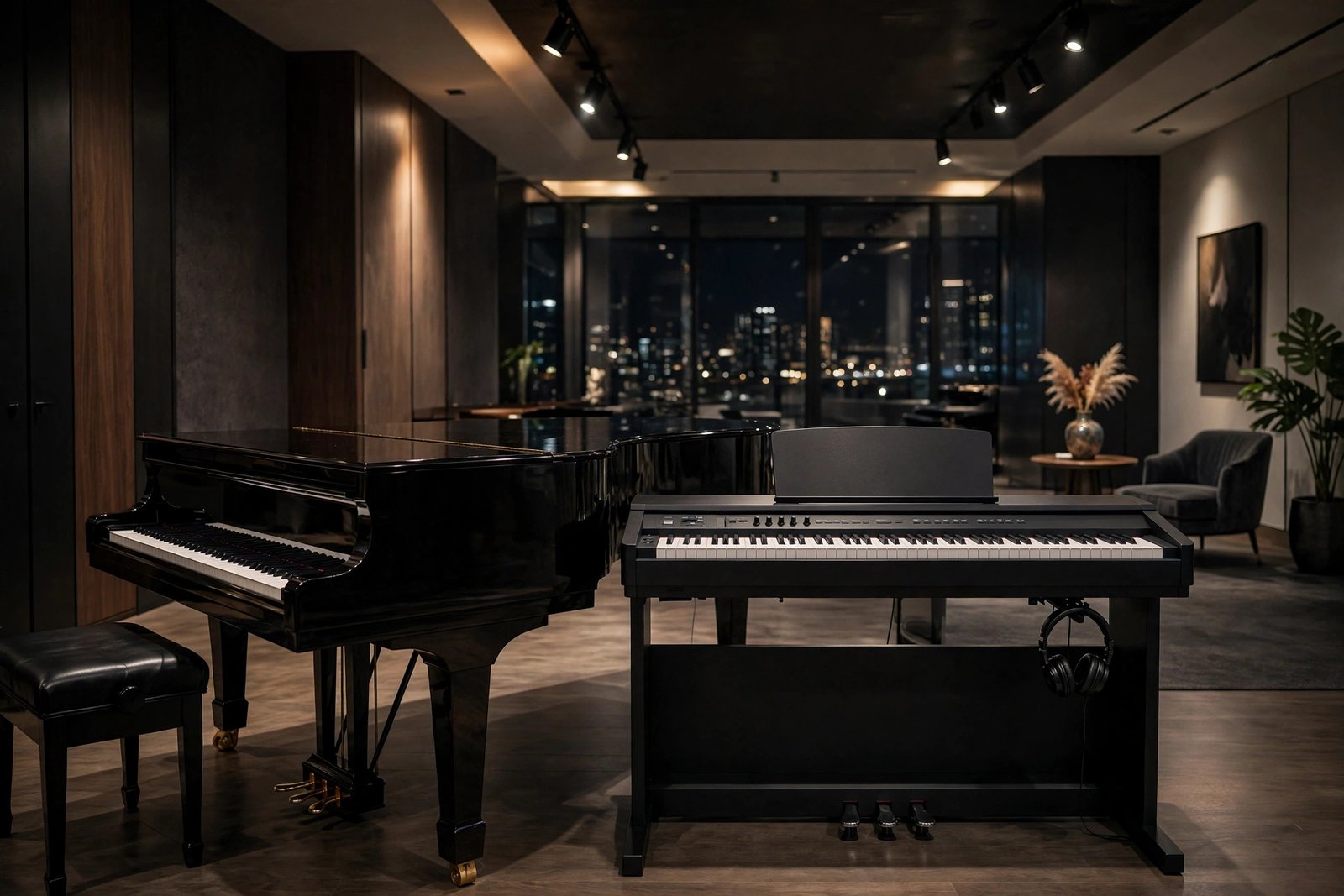
Digital vs Acoustic Piano: Which Should You Choose? (2026 Guide)
The piano in the corner of the room — should it have strings or circuits? The digital versus acoustic piano question divides households, teachers, and forums, and the answer has shifted dramatically as digital technology improved. A £500 digital piano in 2026 does things a £500 acoustic never could, while a good acoustic offers something no speaker can fully reproduce. If you’re choosing for yourself or a child starting lessons, here’s the honest comparison — including the question of whether now is even the right time to decide.
How good are digital pianos now, really?
Let’s start with the technology, because it’s the heart of the question. Modern digital pianos use multi-gigabyte samples of concert grand pianos (or physical modelling), 88 fully weighted hammer-action keys that replicate acoustic key resistance, and speaker systems tuned to project like a soundboard. The best £800–£1,500 digitals fool experienced pianists in blind tests for touch and tone — the key action, graded heavier in the bass like a real piano, is genuinely convincing. What they still can’t fully replicate: the sympathetic resonance of 200+ strings vibrating together, the way the whole wooden case becomes part of the instrument, and the infinite dynamic subtlety of felt hammers on strings. For beginners through intermediate players (roughly the first 5–8 years), these differences are academic — no beginner’s technique exceeds what a good digital can express. The technology crossed the “good enough for serious learning” threshold years ago; current improvements are refinements, not revolutions. Which means there’s no reason to wait for the next model — today’s mid-range digitals are mature products. Which?’s piano and keyboard reviews test current models against these claims.
The case for digital: practicality wins most households
Digitals win on every practical axis. Volume control with headphones means practising at midnight without evicting the family — the single biggest advantage, and the reason most teachers now accept digitals for beginners. No tuning (£80–£120 yearly for acoustics, non-negotiable). No sensitivity to central heating, damp, or house moves (acoustics hate all three). Portability: digitals move in a car; acoustics need specialist movers (£200–£400). Built-in learning tools: metronomes, recording, hundreds of voices, lesson apps, and MIDI connectivity for composition software. And cost: a genuinely good beginner digital costs £350–£600; the equivalent-quality acoustic starts around £2,000 second-hand, £4,000+ new. For flats, terraced houses with thin walls, night-owl practicers, and budget-conscious families, digital isn’t the compromise — it’s the obviously correct choice. If noise is a household concern generally, our guide to soundproofing a bedroom wall cheaply covers the acoustic side of shared living.
The case for acoustic: the irreplaceable things
Yet acoustics endure for reasons beyond nostalgia. The sound of a real piano in a real room — the overtones blooming, the bass you feel in your chest — remains the reference standard; digitals approximate it, acoustics are it. Advanced technique (the subtle tonal control of grades 7–8 and beyond) develops differently on real actions with real escapement and real string response. There’s an inspirational quality: children who practise on a beautiful acoustic often practise more, because the instrument itself rewards touch. Acoustics hold value — a well-maintained Yamaha U1 bought second-hand for £2,500 will sell for similar in a decade; digitals depreciate like electronics. And there’s the furniture factor: a piano is a presence in a home in a way a keyboard on a stand isn’t. The honest acoustic case: if you have the space, the budget (£2,000+ second-hand from a reputable dealer with warranty), tolerant neighbours or a detached house, and a committed player past beginner stage — the acoustic is the richer instrument. For most beginners, it’s the upgrade you make later, if ever.
What to buy at each budget
Under £200: only as a toe-in-the-water — 61 unweighted keys teach notes but not piano technique; acceptable for a few months, then limiting. £350–£600: the beginner sweet spot — 88 weighted keys from Yamaha, Roland, Casio, or Kawai; everything a beginner needs for years. £600–£1,200: better actions and sound, worth it for committed players. £1,200–£2,500: premium digitals rivalling acoustics for touch. Second-hand digitals: good value (check all keys, pedals, and speakers work; models from the last 8 years hold up well). Second-hand acoustics: buy only from dealers offering tuning, warranty, and delivery — private-sale pianos are gambles (cracked soundboards, worn actions, and £300 moving costs). Whatever you buy, budget £30–£60 for an adjustable stool or bench (posture matters from day one) and a sustain pedal if not included. Avoid: “piano-shaped” toys, unweighted 88-key boards marketed as pianos, and anything without a sustain pedal input. For comparing audio gear generally, our smart speaker guide for small flats applies the same value logic to sound-per-pound.
Is now the right time to decide?
The question behind the question is usually about a child starting lessons or a new year’s resolution. Timing advice: buy when lessons start, not months before (motivation is perishable; an unplayed piano becomes furniture fast). September (new school year, lesson sign-ups) and January (resolutions) see the best bundle deals from UK retailers like PMT. Don’t wait for a “better time” technologically — the market is mature and stable. Do wait if: the player hasn’t shown sustained interest (rent or borrow first), you’re moving house soon (pianos and moves mix badly), or budget pressure would make the purchase resented rather than celebrated. The piano will still be there in six months; forced purchases gather dust. When the interest is real and the timing works, decide in a weekend: digital for practicality, acoustic for the long-term romance — and either way, the music starts the day it arrives.
Renting before buying: the low-risk trial
Unsure about the commitment? Renting a piano for 3–6 months (£25–£45/month for a decent digital, more for acoustics from specialist dealers) is the rational trial. It answers the real question — will this person actually practise? — before £500+ leaves your account. Many rental schemes credit payments toward purchase, making the trial nearly free if you buy. Schools and teachers can often recommend rental providers, and some music services rent to pupils directly. The rule: rent when commitment is unproven, buy when the habit is established. A rented piano played daily beats an owned piano gathering dust — and the trial period often reveals preferences (upright vs stage piano, key feel) that make the eventual purchase smarter.
Conclusion
Digital versus acoustic in 2026 isn’t really a contest for beginners — digital wins on cost, silence, and practicality, and modern weighted actions teach genuine technique. Acoustic wins for advanced players, beautiful sound, and long-term value. Match the instrument to your household’s reality, buy in the £350–£600 digital sweet spot (or £2,000+ second-hand acoustic from a dealer), and start when the motivation is real. The right piano is the one that gets played.
Frequently Asked Questions
Can you learn piano properly on a digital piano?
Yes — through beginner to intermediate level (roughly grades 1–6), a good 88-key weighted digital teaches genuine technique. Advanced players eventually benefit from acoustic actions.
How much does a good beginner piano cost in the UK?
£350–£600 for a quality 88-key weighted digital piano. Equivalent-quality acoustic pianos start around £2,000 second-hand from reputable dealers.
Do digital pianos need tuning?
No — never. That’s a major cost and hassle saving versus acoustics, which need professional tuning (£80–£120) at least yearly.
Can I practise piano quietly in a flat?
On a digital piano, yes — headphones make practice silent to others. Acoustic pianos can’t be silenced and may disturb neighbours, especially in flats or terraces.
Should I buy second-hand?
Second-hand digitals from the last 8 years are good value if all keys, pedals, and speakers work. Second-hand acoustics should come from dealers with warranty, tuning, and delivery — private sales are risky.