
Crypto Market Cycles Explained: How They Really Work
Every few years, the same film plays: crypto prices rocket to euphoric highs, your taxi driver starts giving token tips, then everything collapses 70–80% and the obituaries roll in — until the cycle starts again. These boom-and-bust rhythms are called market cycles, and understanding them is arguably the highest-value knowledge a crypto beginner can acquire. Not because cycles let you predict prices (they don’t, reliably), but because they explain the psychological traps that destroy most investors: buying euphoria, selling despair, and mistaking a bull market for genius. This guide explains how crypto cycles actually work, what drives them, where the popular theories overreach, and how to position yourself sanely through the next one.
The Anatomy of a Crypto Cycle
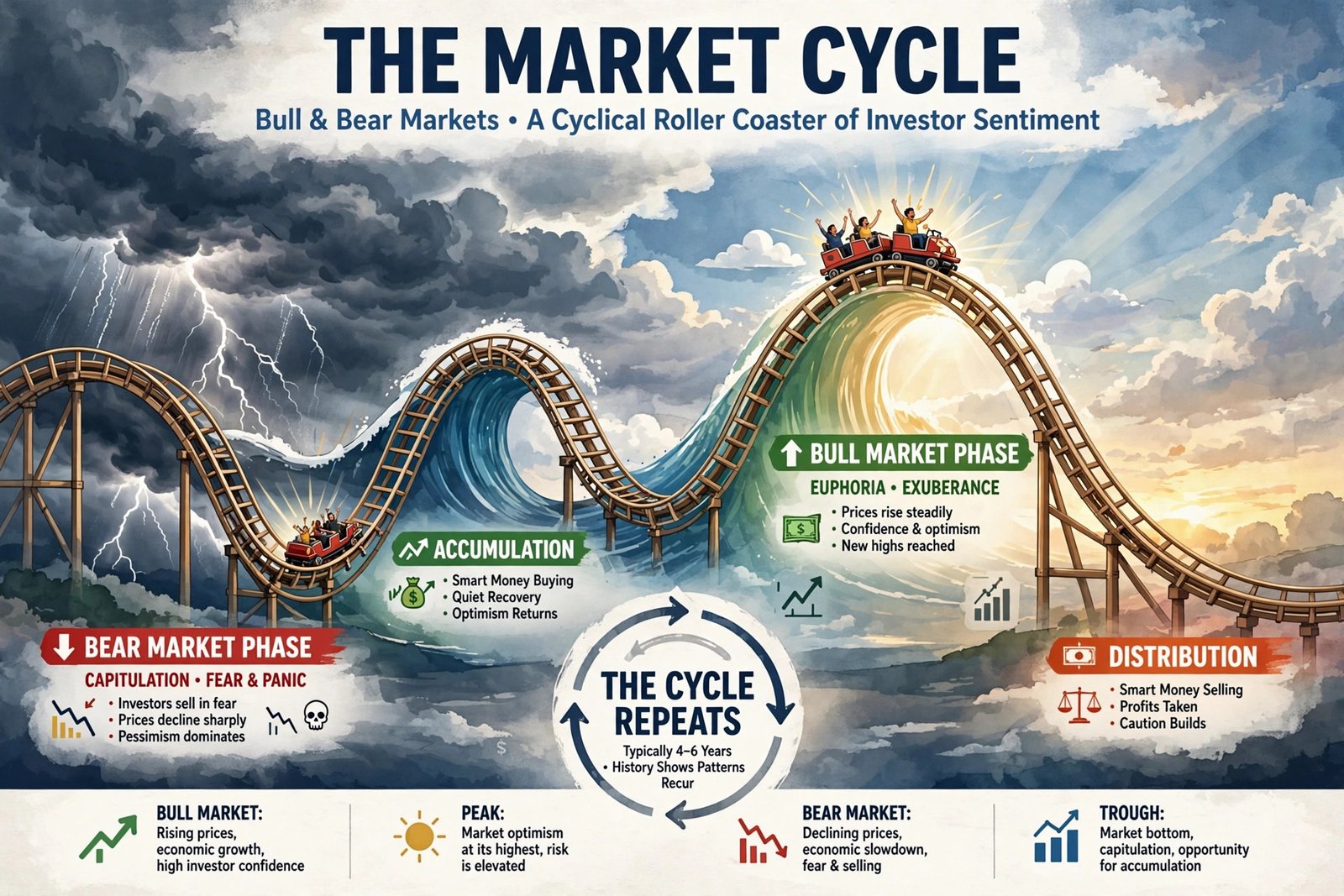
Bitcoin’s history shows a repeating four-act structure, roughly aligned with its halving events (more on those separately). Act one: accumulation — prices flat and boring after a crash, headlines declaring crypto dead, smart money quietly buying. Act two: the bull run — prices climb, media coverage returns, each new high pulls in fresh buyers. Act three: euphoria and the blow-off top — vertical price spikes, absurd predictions (£1 million Bitcoin by Christmas), your least financial friends launching memecoins. Act four: the bear market — an 70–85% drawdown over a year or more, exchanges collapsing, “crypto is dead” headlines again. Then, eventually, accumulation resumes.
The 2017 cycle peaked near $20,000 before an 84% crash; the 2021 cycle peaked near $69,000 before a 77% crash; each recovery eventually exceeded the previous peak. Recognising the pattern doesn’t mean timing it — the tops and bottoms are only obvious in hindsight — but it reframes what you’re seeing. Euphoria isn’t evidence of a new paradigm; despair isn’t evidence of permanent death. Both are just acts in the play.
What Actually Drives the Cycles
Cycles aren’t magic; they’re driven by identifiable forces. The halving — Bitcoin’s supply issuance cutting in half every four years — reduces new supply hitting the market, and historically bull runs have followed halvings by 12–18 months. But halvings alone don’t explain the scale of the moves. The bigger drivers are liquidity and psychology: loose monetary policy and cheap money inflate all risk assets (crypto most of all), while tightening crushes them. Crypto’s cycles rhyme with tech-stock cycles for exactly this reason.
Then there’s reflexivity — prices rising attracts buyers, which pushes prices higher, which attracts more buyers, until the marginal buyer is exhausted and the whole thing unwinds. Add leverage (traders borrowing to amplify bets), and you get forced selling cascades on the way down that overshoot fundamentals in both directions. Understanding this matters because it tells you what doesn’t drive cycles: the technology barely changes between top and bottom. Bitcoin in the depths of a bear market is the same protocol as at the peak — only the narrative and the leverage changed.
Two Cycles Up Close: 2017 and 2021
The 2017 cycle is the textbook example. Bitcoin rose from around $1,000 in January to nearly $20,000 in December, driven by the ICO mania — hundreds of new tokens launching, retail frenzy, mainstream media declaring a revolution. Then came 2018: an 84% collapse, ICO projects imploding, and a long “crypto winter” where prices flatlined for over a year. Anyone who bought the December top waited three full years just to break even.
The 2021 cycle rhymed but differed in texture. Institutional money arrived — Tesla’s treasury purchase, El Salvador’s adoption, the Coinbase IPO — and Bitcoin peaked near $69,000 in November 2021. The bust that followed (the Terra collapse, then FTX) was arguably worse in human terms, wiping out household savings on a scale 2018 never reached. Yet the recovery came faster, and by 2024–2025 Bitcoin had printed new all-time highs. The lesson across both: the assets and narratives change, the human emotions don’t, and every cycle’s “this time it’s different” chorus ages the same way.
Where Cycle Theory Overreaches
An honest guide must flag the limits. First, “four-year cycles” are a sample size of three — that’s barely data, and each cycle has differed: institutional involvement, ETFs, and regulation change the structure. The cycle may be lengthening, dampening, or transforming as the market matures. Second, cycle analysis is useless for altcoins individually: most altcoins from previous cycles never recovered their peaks at all. “Buying the dip” works as a concept mainly for assets that survive — Bitcoin and a handful of others — not for the thousands of tokens that bled to zero.
Third, and most important: knowing about cycles doesn’t confer timing ability. Study after study shows retail investors buy high and sell low even when they understand cycles intellectually, because euphoria and fear override theory in real time. The value of cycle knowledge isn’t prediction — it’s inoculation. When everyone’s euphoric, you remember act three. When everyone’s despairing, you remember act one. That framing is what keeps you holding (or buying) when it counts.
Positioning Yourself Through the Next Cycle
Practical application beats theory. Decide your strategy before euphoria or despair arrives: a fixed allocation you can live with (many advisers suggest crypto as a small satellite position, not the core of your wealth), a regular buying schedule that continues through bear markets, and pre-committed rules for taking profits — because nobody ever went broke taking profits, while plenty went broke riding euphoria to the top and despair to the bottom.
Keep the rest of your financial life boring and solid while crypto does its drama: a clear budgeting framework ensures your crypto allocation stays a choice rather than a gamble with the rent money, and smart budgeting habits keep the habit sustainable across the multi-year grind of a bear market. And stay alert in euphoric phases — they’re when fraud patterns spike, because scammers follow the crowds.
Finally, respect the regulator’s view: the FCA’s cryptoasset guidance is blunt that you should be prepared to lose everything you invest. Size your position so that the worst cycle outcome — an 80% drawdown that takes years to recover — is survivable, not ruinous. If it isn’t survivable, your position is too big regardless of what the cycle charts say. For the macro backdrop that drives so much of the cycle, the Bank of England’s explainers decode interest rates and money in plain English — and HMRC’s crypto tax guidance reminds you the taxman takes an interest in every cycle’s winners.
Market cycles are the closest thing crypto has to a weather system: you can’t control it, you can’t precisely forecast it, but you can dress for it. Understand the four acts, respect the drivers, distrust anyone selling precise predictions — and build a strategy boring enough to survive all four seasons.
Frequently Asked Questions
How long does a full crypto cycle last?
Historically around four years, loosely tied to Bitcoin’s halving schedule — roughly a year of bear market, a year of accumulation, and a one-to-two-year bull run. But the sample size is small and the pattern may be changing as the market matures.
Are we in a bull or bear market right now?
That depends on when you’re reading this — which is exactly the point. Check current prices against the previous cycle’s peak and the most recent major drawdown; the cycle position is clearer in hindsight than in real time.
Do altcoins follow Bitcoin’s cycles?
Broadly yes in direction, but with far more violence — altcoins typically rise harder in bull markets and fall further in bears, and many never recover their previous peaks at all.
Can understanding cycles help me time the market?
Not reliably. Cycle knowledge helps you avoid the psychological traps (buying euphoria, selling despair) and size positions sensibly — it doesn’t give you tradable timing signals.