
Cricket Basics Explained: How Long Until It Clicks?
Cricket has a reputation problem: to the uninitiated, it’s the sport that takes five days, stops for lunch and tea, and ends in a draw — incomprehensible by design. But beneath the reputation lies one of the world’s most tactically rich, culturally deep, and genuinely thrilling sports, and understanding its basics is far quicker than folklore suggests. The real question: how long before the investment pays off — before you can watch a match with comprehension, follow the drama, and maybe even play? The answer: an afternoon for the basics, a season for fluency, and the rewards start immediately. This is the no-nonsense beginner’s guide.
The Basics in Fifteen Minutes (Really)
Here’s the whole sport, stripped down. Two teams of 11. One team bats (tries to score runs), the other bowls and fields (tries to stop them and get them out). The bowler hurls the ball at the wicket (three wooden stumps); the batter defends it and hits the ball to score runs (running between the wickets, or boundaries: 4 for reaching the rope, 6 for clearing it). Batters get out in various ways — bowled (ball hits stumps), caught, LBW (leg before wicket — the complex one, ignore it for now), run out. Each team’s batting turn is an innings; when 10 batters are out (or the overs run out), innings ends. Most runs wins. That’s cricket. Everything else is detail.
The three formats: Test cricket (5 days, the purist’s chess match — each team bats twice), One Day Internationals (50 overs per side, ~8 hours), and T20 (20 overs per side, ~3 hours — fast, loud, the beginner’s gateway drug). Start with T20: it’s designed for newcomers, every ball matters, and a whole match fits in an evening. The Hundred (100 balls per side) is even more beginner-friendly — and knowing how to watch live sport without Sky means you will not miss a ball. Test cricket is the connoisseur’s reward — come back to it once you’re hooked.
What “Understanding” Actually Unlocks (and When)
After one T20 match (~3 hours): you get the core loop — bat, bowl, runs, wickets, the tension of a chase. You can follow a scorecard and feel the drama. After 3–4 matches (a few weeks): tactics emerge — why captains set fields certain ways, what a “good over” looks like, why spinners bowl in the middle overs, the calculus of required run rates. You start having opinions. After a full season (summer): fluency — you understand declarations, follow-the-on, the rhythms of Test cricket, the narratives (the Ashes! the rivalries!), and you can explain LBW without notes. The real result — that moment watching a tight finish with genuine comprehension and pounding heart — typically arrives within your first month of casual watching. Cricket’s learning curve is front-loaded: steep for an afternoon, then pure pleasure.
The fastest route: watch T20 with someone who knows the game (every cricket fan loves explaining it — it’s practically a duty), keep a beginner’s glossary handy for the first few matches, and don’t try to learn everything at once. The BBC’s cricket coverage includes excellent explainers, and the ECB (England and Wales Cricket Board) runs beginner resources and casual formats like All Stars Cricket for kids and park cricket for adults.
Playing: Easier to Start Than You Think
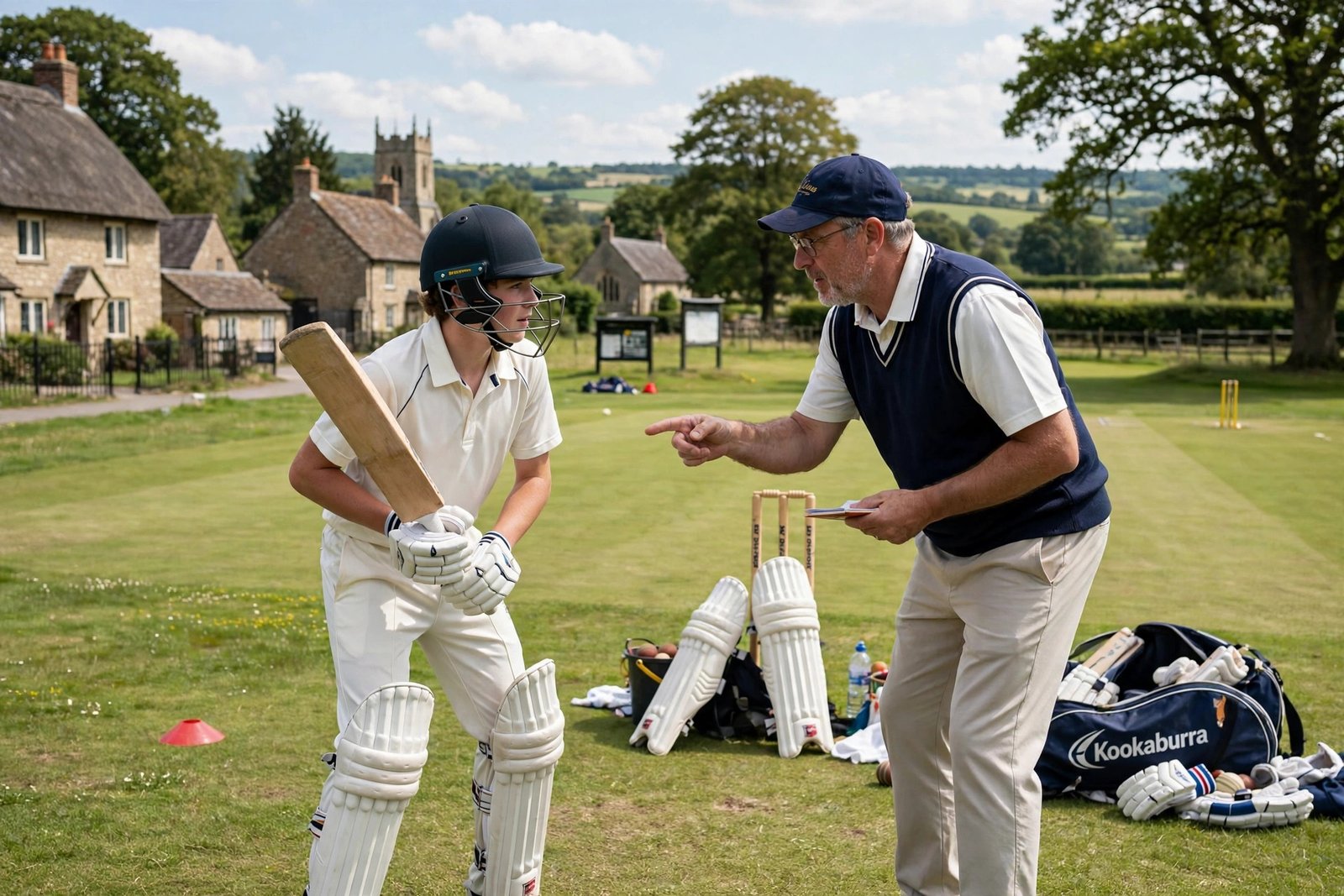
Watching is one thing; playing is where cricket truly hooks people — and it’s more accessible than its posh image suggests. Casual entry: park cricket with friends (a tennis ball, a bat, jumpers for goalposts — sorry, stumps), Last Man Stands leagues (8-a-side, 20 overs, weeknight, all abilities), and softball cricket sessions run by clubs specifically for beginners. Club cricket: most villages and towns have clubs desperate for players — Saturday league teams from elite to “we’re just happy to field eleven”, Sunday friendlies, midweek T20. Turn up, mention you’re new, and you’ll be welcomed — cricket clubs run on volunteers and goodwill, and new players are treasured.
Costs: minimal to start — clubs lend kit generously; your own bat (£40–£80 beginner), box and pads eventually (£50–£100 total). Membership £50–£150/year typically. The learning: batting basics (stance, straight bat, watching the ball) take a few sessions; bowling (the run-up, the action) is the harder skill — get one coached session early to avoid injury and bad habits. And it’s superb exercise disguised as a summer afternoon — just remember fuelling properly around matches, which can last all day: well within healthy activity, social to its core, and playable into old age — village cricket is full of seventy-year-olds still turning out.
The Ashes and the Rivalries: Cricket’s Great Stories
Every sport has its epics; cricket’s are operatic. The Ashes (England vs Australia, since 1882) is the oldest rivalry in sport — named for a mock obituary mourning English cricket’s “death” after an Australian victory, with the tiny urn becoming the most famous trophy in the game. Series every couple of years produce legendary moments: Botham’s 1981 heroics, the 2005 series (widely called the greatest ever), Stokes’s 2019 Headingley miracle. India vs Pakistan carries geopolitical weight that makes it arguably the most-watched rivalry on earth. The World Cups (ODI and T20) deliver the global spectacles. Knowing these narratives transforms watching: you’re not just seeing balls and runs, you’re seeing chapters in century-old stories. Ask any cricket fan for their “where were you when” moment — they’ll have three, and they’ll tell you all of them at length. That’s the culture you’re joining, and it’s wonderful.
The Culture: Why It Hooks People
Cricket’s secret is that it’s as much social institution as sport: the tea interval, the village green, the touring sides, the characters. The narratives run deep — the Ashes (England vs Australia, 140+ years of rivalry), the World Cups, the IPL’s glitz versus Test cricket’s tradition. Understanding the basics plugs you into all of it: the radio commentary (Test Match Special is a national treasure — witty, meandering, wonderful), the pub debates, the summer rhythm of it. For many, cricket becomes the soundtrack of English summer — and that cultural membership is the real payoff, arriving within weeks of starting to pay attention.
How long does understanding cricket basics take before you see real results? An afternoon for the core concepts, a month for genuine match enjoyment, a season for fluency — and the first “I actually get this” thrill arrives during your very first T20 finish. Start with the short format, watch with a fan, try a casual game in the park. Cricket’s reputation for incomprehensibility is the biggest myth in sport — it’s just a bat, a ball, and five days of gloriously unnecessary complexity. You’ll love it.
Frequently Asked Questions
What is LBW in simple terms?
If the ball would have hit the stumps but hit the batter’s leg first (and they weren’t offering a shot, roughly), they’re out. It’s cricket’s most debated law — even experts argue about LBW decisions, so don’t worry about mastering it immediately.
What’s the best format for a beginner to watch?
T20 — three hours, fast scoring, constant action, made for newcomers. The Hundred is similarly accessible. Graduate to one-dayers, then Test cricket once you’re invested.
How long does a Test match actually take?
Up to five days, six hours of play daily with lunch and tea breaks. It can still end in a draw — which, once you understand it, is a feature (the tactical depth is unmatched), not a bug.
Can adults start playing cricket with no experience?
Absolutely — clubs welcome adult beginners warmly, softball/last-man-stands formats are designed for it, and the social side means you’ll improve while making friends. Most clubs will lend you kit to start.