Robbie Williams Net Worth, Age, Family and Career — Full Profile
Robbie Williams Net Worth, Age, Family and Career — Full Profile Robbie Williams is the Stoke-on-Trent singer who left the biggest boy band of the 1990s…
Robbie Williams Net Worth, Age, Family and Career — Full Profile
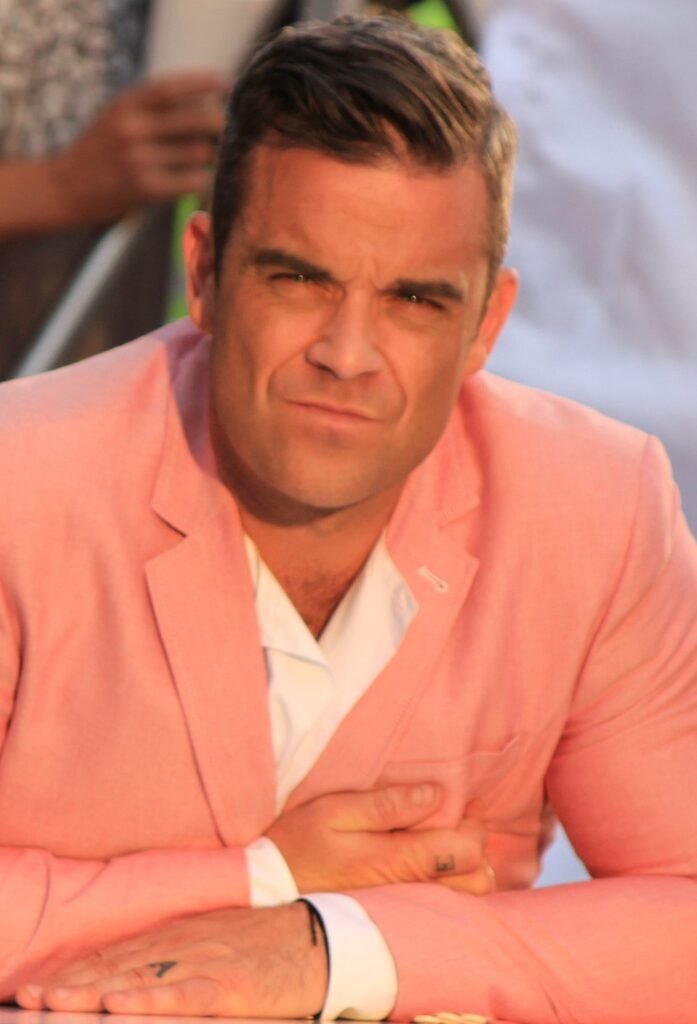
Robbie Williams is the Stoke-on-Trent singer who left the biggest boy band of the 1990s and became, by chart measures, the most successful solo album artist in the country’s history. Celebrity Net Worth puts his fortune at an estimated $300 million. This profile sets out the facts plainly — his age, height, wife, four children, parents, best-known songs and albums, and his property — in one scannable digest.
Now 52, Williams remains married to actress Ayda Field, his wife since 2010, and in January 2026 his album Britpop gave him a sixteenth number one album as a solo artist — more than any other act in chart history, passing a record held for a quarter of a century by The Beatles. He was still touring the record in November 2026, performing in Sydney on 14 November. The story below runs from a Stoke childhood to that record.
Angels Turns a Leaver into a Solo Star
1997 — Life Thru a Lens and Angels
Life Thru a Lens, released in September 1997 and written largely with Guy Chambers, started slowly — until its fourth single, Angels, released that December, turned the whole project around. Angels never topped the chart at the time, peaking at number four, but it became the defining ballad of its era, the album climbed to number one the following spring, and Williams had a career. Old Before I Die and Let Me Entertain You, from the same album, supplied the swagger either side of the ballad.
1998 — I’ve Been Expecting You and Millennium
I’ve Been Expecting You, released in 1998, was bigger still: Millennium gave him his first solo number one single, No Regrets and Strong followed it into the top five, and the album spent weeks at number one. In 1999 he played the biggest venues in the land and began an attempt on the United States market that never quite took — a footnote in a career that, at home and across Europe, Australia and Latin America, had no need of it.
2000 — Sing When You’re Winning and Rock DJ
Sing When You’re Winning, released in 2000, produced Rock DJ, a number one single whose provocative promotion confirmed his gift for controlled outrage, and stadium concerts followed — by 2003 he was playing to a quarter of a million people across three nights at Knebworth, a record for a solo act of his generation. Swing When You’re Winning, a big-band album released in 2001, spent seven weeks at number one and showed the entertainer his father had been, surfacing in the son.
2002 — Escapology and the EMI deal
Escapology, released in 2002, produced Feel and Come Undone and completed a run of five era-defining albums. The same year he signed a new contract with EMI reported at £80 million, then described as the largest deal in the country’s music history. That figure was the reported value of a multi-album contract, not a payment into his account and not his net worth — a distinction the money section in this profile keeps, because the deal’s headline number is still routinely misquoted as his fortune. In 2005 he set a world record by selling 1.6 million concert tickets in a single day for his 2006 world tour.
2009 — Reality Killed the Video Star and the Take That reunion
After the experimental Rudebox in 2006 divided opinion and a quieter period followed, Reality Killed the Video Star in 2009 restored him to number two with the single Bodies. In 2010 he rejoined Take That for the album Progress and a record-breaking stadium tour — the prodigal’s return, handled with a warmth that surprised everyone who remembered 1995. Solo success resumed with Take the Crown in 2012 and its number one single Candy, and Swings Both Ways in 2013.
2016 — The Heavy Entertainment Show and fatherhood years
The Heavy Entertainment Show, released in 2016, became his twelfth number one album, and The Christmas Present followed in 2019. These were the years in which his public persona changed most: open about addiction, anxiety and recovery in interviews, settled in family life, and funny about his own mythology in a way the younger Williams could not have managed. XXV, an orchestral reworking of his catalogue released in 2022, became his fourteenth number one album. Keeping concert fitness across three decades is its own discipline — readers building a low-impact routine around work can start with our guide to swimming for fitness twice a week, which sets out what two weekly sessions can realistically do.
2026 — Britpop and a record that stood for 25 years
Britpop, surprise-released on 16 January 2026, debuted at number one and gave Williams his sixteenth number one album as a solo artist — passing the record of fifteen held by The Beatles for a quarter of a century, as Guinness World Records confirmed on 29 January 2026. The album, made with collaborators including Tony Iommi and Chris Martin, was the record he said he had wanted to make in 1997. With eighteen BRIT Awards, he holds that record too. In November 2026 he was performing the album in Australia, talking between songs about his wife and children — the full arc, from Stoke to a chart record that may stand as long as the one he broke, completed in public.
Ayda Field and Four Children
Williams married the actress Ayda Field on 7 August 2010, at their home in Los Angeles, after a relationship that began in 2006 and an engagement announced in 2009. Field, who grew up in California, has worked alongside him publicly for years and is a familiar voice in his interviews and on his social channels; in January 2026 the couple were photographed celebrating his chart record together in Paris. The verified label is wife, correct and unbroken since 2010.
The couple have four children: Theodora, known as Teddy, born in September 2012; Charlton, known as Charlie, born in October 2014; Colette, known as Coco, born in September 2018; and Beau, born in February 2020. The two younger children were born with the help of a surrogate, a fact the couple shared openly at the time of each birth. Williams speaks about fatherhood with a candour that has become part of his act — in January 2026 he joked that four children were “four more than I ever thought I’d have” — and the family divide their time between London and their travels on tour.
His parents’ influence runs through the story in both directions: Peter’s years as a club comedian gave him the stagecraft and the patter, and Janet, who encouraged the 1990 audition and ran his fan club in the early solo years, gave him the push. He has been frank for decades about the addiction and mental-health problems that accompanied his fame, about long periods of sobriety, and about the damage the Take That split and the years after it did him. That frankness, once a liability in interviews, is now the quality audiences cite most — the entertainer who tells the truth about what the entertaining cost.
A Stoke Childhood Inside Show Business
Robert Peter Williams was born on 13 February 1974 in Stoke-on-Trent, Staffordshire, and raised in Tunstall, one of the city’s six towns. His father, Peter Williams, performed as a comedian under the stage name Pete Conway and later ran a pub and a social club; his mother, Janet Farrell, worked as a florist. His parents separated when he was young, and he grew up mainly with his mother, attending local schools and performing in school productions — Gilbert and Sullivan among them — with the confidence of a boy raised around pub entertainers.
At sixteen, working a job selling double glazing, he answered — at his mother’s prompting — an advertisement for the final place in a new pop group being assembled in Manchester. The audition, in 1990, won him the place. The group was Take That, and for five years Williams was its youngest, loudest and least containable member, singing lead on tracks such as Could It Be Magic while the group became the defining pop act of the first half of the decade.
The split, when it came in July 1995, was messy and public, and the year that followed — parties, weight gain, a legal fight over his contract that barred him from recording — made him a cautionary tale in the music press before he had released a note alone. The solo career that began in 1996 was therefore not a coronation but a rescue attempt, and everyone involved, Williams most of all, knew it.
$300 Million and a Record-Breaking Britpop
Celebrity Net Worth puts Williams’s fortune at an estimated $300 million. The Sunday Times Rich List, the other allowed source in this series, has listed him for many years among the wealthiest musicians in the country; its historical listings valued him at more than £130 million as long ago as 2009, and recent wealth-list coverage places him in the £220 million to £230 million range — the same order of magnitude as the Celebrity Net Worth figure once currencies are converted, and consistent with a fortune built over thirty years rather than a single payday. He has sold more than 75 million records worldwide, by Celebrity Net Worth’s count.
Two figures must be kept out of the total, as this series always keeps them. The 2002 EMI contract, reported at £80 million, was the headline value of a multi-album deal — a commitment spread over years and albums, not cash in hand. And his property transactions, though remarkable, are transactions: he bought an estate in Beverly Crest, Los Angeles, in 2015 for a reported $32 million and sold it in 2022 to the rapper Drake for a reported $75 million, and sold a further Los Angeles estate in Holmby Hills in 2024 for a reported $65 million. The gains inside those deals are real money and part of how the fortune grew, but the sale prices themselves are not his net worth and are never added to it here.
What he holds now is reported more quietly. The family’s London base is a Kensington property bought for a reported £17.5 million, once the home of the director Michael Winner, and the couple also hold an estate near Lake Geneva in Switzerland, reported when bought at about £24 million. No combined property valuation is published, and none is invented here; the honest summary is a fortune estimated at $300 million, held across music rights, investments and homes on two continents.
That is the digest: a double-glazing salesman from Tunstall who joined a boy band at sixteen, walked out at twenty-one, rescued himself with Angels, and at 52 passed The Beatles’ album record — with a wife of sixteen years, four children, eighteen BRIT Awards and an estimated $300 million fortune, still, by every account from the November 2026 concerts, determined to entertain.
Take That to Sixteen Number Ones
| Take That to Sixteen Number Ones | Details |
|---|---|
| Born | 13 February 1974, in Stoke-on-Trent, Staffordshire |
| Age | 52 years old |
| Height | 6 feet 1 inch (1.85 m) |
| Weight | No reliable published figure |
| Wife | Ayda Field, actress — married on 7 August 2010 |
| Children | Four — Theodora, Charlton, Colette and Beau |
| Parents | Peter Williams (father) and Janet Farrell (mother) |
| Family | Raised in Stoke-on-Trent and Tunstall; father of four; married since 2010 |
| Songs | Angels, Millennium, No Regrets, Rock DJ, Feel, Come Undone, Candy, Let Me Entertain You |
| Albums | Life Thru a Lens, I’ve Been Expecting You, Sing When You’re Winning, Swing When You’re Winning, Escapology, Take the Crown, XXV, Britpop |
| House | A Kensington property in London bought for a reported £17.5 million and an estate near Lake Geneva in Switzerland are both widely reported |
| @robbiewilliams — his official account | |
| Net Worth | Estimated $300 million (Celebrity Net Worth) |