
How Many Receptacles on a 15 Amp Circuit? Complete Answer
This is one of those questions that sounds simple and turns out to have a “it depends” answer that actually matters for your safety. If you’re adding outlets in a bedroom, wiring a home office, or trying to figure out why the breaker keeps tripping when the space heater and the hair dryer run at the same time, the number of receptacles is only half the story. The other half is what you plug into them.
Let’s get into what the code actually says, the maths behind it, and how to plan a circuit that won’t leave you in the dark.
What the Electrical Code Actually Says
Here’s the surprise: the US National Electrical Code (NEC) does not specify a maximum number of receptacles on a general-purpose residential 15-amp circuit. You could, in theory, wire twenty outlets on one circuit and pass inspection — as long as the wiring is correct. The code cares about wire size, breaker protection, and proper installation, not the outlet count.
That said, electricians follow a long-standing rule of thumb: 8 to 12 receptacles per 15-amp circuit in residential settings. This isn’t pulled from thin air — it comes from the commercial calculation method. NEC 220.14(I) assigns 180 volt-amps per receptacle yoke for load calculations. On a 15-amp, 120-volt circuit (1,800 volt-amps total), dividing by 180 gives you 10 receptacles. That’s where the familiar “about ten outlets” guidance comes from.
Canada’s electrical code is stricter and more explicit: a maximum of 12 receptacles on a 15-amp circuit. Many US electricians treat 12 as the practical ceiling too.
A note for UK readers: UK homes don’t use 15-amp general circuits at all. The UK standard is a 32-amp ring final circuit wired in 2.5mm² cable, protected under BS 7671. If you’re in the UK, this article’s maths doesn’t apply to your wiring — and any new circuit work is notifiable under Part P of the Building Regulations, so use a registered electrician. The load-planning principles below are still useful for understanding why circuits trip.
The 80% Rule: The Number That Actually Matters
Forget counting outlets for a moment. The rule that keeps your home safe is this: a circuit should not carry more than 80% of its rated capacity on a continuous load (defined as running for 3 hours or more). For a 15-amp circuit:
- Full rating: 15 amps × 120 volts = 1,800 watts
- Safe continuous load: 12 amps × 120 volts = 1,440 watts
So the real question isn’t “how many outlets?” but “how many watts are plugged in and running at once?” Ten outlets with phone chargers and lamps barely sip power. Two outlets running a 1,500-watt space heater and a 1,200-watt hair dryer will trip the breaker — and rightly so, because that’s 2,700 watts on a circuit safely rated for 1,440 continuous.
Doing the Maths for Your Circuit
Planning a new circuit or troubleshooting an overloaded one? Add up the wattage of everything likely to run simultaneously:
- List every device on the circuit and its wattage (check the label or manual).
- Add them up for a realistic worst case — not everything you own, but everything that runs at the same time.
- Keep the total under 1,440 watts for continuous loads, and under 1,800 watts absolute maximum.
Typical draws for reference: LED lamp 10W, phone charger 20W, laptop 65W, TV 100–200W, gaming PC 400–600W, microwave 1,000–1,200W, toaster 1,200W, hair dryer 1,500–1,800W, space heater 1,500W. Notice how quickly one heat-producing appliance eats the whole circuit — which is why kitchens, bathrooms, and workshops get dedicated 20-amp circuits by code.
If you’re also wondering what your biggest kitchen appliance pulls, see our guide to how many amps does a fridge use“>how many amps a fridge uses — it explains why fridges get their own circuit too.
Wire Size and Breaker Basics
A 15-amp circuit must be wired with 14 AWG copper wire (minimum) and protected by a 15-amp breaker. This is non-negotiable. The breaker exists to protect the wire, not your appliances — a 20-amp breaker on 14-gauge wire is a fire hazard because the wire can overheat before the breaker trips. When in doubt, electricians often run 12 AWG wire (rated for 20 amps) even on 15-amp circuits, which gives extra safety margin and makes future upgrades easy.
Lighting loads are barely worth counting by comparison — see how bright is 1000 lumens“>how bright 1000 lumens actually is for a sense of how little modern LEDs draw. Modern code also requires AFCI (arc-fault) protection in most living areas and GFCI (ground-fault) protection in kitchens, bathrooms, garages, and outdoors. If you’re extending a circuit in an older home, bringing the protection up to current standards is smart and often required by local code.
Safety: Non-Negotiable Rules
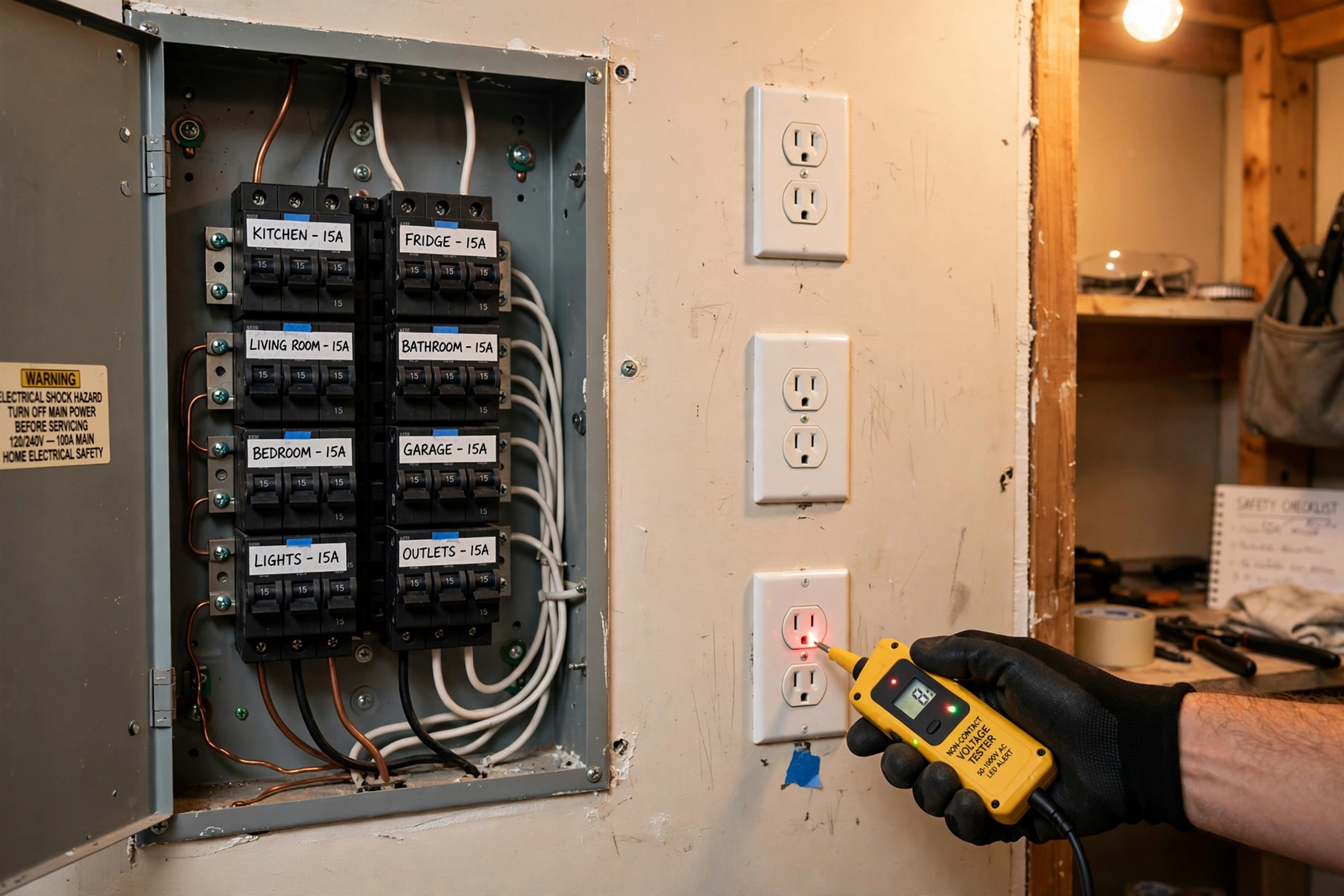
- Kill the power first. Switch off the breaker, then verify with a non-contact voltage tester at every box you’ll touch. Breakers can be mislabelled.
- Never work on a live circuit. “I’ll just be careful” is how people get hurt. There is no safe shortcut.
- Don’t daisy-chain power strips. One strip per receptacle, and never plug a space heater into a strip — plug it directly into the wall.
- Watch for warning signs: breakers that trip repeatedly, outlets that feel warm, buzzing sounds, or a burning smell. These mean stop and call an electrician — not reset the breaker again.
- Aluminium wiring (common in 1960s–70s US homes) needs special connectors and expertise. Don’t DIY pigtail it without proper training.
The National Fire Protection Association, which publishes the NEC, has excellent plain-language resources on home electrical safety, and the US Department of Energy offers guidance on safe home energy use.
Common Mistakes Homeowners Make
- Counting outlets instead of watts. Twelve outlets is fine if the loads are light; four outlets can be too many if they feed heaters.
- Ignoring continuous vs. intermittent loads. A 1,500W heater running all evening is a continuous load — it needs that 80% headroom. A toaster running for three minutes doesn’t.
- Extending circuits with undersized wire. Every foot of new wire must match the circuit’s gauge.
- Backstabbing receptacles. Pushing wires into the push-in holes on the back of cheap outlets is faster but far less reliable than wrapping them around the screw terminals. Pros use the screws.
- Mixing up the tab. On split-wired receptacles (common in kitchens), the metal tab between the hot screws must be broken. Forgetting this creates a dead short.
Frequently Asked Questions
Can I put 15 receptacles on a 15-amp circuit?
The NEC doesn’t forbid it for residential circuits, but it’s poor practice. Stick to 8–12 as a sensible maximum, and more importantly, keep the simultaneous load under 1,440 watts continuous. If you genuinely need more outlets in one area, run a second circuit rather than overloading one.
How many watts can a 15-amp circuit handle?
1,800 watts absolute maximum (15A × 120V), but only 1,440 watts for continuous loads of 3+ hours, per the 80% rule. Treat 1,440W as your real-world limit when planning.
Why does my breaker trip when I run two appliances?
Almost always, the combined wattage exceeds the breaker’s rating. Two 1,500W heat-producing appliances on one 15-amp circuit is 3,000W against an 1,800W maximum — the breaker is doing its job. Move one appliance to a different circuit, or have an electrician add a dedicated circuit.
Should a fridge or microwave share a 15-amp circuit?
No. The NEC requires dedicated circuits for major kitchen appliances. A fridge should be on its own 15- or 20-amp circuit, and microwaves need a dedicated 20-amp circuit. Sharing them with general receptacles is how you get nuisance tripping and, worse, a fridge that silently loses power.
Can I replace a 15-amp breaker with a 20-amp breaker to stop tripping?
Absolutely not — unless the entire circuit is wired with 12 AWG or larger wire. Upsizing the breaker without upsizing the wire removes the protection the wire depends on and creates a genuine fire risk. If a 15-amp circuit can’t handle your loads, the answer is a new circuit, not a bigger breaker.
Do LED lights count against the receptacle limit?
Lighting is usually on separate circuits from receptacles in modern wiring, so they don’t count toward outlet totals. Even so, LEDs draw so little (often under 10W each) that a whole house of LED lighting barely registers against circuit capacity.
One thought on “How Many Receptacles on a 15 Amp Circuit? Complete Answer”