
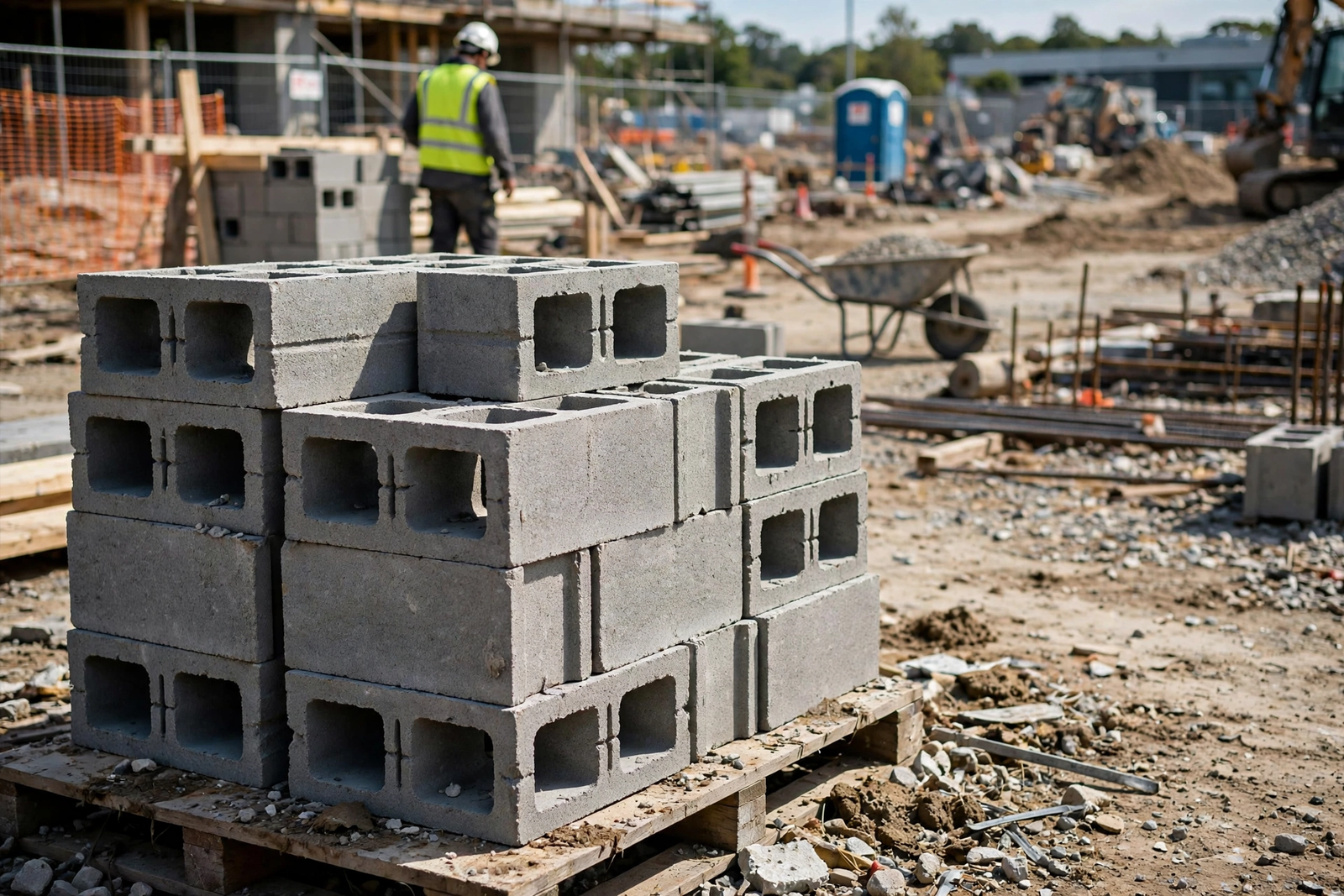
How Much Does a Concrete Block Weigh? (28-35 lb)
Whether you’re building a garden wall, planning a delivery, or calculating foundation loads, concrete block weight affects everything from labour to transport costs. Here’s what the different types weigh and why it matters.
Standard Concrete Block Weights
The most common block — the 8×8×16 inch hollow concrete masonry unit (CMU) — weighs:
- Standard weight block: 28–35 lb (12.7–15.9 kg)
- Medium weight block: 24–28 lb
- Lightweight block: 22–28 lb (made with expanded shale or pumice aggregate)
- Solid block (same size): 45–55 lb
Weight varies by manufacturer, moisture content, and aggregate type. A freshly made “green” block can weigh several pounds more than a cured one. The National Concrete Masonry Association publishes technical standards for CMU specifications.
Other Common Block Sizes
- 4×8×16 (half block): 14–18 lb
- 6×8×16: 22–28 lb
- 12×8×16: 40–50 lb
- Cap block (2×8×16): 10–14 lb
Why Block Weight Matters
Manual Handling
At 30+ lb each, standard blocks are a genuine workout. UK manual handling guidance suggests 25 kg as a maximum for occasional lifts by fit adults — a standard block sits comfortably under that, but laying hundreds in a day is exhausting and risks back injury. Professional bricklayers pace themselves and use proper lifting technique. Take breaks, keep blocks close to your body, and consider lightweight blocks for DIY projects.
Delivery and Transport
Blocks are sold by the pallet — typically 90–120 blocks per pallet. That’s 2,500–4,200 lb per pallet, requiring a flatbed or crane-offload lorry. Delivery charges often depend on weight and access. For a garden wall needing 200 blocks, you’re looking at roughly 3 tonnes of material — plan vehicle access accordingly.
Structural Loading
Engineers calculate wall loads from block weight plus mortar. A single-wythe 8-inch block wall weighs about 55 lb per square foot of wall face. Foundations must be designed for this dead load plus anything the wall supports. This is why foundation depth matters so much — the ground must bear the cumulative weight.
Lightweight vs Standard Blocks
Lightweight blocks use expanded clay, shale, or pumice as aggregate instead of sand and gravel:
- Pros: easier to handle, better insulation, lower transport costs, less foundation load
- Cons: slightly lower strength, more expensive per unit, can be harder to cut cleanly
For most DIY garden walls and sheds, lightweight blocks are the friendlier choice. For structural work, retaining walls, or anything load-bearing, standard-weight blocks (or engineer-specified units) are the norm. The UK Health and Safety Executive provides guidance on manual handling in construction.
How Many Blocks Do You Need?
For an 8×8×16 block wall, allow roughly 112 blocks per 100 square feet of wall (including ~5% waste for cuts and breakages). So a garden wall 10 feet long and 4 feet high (40 sq ft) needs about 45 blocks — weighing roughly 1,400 lb total. Always order a few extra; running short mid-project is far more expensive than having spares.
Types of Concrete Blocks Compared
- Standard hollow CMU: 28–35 lb. The workhorse — good strength, economical, widely available. Two hollow cores reduce weight while maintaining structural capacity.
- Lightweight CMU: 22–28 lb. Made with expanded aggregate. Better thermal insulation, easier handling. Slightly lower compressive strength.
- Solid CMU: 45–55 lb. Used where maximum strength or sound insulation is needed — lintel courses, piers, high-load walls.
- Split-face block: 30–38 lb. Decorative fractured face for architectural walls. Same structural properties as standard.
- Retaining wall block: 25–80 lb depending on system. Interlocking designs for gravity retaining walls; heavier units for taller walls.
Don’t Forget the Mortar
Block weight is only part of the story. Mortar adds roughly 7–10 lb per block in a standard wall — about 20–25% extra. A wall of 100 blocks at 32 lb each (3,200 lb) becomes ~4,000 lb once mortared. Engineers always include mortar in dead-load calculations.
An 80 lb bag of pre-mixed mortar covers about 12–15 standard blocks. For our 200-block garden wall example, that’s 14–17 bags — another 1,200+ lb of material to get delivered. Always factor mortar into delivery planning and foundation design.
Building Regulations for Block Walls
In the UK, garden walls over 1 metre high next to a road (or 2 metres elsewhere) generally need planning permission. Structural walls — house extensions, retaining walls holding back significant soil — need Building Regulations approval and usually an engineer’s design.
Key rules of thumb:
- Garden walls under 1m: usually permitted development, DIY-friendly
- Retaining walls: get professional advice — soil pressure is deceptive and failures are dangerous
- Foundations: typically 150–300mm of concrete, twice the wall width, below frost line
- Damp-proof course: required where walls meet buildings
The UK government’s approved building documents set out the technical requirements. When in doubt, a structural engineer consultation (£300–£500) is cheap insurance against a wall that leans, cracks, or collapses.
Cutting Blocks: What to Expect
You’ll inevitably need to cut blocks for corners and openings. A bolster chisel and lump hammer work for rough cuts; an angle grinder with a diamond blade gives clean results (wear a dust mask — concrete dust is a lung hazard). Score deeply on all four sides before striking. Lightweight blocks cut more easily than dense standard units, which is another point in their favour for DIY.
How Blocks Are Made
Understanding manufacture explains the weight variations. CMUs are made by mixing Portland cement, water, and aggregate (sand, gravel, or lightweight expanded materials), then compacting the mix in steel moulds under vibration. The “green” blocks cure for 24–48 hours before shipping, continuing to gain strength for 28 days.
Moisture content at purchase affects weight noticeably — a block stored outdoors in rain can weigh 2–3 lb more than a kiln-dried one. It dries out after laying, but if you’re calculating crane loads or delivery weights, assume the heavier figure.
Recycled and Sustainable Options
The concrete industry is cleaning up its act. Many manufacturers now offer blocks with recycled aggregate (crushed demolition concrete) or supplementary cementitious materials like fly ash and slag, which reduce the carbon footprint significantly. These perform identically to conventional blocks and weigh about the same.
For garden projects, reclaimed blocks from demolition yards are cheaper and greener — just check they’re sound (no cracks, not crumbling) and consistent in size. A reclaimed standard block weighs the same 28–35 lb as a new one.
Related: brick weight guide.
Frequently Asked Questions
How much does a standard cinder block weigh?
28–35 lb for a hollow 8×8×16 block. “Cinder block” technically refers to older blocks made with coal cinders; modern CMUs use concrete aggregate.
How much does a pallet of blocks weigh?
Typically 2,500–4,200 lb depending on block type and count per pallet.
What’s the difference between concrete block and cinder block?
True cinder blocks (made with coal ash) are lighter and weaker; they’re largely obsolete. Modern “cinder blocks” are actually concrete masonry units.
Can I lay blocks myself?
Yes for non-structural garden walls. For anything load-bearing or over 1 metre high, consult building regulations and consider a professional.
How heavy is a solid concrete block?
A solid 8×8×16 block weighs 45–55 lb — nearly double a hollow one.
Do concrete blocks absorb water?
Yes — they can absorb several pounds of water when saturated, which matters for weight calculations and frost resistance.
One thought on “How Much Does a Concrete Block Weigh? (28-35 lb)”