
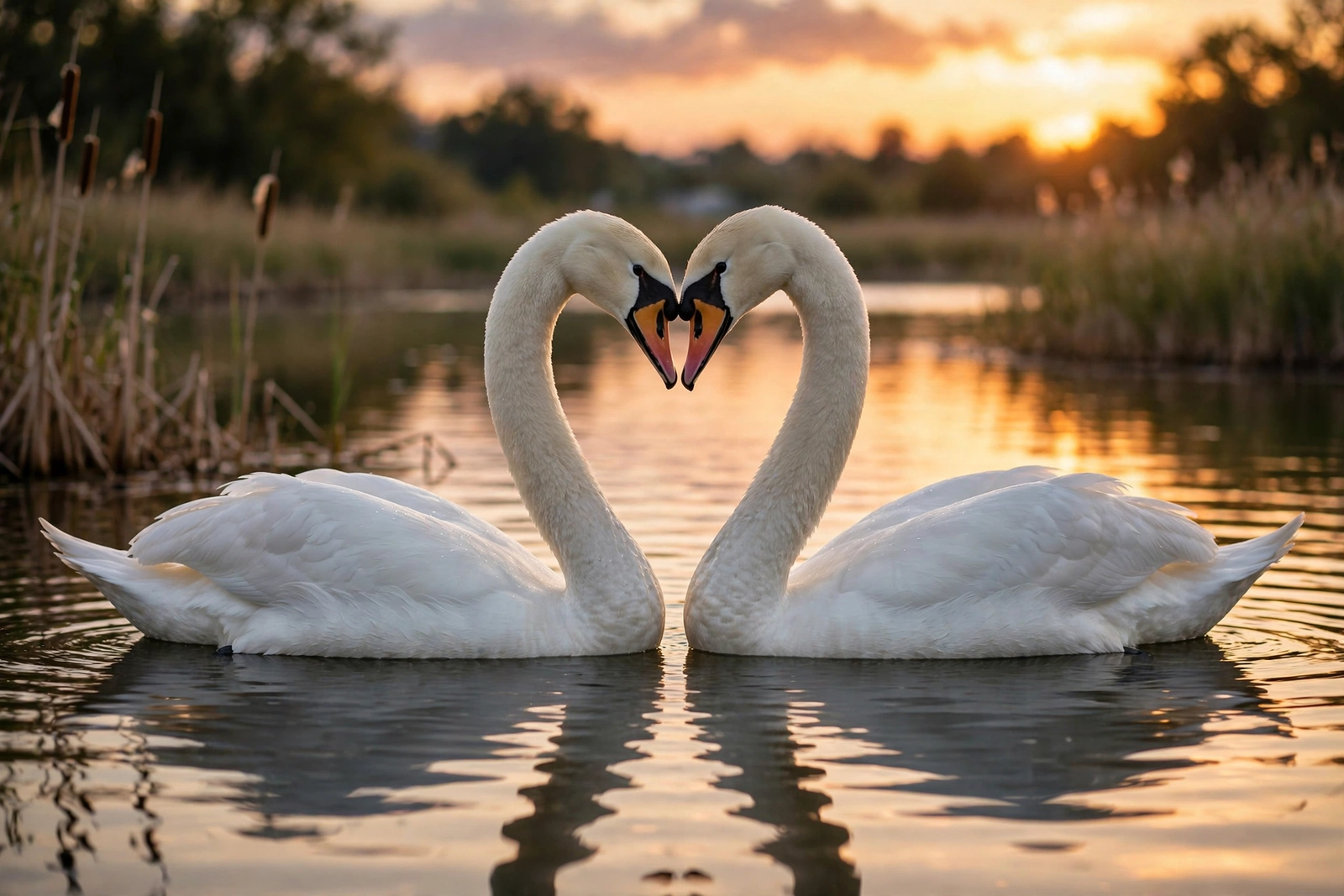
How do Birds Mate? The Cloacal Kiss Explained
Bird reproduction is one of nature’s most fascinating workarounds. Unlike mammals, the vast majority of birds have no external genitalia at all — yet they reproduce with remarkable efficiency. Here’s how it actually works, from courtship to fertilisation.
The Cloacal Kiss: How Most Birds Mate
Both male and female birds have a cloaca — a single opening used for excretion and reproduction. During mating, the male mounts the female’s back, she lifts her tail feathers to expose her cloaca, and he presses his against hers. The whole act typically lasts just a few seconds.
Sperm is transferred from male to female during this brief contact, then travels up the oviduct to fertilise eggs. It sounds improbable, but it’s extraordinarily effective — birds have been doing it this way for over 150 million years. The RSPB’s bird wildlife guides describe breeding behaviours across hundreds of species.
The 3% Exception: Birds With Penises
About 3% of bird species do have external reproductive organs, including:
- Ducks, geese, and swans — waterfowl have corkscrew-shaped penises
- Ostriches, emus, and rheas — large flightless birds (ratites)
- Tinamous — South American ground birds
Evolutionary biologists believe the ancestors of all birds had penises, but most lineages lost them — possibly because a quick cloacal kiss reduces the time birds are vulnerable to predators during mating. Waterfowl retained theirs, likely because mating on water makes the cloacal kiss mechanically difficult.
Courtship: The Dance Before the Kiss
Mating itself is brief, but courtship can be elaborate and prolonged:
- Song: Male songbirds sing complex songs to attract females and warn off rivals — a female can judge a male’s health and fitness from his song
- Displays: Birds of paradise perform extraordinary dances; peacocks fan iridescent tails; grebes perform synchronised “rushing” ceremonies on water
- Gifts: Male terns present fish to females; bowerbirds build and decorate elaborate structures with coloured objects
- Mutual preening: Many bonded pairs groom each other’s head feathers, strengthening the pair bond
These rituals aren’t just for show — they’re honest signals. A male who can afford the energy for spectacular displays, or who holds a prime territory, is advertising good genes. Females choose accordingly, which is why sexual selection has produced such extravagant plumage. For more on avian behaviour, the British Trust for Ornithology conducts long-running studies on UK breeding birds.
From Mating to Egg-Laying
After successful mating, the female’s ovary releases an ovum into the oviduct, where fertilisation occurs. The egg then takes about 24 hours to form fully — gaining albumen (egg white), membranes, and the hard calcium shell — before being laid.
Females can store sperm for days or even weeks, meaning a single mating can fertilise an entire clutch of eggs. Ducks can store viable sperm for over two weeks; some seabirds for even longer. This is enormously useful for species where mating opportunities are brief.
How Many Times Do Birds Mate?
It varies enormously. Some species mate once per breeding season and stay monogamous for life (swans, albatrosses, many eagles). Others mate dozens of times daily during the breeding season (sparrows, dunnocks). Polygynous species like pheasants see males mating with multiple females while females mate once.
Monogamy, Polygamy, and Everything Between
- Monogamous (~90% of birds): Most songbirds, raptors, and seabirds form pair bonds, often for life. Both parents typically raise the young.
- Polygynous: One male with multiple females — common in pheasants, grouse, and some wrens.
- Polyandrous: One female with multiple males — rare, seen in jacanas and phalaropes, where males do all the incubating.
- Promiscuous: No lasting bonds — dunnocks and some shorebirds mate with multiple partners.
Even “monogamous” species aren’t always faithful — DNA studies reveal that 10–40% of chicks in many songbird nests are fathered by males other than the female’s partner. Extra-pair mating is one of ornithology’s most entertaining discoveries. If you enjoy observing these behaviours firsthand, our guide to choosing garden bird feeders will help attract breeding birds to your garden.
Mating in Common Garden Birds
You can observe all of this in your own garden each spring:
- Robins: Males sing from high perches from January onwards; pairs form by March. The male feeds the female as part of courtship — if she accepts food, the bond is forming.
- Blackbirds: Males perform “beak-wiping” displays and chase rivals. Pairs often stay together for the season, sometimes for life.
- Blue tits: Females inspect nest boxes while males sing nearby. Extra-pair mating is common — up to 40% of chicks may have a different father.
- Doves and pigeons: Famous for billing and cooing — the male puffs his chest, bows, and coos while circling the female.
- Sparrows: Males display their black bibs; the bigger the bib, the more attractive. House sparrows mate frequently through the season.
Spring is the best time to watch. A pair of binoculars and a quiet spot near a feeder will reveal behaviours most people never notice. The Woodland Trust’s bird guides help identify what’s happening in your garden month by month.
What Happens When Mating Fails?
Not every mating succeeds. Young, inexperienced birds often fumble the cloacal kiss — timing and positioning take practice. Unfertilised eggs are simply laid and abandoned (or eaten by predators). Females of many species will re-mate quickly if the first attempt fails.
In captive breeding programmes for endangered species, keepers sometimes assist with artificial insemination — famously used for California condors and kakapo. In the wild, though, the system works: a healthy pair of small songbirds can raise two or three broods per season, each of 4–8 chicks.
The Evolutionary Logic
Why did 97% of birds lose the penis? The leading theory involves speed and safety. A cloacal kiss takes seconds; prolonged copulation would leave birds exposed to predators. There’s also a female-choice angle: without intromission, females retain more control over fertilisation, and males can’t force mating as easily — which may explain why forced copulation is rare in most bird species (ducks being a notorious exception).
Whatever the reason, it’s worked spectacularly: birds are among the most successful vertebrates on Earth, with over 11,000 species on every continent including Antarctica.
Related: fish reproduction methods.
Frequently Asked Questions
How do birds mate without penises?
Through the “cloacal kiss” — brief contact between the male’s and female’s cloacas transfers sperm in seconds.
How long does bird mating take?
The physical act usually lasts just a few seconds, though courtship rituals can go on for days or weeks.
Do birds mate for life?
Many do — swans, albatrosses, eagles, and most seabirds form lifelong pair bonds. But most small songbirds re-pair each season.
Which birds have penises?
Ducks, geese, swans, ostriches, emus, and tinamous — about 3% of species.
Can female birds lay eggs without mating?
Yes, but the eggs will be unfertilised and won’t hatch — like the eggs hens lay daily.
How soon after mating are eggs laid?
Usually within 24–48 hours for the first egg, with one egg laid per day until the clutch is complete.