
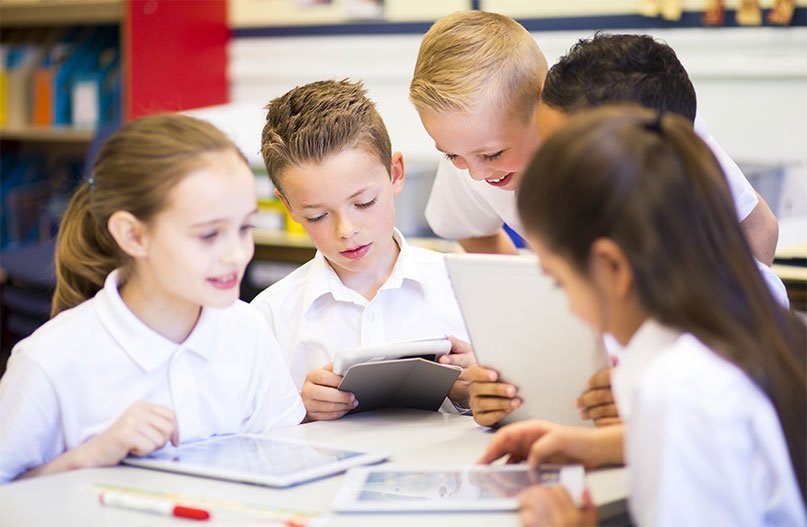
What Should Children Learn About AI at School?
Today’s primary school children will graduate into a world shaped by AI in ways we can barely imagine. The curriculum hasn’t fully caught up — which leaves parents, teachers, and policymakers asking: what should children learn about AI at school? Not coding neural networks at age eight, but something more fundamental: the understanding and critical skills to live well alongside intelligent machines. Here’s what a sensible AI education looks like, age by age.
The Foundation: AI Literacy for Everyone
Before specifics, the principle: AI literacy is becoming as fundamental as digital literacy. Every child needs a working understanding of what AI is, what it can and can’t do, and how it affects their life — regardless of whether they ever work in tech. This isn’t a specialist subject; it’s citizenship. The children who understand AI will navigate it deliberately; those who don’t will be shaped by it passively.
Primary School (Ages 5–11): Concepts Through Play
Young children don’t need technical detail — they need accurate mental models:
- What AI is (and isn’t). AI isn’t a person, doesn’t have feelings, and isn’t magic — it’s a tool made by people that finds patterns in data. Correcting the “robot friend” misconception early matters enormously.
- How it learns from data. Simple activities: train a basic image classifier on drawings, see how more examples improve it. The concept “AI learns from examples, and bad examples teach bad lessons” is graspable at this age.
- AI is already around them. Voice assistants, recommendation feeds, game opponents — help children notice the AI in their daily lives. Our tour of everyday AI is a good parent-child read.
- Asking good questions. The seed of prompting skill — learning to ask clear, specific questions — is valuable far beyond AI.
- Creative exploration. Supervised, age-appropriate creative play with AI tools — generating stories, illustrating ideas — builds comfort and intuition.
Secondary School (Ages 11–16): Critical Understanding
As children encounter AI independently, education must get serious:
- How AI makes decisions — and its limits. Understanding that AI predicts rather than knows, and why that means it can be confidently wrong. The concept of AI hallucinations, taught simply, is eye-opening for teenagers.
- Bias and fairness. AI trained on biased data produces biased outcomes — in hiring, policing, lending. This connects powerfully to PSHE and citizenship themes teenagers already care about.
- Media literacy for the AI age. Deepfakes, AI-generated misinformation, manipulated images — the detection skills in our parents’ guide to spotting fake news belong in the classroom too.
- Data and privacy. What data AI systems collect, how it’s used, and what rights they have. Practical: reviewing app permissions, understanding terms of service basics.
- Academic integrity. Clear, nuanced teaching on acceptable vs. unacceptable AI use in schoolwork — not just “don’t cheat” but why the distinction matters for their learning. (See also how teachers detect AI-written essays.)
- Careers awareness. Honest discussion of how AI is changing work — which our analysis of AI-proof careers supports — so subject choices are informed, not fearful.
Sixth Form and Beyond (16+): Depth and Agency
- Technical foundations for those interested — how machine learning actually works, basic data science, the maths behind the magic.
- Ethics and governance. Who decides how AI is used? What regulation exists? How do societies balance innovation and safety? Genuine philosophical and political questions for young adults.
- AI as a professional tool. Using AI effectively and responsibly in their field of interest — the skill employers will expect.
- Creating with AI. Moving from consumers to creators — building things with AI tools, understanding the creative and commercial possibilities.
What Parents Can Do Now
Don’t wait for the curriculum:
- Talk about AI at home. When you encounter it — a recommendation, a chatbot, a news story — narrate your thinking aloud.
- Explore together. Try AI tools with your children, discussing what’s impressive and what’s unreliable.
- Model critical habits. Verify before sharing; question sensational content; discuss privacy choices openly.
- Ask the school. What is your child’s school teaching about AI? The question itself pushes the agenda forward.
The UK government’s guidance on AI in education is evolving — the Department for Education publishes resources for schools, and organisations like the BBC Bitesize increasingly cover AI topics for young learners.
Resources for Parents Right Now
You don’t need to wait for curriculum reform. Start with conversation: the dinner-table discussions about AI encounters cost nothing and matter most. Then explore together — try an image generator with your child and discuss what’s impressive and what’s wrong; ask a chatbot a question you know the answer to and spot its mistakes together. These shared experiences build intuition that lectures can’t.
For structured learning, several excellent free resources exist. The Raspberry Pi Foundation offers free AI and computing projects for young people. Google’s Teachable Machine lets children train a simple image classifier in minutes — the single best 15-minute demonstration of “AI learns from data” available. BBC Bitesize covers AI topics for various ages, and organisations like Common Sense Media provide family guides to AI tools and media literacy.
A note on the coding debate: there’s a fashion for suggesting children don’t need to learn programming “because AI writes code now.” This misses the point. The value of learning to code was never primarily about producing code — it’s about structured thinking, debugging, and understanding how digital systems work. Those matter more in the AI age, not less. AI literacy and computational thinking are complements, not substitutes. The children who’ll thrive aren’t those who avoided the hard subjects because AI exists — they’re those who learned to think clearly and direct AI powerfully.
The Bottom Line
Children should learn AI literacy as a core life skill: young children need accurate mental models (AI is a pattern-finding tool, not a person); secondary students need critical understanding (limits, bias, misinformation, privacy, integrity); older students need depth, ethics, and professional fluency. The goal isn’t producing AI engineers — it’s raising citizens who understand the most transformative technology of their lifetime well enough to use it wisely, question it confidently, and shape how it’s governed. That education starts at home as much as at school.