
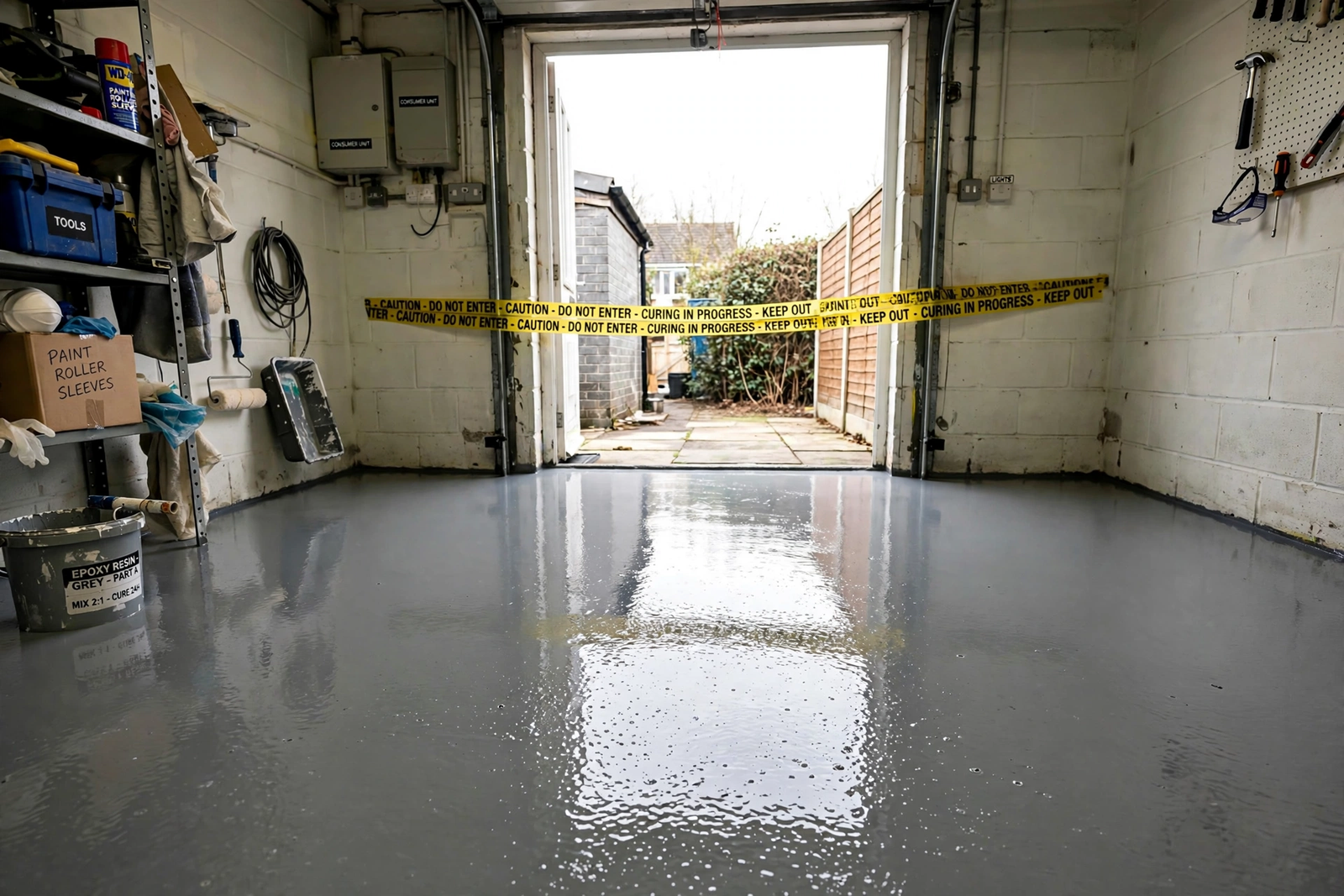
How Long does It Take for Epoxy to Dry? Complete Answer
Epoxy’s curing timeline catches more DIYers out than any other part of the job. The floor looks done after a day, feels hard after two — and then someone parks on it, drags a toolbox across it, or spills brake fluid on day three, and the damage is permanent. Understanding exactly what happens during those 7 days is the difference between a floor that lasts 15 years and one that fails in 15 months.
The Curing Stages Explained
Epoxy does not “dry” — it cures through a chemical reaction between resin and hardener (polymerisation). This happens in distinct stages:
- Pot life (30–60 min): working time after mixing. The clock starts the moment resin meets hardener.
- Tack-free (6–10 hours at 20°C): surface no longer sticky to a light touch. Still extremely vulnerable.
- Light foot traffic (24 hours): careful walking in clean, soft-soled shoes. No dragging, no furniture.
- Full foot traffic (48–72 hours): normal walking; still no vehicles or heavy point loads.
- Vehicle traffic (5–7 days): cars can park. Hot tyres are the ultimate test — they soften partially-cured epoxy and lift it. Budgeting the project? See epoxy garage floor costs.
- Full chemical cure (7 days): maximum hardness, chemical resistance and adhesion achieved.
These times assume ~20°C and moderate humidity. Every 10°C drop roughly doubles curing time — at 10°C, that 7-day cure becomes two weeks. Below 5°C, most standard epoxies effectively stop curing.
Cure Times by Product Type
- 100% solids epoxy: 24 hrs foot traffic, 5–7 days full cure. The toughest finish, slowest to fully harden.
- Water-based epoxy: 24 hrs foot traffic, 5–7 days full cure; thinner film, slightly less chemical resistance.
- Solvent-based epoxy: similar to 100% solids; strong fumes during cure — ventilate well.
- Polyaspartic topcoat: foot traffic in 4–6 hours, vehicles next day, full cure 48–72 hours. The speed champion — which is why pros love it for one-day garage makeovers.
- Epoxy mortar / screed: thicker sections cure through more slowly; allow the full 7 days before heavy loading.
What Affects Curing Time?
Temperature — the big one
Temperature dominates everything. A garage floor coated in a British October (12°C) cures dramatically slower than the same floor in July (22°C). If you must coat in cool weather, warm the space for 48 hours before and 7 days after application — space heaters work, but keep them away from fumes and never point them directly at the wet surface.
Humidity
High humidity slightly slows epoxy cure and can cause amine blush — a waxy, greasy film on the surface that prevents subsequent coats bonding. If blush appears, wash with warm water and detergent, rinse, let dry, then recoat. Low humidity is ideal.
Film thickness
Thicker coats cure slower through their depth and generate more exothermic heat — which in extreme cases (deep pours) can cause yellowing or cracking. Follow the manufacturer’s coverage rates; “a bit extra for luck” backfires with epoxy.
Mix ratio accuracy
Wrong ratios do not just slow curing — they prevent it. Too little hardener leaves permanently soft, tacky patches; too much makes a brittle, chalky film. Measure by weight with digital scales for small kits, or use the full pre-measured packs as supplied. Never split a two-pack kit unless you can measure both parts precisely. The slab underneath matters — see cement drying times for new concrete.
Airflow
Gentle ventilation carries away solvents and moisture, aiding cure. But strong draughts across the wet surface cause rippling and dust contamination. Ventilate the room, not the floor.
How to Tell It Is Cured
- Fingernail test: a firm thumbnail press should leave no mark on a cured floor. If it dents, wait longer.
- Solvent wipe: dab a cloth with methylated spirits on an inconspicuous spot — if colour transfers or the surface softens, it is not fully cured.
- Smell: strong solvent/ammonia odour means curing is still active; a faint smell is normal for several days.
- Temperature: curing epoxy generates slight warmth; a floor at ambient temperature has likely finished its exothermic phase.
The Critical First Week: Rules
- 24 hours: socks or soft clean shoes only. No furniture, no tools, no pets with claws.
- 48–72 hours: normal foot traffic; still no dragging, no ladders with sharp feet, no heavy point loads.
- 5–7 days: vehicles OK. Place cardboard or mats under tyres for the first fortnight if you want to be cautious — hot tyre pickup is the classic early failure.
- 7 days+: full service — oil, brake fluid, solvents. Wipe spills reasonably promptly anyway; cured epoxy resists chemicals but is not invincible.
- Keep it clean: grit underfoot during the first week grinds into the soft surface. Sweep before walking on it.
- Warm the space to 20–25°C before and during cure — the single most effective step.
- Choose fast-cure formulations — many manufacturers offer winter/fast hardeners for cool conditions.
- Use a polyaspartic topcoat — cures in hours rather than days for the final layer.
- Dehumidify damp garages to around 50% RH.
Speeding Up Curing (Safely)
What not to do: blast with fan heaters (skins the surface, traps uncured material beneath), add extra hardener (“more” does not mean “faster” — it means “ruined”), or coat below the product’s minimum temperature hoping for the best.
Recoat Windows: Timing Matters
Multi-coat systems have a recoat window — typically 12–24 hours at 20°C. Recoat within the window and the layers chemically bond. Miss it (beyond 48–72 hours) and you must abrade the surface before the next coat, or it may delaminate. Read the data sheet before starting day one, and plan your coats so you hit every window — this is where DIY schedules most often go wrong.
Troubleshooting Cure Problems
Still tacky after 48 hours
Causes: cold temperatures, wrong mix ratio, or high humidity. Warm the space and wait — mild cases recover. If still tacky after a week at 20°C, the mix was wrong and the coating must come off.
Soft spots
Incomplete mixing — resin-rich and hardener-rich zones. Prevention (thorough 3-minute mix, scraping sides) beats cure; affected areas usually need removal and recoating.
Bubbles / pinholes
Air escaping from porous concrete during cure, worse in warm conditions (outgassing). Prevent with a proper primer/sealer coat; fix by sanding and recoating.
Amine blush
Waxy film from humidity during cure. Wash off with warm water and detergent before recoating — never coat over it.
For product-specific cure schedules, check the data sheets from suppliers like Resincoat, and Screwfix’s resin flooring range lists working times and coverage rates for each kit.
Frequently Asked Questions
How long does epoxy take to dry?
Touch-dry in 6–10 hours, foot traffic at 24 hours, vehicles at 5–7 days, full chemical cure at 7 days (all at ~20°C). Cold weather extends every stage.
Can I walk on epoxy after 24 hours?
Carefully, in clean soft shoes — yes. But no furniture, dragging or heavy loads until 48–72 hours, and no vehicles until day 5–7.
Why is my epoxy still sticky after 3 days?
Almost certainly temperature (too cold) or mix ratio error. Warm to 20°C+ and wait; if no improvement in a week, strip and redo.
Does epoxy dry faster in heat?
Yes — warmth accelerates cure, but direct heat on the wet surface causes skinning, bubbles and uneven cure. Warm the room, not the floor.
When can I park my car on a new epoxy floor?
5–7 days minimum at normal temperatures. Hot tyres on partially cured epoxy cause tyre pickup — the coating lifts in tyre-shaped patches.
How do I speed up epoxy curing in winter?
Heat the space to 20°C+ for 48 hours before and 7 days after application, use a fast/winter hardener if available, and consider a polyaspartic topcoat for the final layer.