
How Long does It Take for Cement to Dry? Complete Answer
Ask any builder “how long does cement take to dry?” and the first thing they will tell you is that “dry” is the wrong word. What looks and feels dry on the surface can still be chemically active underneath — and treating it as finished too early is one of the most common causes of DIY failures, from cracked screeds to blown render.
Drying vs Curing: The Crucial Difference
Two processes happen when cement hardens. Drying is the evaporation of excess water from the surface. Curing (hydration) is the chemical reaction in which water bonds with cement particles, forming the crystal structure that gives concrete its strength.
Here is the part most DIY guides skip: curing needs water. If the surface dries out too quickly — hot sun, strong wind, fan heaters — hydration stops prematurely and you get a weak, dusty surface over a compromised core. That is why the Portland Cement Association recommends keeping fresh concrete moist for the first week rather than letting it bake dry.
So the goal is controlled moisture loss: firm surface, but enough internal moisture for hydration to complete. Covering fresh work with polythene sheeting is the simplest DIY way to achieve this.
How Long for Each Type of Work
Concrete slabs and foundations
- 24 hours: light foot traffic only, tread carefully
- 3 days: roughly half of design strength
- 7 days: around 70% strength — shed bases and light structures can go on
- 28 days: full design strength — driveways can take cars
Mortar and pointing
Mortar joints firm up in 24–48 hours and can be brushed and finished in that window. Substantial strength develops over 7 days, with full cure at 28 days. Fresh pointing is extremely vulnerable to frost and driving rain in its first two days — always check the forecast before starting.
Sand and cement render
The rule of thumb is one day per millimetre of thickness. A standard 15–20 mm two-coat render needs an absolute minimum of two to three weeks before painting, and longer in a damp British autumn. Paint too early and trapped moisture blisters the paint within months. Use breathable masonry paint for the first decoration.
Floor screeds
Traditional sand/cement screed dries at roughly 1 mm per day up to 40 mm, then more slowly. A 50 mm screed commonly needs two to three months before moisture-sensitive coverings like engineered wood or vinyl can go down. Never guess with screeds — a failed floor costs far more than a moisture test. Anhydrite (liquid) screeds are faster but need the surface laitance sanded off and a compatible primer before tiling. If you plan to coat the slab afterwards, see how much epoxy garage flooring costs.
Factors That Change the Timescale
Temperature
Below 5°C, hydration slows to a crawl; near freezing it stops. Winter work in the UK needs frost-proofer additives and insulated blankets over fresh work for at least 48 hours. Never place concrete on frozen ground. Frost-damaged mortar has a tell-tale crumbly, biscuit-like texture and must be removed and redone — there is no repair.
Airflow and humidity
Still, damp air slows drying; excessive heat and draughts cause surface shrinkage cracks. Gentle, steady ventilation is the sweet spot. A screed in a sealed-up room in November can take twice the textbook time.
Water content and thickness
Wetter mixes dry slower and finish weaker — use the least water that still gives workability. Thick sections cure from the outside in, so judge by depth, not by how the surface feels.
Cement type
Rapid-setting cement can take light loads within hours but is unforgiving to mix and place — only mix what you can use in 20 minutes. Sulfate-resisting cement, used in aggressive ground conditions, gains early strength more slowly. Masonry cement (with built-in plasticiser) is easier to lay but slightly lower in strength.
How the Professionals Cure Concrete
On commercial jobs, curing is a specified operation. The standard methods translate well to DIY:
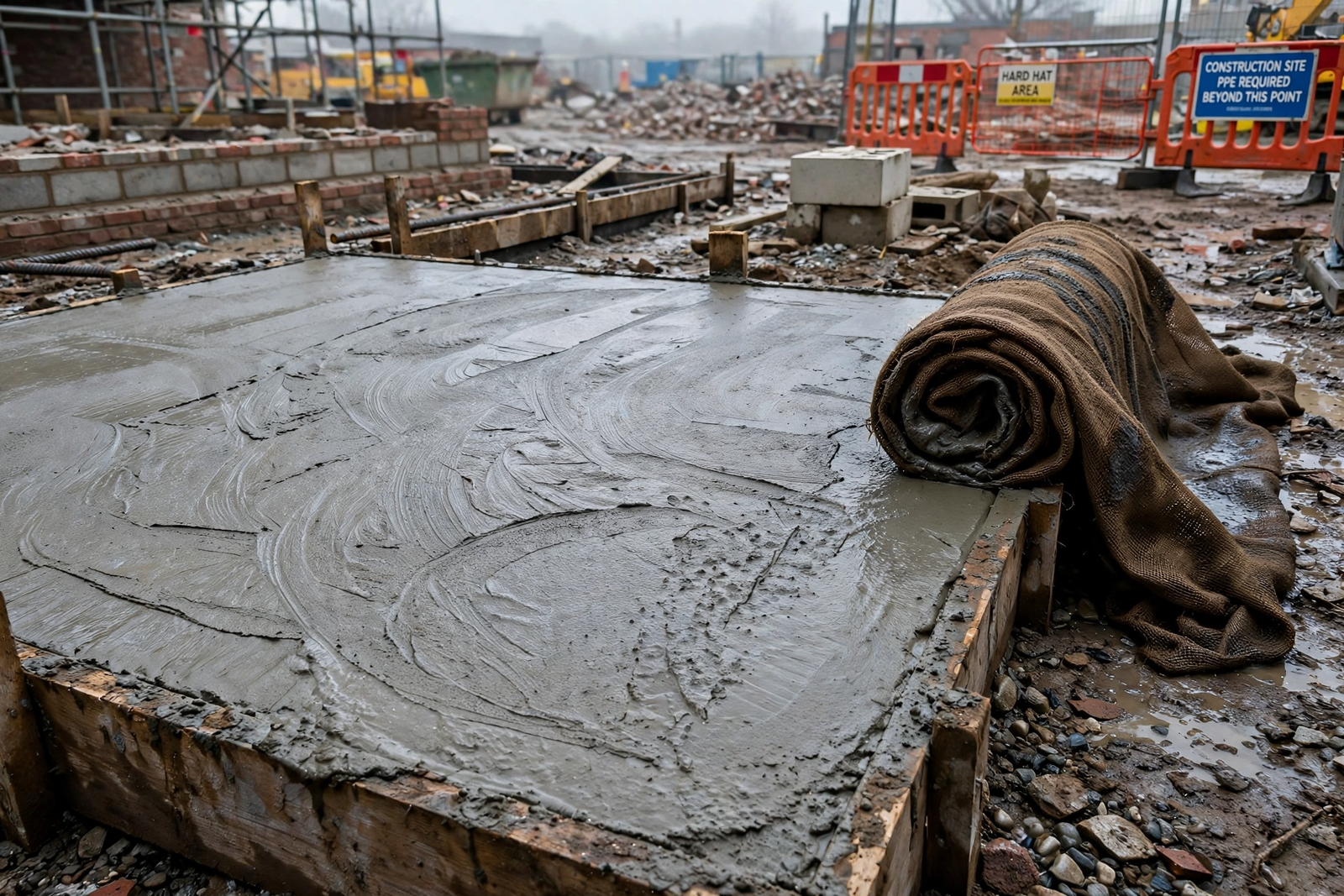
- Polythene covering: lay sheeting over the slab once it is firm enough not to mark; leave for 7 days. Costs pennies, big payoff.
- Damp hessian or sand: the traditional method — keep coverings damp for a week.
- Curing compounds: spray-on membranes that seal moisture in, handy for large areas.
Research from the Building Research Establishment consistently shows properly cured concrete significantly outperforms air-dried concrete in strength, surface hardness and frost resistance. For a garden slab or shed base, a week under polythene is the single highest-value step you can take.
Testing Whether It Is Ready
- Thumbnail test: a firm thumbnail press should leave no indentation.
- Colour check: concrete lightens as it dries; dark patches are still damp.
- Polythene sheet test: tape down 1 m² of polythene for 24 hours; condensation underneath means moisture is still escaping.
- Hygrometer: the only reliable test for screeds before laying wood or vinyl — most coverings need relative humidity below 75%.
- Tap test: a hollow, drummy sound when tapping a screed suggests debonding or too-rapid drying.
What Not to Do
Do not force-dry with direct heat from fan heaters or heat guns. It shrinks and cracks the surface while the interior stays wet and weak — the classic recipe for a screed that hollows and cracks months later. Do not lay floor coverings “a bit early to save time”. And do not add extra water to a stiffening mix to make it workable again; that permanently weakens it.
If a mix is going off in the barrow, it has gone — mix a fresh batch. Retempering (re-wetting) is one of those shortcuts that always costs more than it saves.
A Seasonal Timetable for UK Projects
Timing your project to the season makes life much easier. Spring (April–May) is the ideal window: mild temperatures, lengthening days and generally moderate humidity. Concrete poured in spring cures beautifully with minimal fuss.
Summer brings the opposite problem — rapid surface drying. In a heatwave, damp down the substrate before placing concrete, work early in the morning, and get polythene over the slab promptly. Shrinkage cracking is most common on hot, windy days, so plan accordingly.
Autumn is workable but the margin for error shrinks. Days shorten, nights cool, and that first unexpected frost can catch you out. Keep frost-proofer and thermal blankets on hand from October onwards, and avoid starting large pours late in the day when temperatures are falling.
Winter is for small, sheltered jobs only — or for planning. If you must pour, heated enclosures are the professional answer, but for most DIYers the sensible choice is to wait. Use the downtime to prep the site so you can move fast when spring arrives.
Whatever the season, the golden rules never change: protect from frost for 48 hours, do not flood the surface, keep it covered for a week, and test before loading. Follow those and your concrete will outlast the structure it supports.
Frequently Asked Questions
How soon can I walk on new concrete?
Carefully after 24 hours in mild weather. Give it 3 days before normal use and 7 days before parking a car on a new driveway.
Can I pour concrete in a UK winter?
Only if temperatures stay above 5°C with no frost forecast for 48 hours. Use frost-proofer, cover with thermal blankets, and never pour onto frozen ground. When in doubt, wait for better weather.
How long before painting new render?
Minimum two to three weeks for a standard two-coat render, longer when damp. First coat should be a breathable masonry paint.
Why is my new mortar crumbling?
Almost always frost damage during curing, too much water in the mix, or drying too fast in sun/wind. Crumbled mortar cannot be repaired — rake it out and repoint.
Is 28-day concrete at full strength?
It has reached its design strength, yes — though concrete keeps gaining strength slowly for years afterwards. 28 days is the industry reference point. Our concrete drying timetable breaks the stages down in more detail.
When can I tile on a new screed?
When a hygrometer reads below 75% RH — often many weeks for a 50 mm sand/cement screed. Tiling early is a leading cause of adhesive failure and tenting tiles.
One thought on “How Long does It Take for Cement to Dry? Complete Answer”