
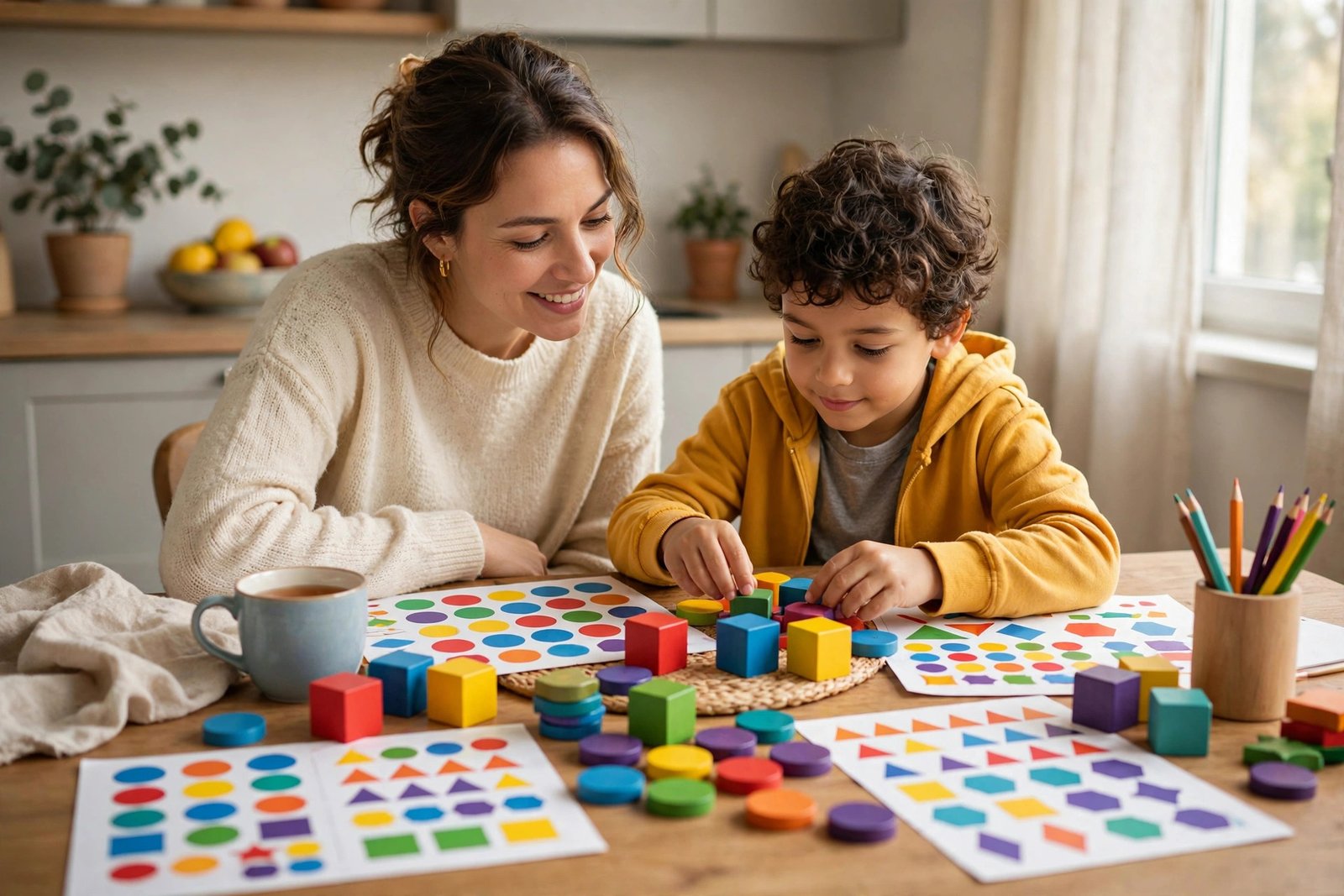
Is Helping Kids With Maths Homework Actually Worth Your Time?
It starts innocently enough: a seven-year-old slides their maths book across the kitchen table, looks up with hopeful eyes, and asks for help with fractions. You stare at the page, realise the methods look nothing like the ones you learned in 2004, and quietly panic. If you are a beginner — no teaching background, no maths degree, just a parent trying to help — is it actually worth the effort? The honest answer is yes, but only if you help in the right way.
This article looks at what the research really says about parents helping with maths homework, where well-meaning help goes wrong, and how a complete beginner can make those twenty minutes at the kitchen table genuinely useful instead of a nightly battle.
What the Research Actually Shows
Decades of education research converge on one finding: parental involvement in learning matters enormously, but how you help matters more than how much. Studies of primary-school maths consistently show that children whose parents engage with their learning — asking questions, showing interest, making maths part of everyday life — outperform those whose parents stay distant.
But there is a catch, and it is a big one. Research also finds that when parents who are anxious about maths try to teach it directly, children can actually do worse. The mechanism is simple: maths anxiety is contagious. If you approach the homework with dread, sighing and saying “I was never any good at this either,” your child absorbs the message that maths is something to fear. The takeaway is not to avoid helping — it is to help differently, as a coach rather than a teacher. The BBC Bitesize maths resources are an excellent neutral third party to lean on when your own confidence wobbles.
The Beginner’s Realistic Role: Coach, Not Teacher
Forget the image of a parent delivering a mini-lesson at the whiteboard. Your actual job has four parts, and none of them require you to know the answer in advance.
First, create the conditions: a consistent time, a clear table, the phone put away. Second, ask questions instead of giving answers: “What do you think the first step is?” “Can you show me how your teacher did one like this?” “What happens if we try it with smaller numbers?” Third, normalise struggle: “This is supposed to feel hard at first — that’s your brain growing.” Fourth, know when to stop: twenty focused minutes beats an hour of tears.
This coaching approach has a hidden benefit: it builds the exact thinking skills maths is meant to teach. A child who learns to break a problem down, test an idea and check their work is learning mathematics, even when the parent never stated a single rule.
Where Beginners Go Wrong (and How to Avoid It)
The number one beginner mistake is teaching your own method. Maths pedagogy has changed: children now learn column methods, number lines, bar models and partitioning before they meet the algorithms you remember. If you override the school’s method with “just do it my way, it’s faster,” you create confusion that the teacher then has to undo. Always ask your child to show you the school’s method first.
The second mistake is doing the work for them. Hovering, correcting every line and eventually writing the answers yourself feels helpful but teaches learned helplessness. A good rule: your pen stays capped. The third mistake is turning it into a nightly war. If homework regularly ends in tears — yours or theirs — the routine needs redesigning, not more effort. Shorter sessions, a snack first, or moving homework to straight after school can transform the dynamic.
Finally, avoid the trap of making it a test of your own intelligence. Your child does not need you to be brilliant at maths; they need you to be calm, curious and consistent. For older children moving toward exam years, the same coaching principles scale up — see our guide to reducing stress without spending money for what comes next.
Making Maths Part of Everyday Life
Some of the most powerful maths help happens nowhere near a textbook. Cooking together is fractions and measurement. Shopping is percentages, estimation and budgeting. Board games like Monopoly, card games and even darts build number fluency without anyone noticing they are “doing maths.”
Try narrating numbers out loud: “That pizza is £8.50 and we’ve got a 20% voucher — what do you reckon we’ll pay?” Let them estimate before they calculate; estimation is a genuine mathematical skill that schools value. For younger children, counting stairs, spotting number plates and timing the microwave all count. The goal is to make numbers feel like a normal, friendly part of life rather than a school-only ordeal.
When to Bring in Backup
There are moments when a beginner parent should sensibly step back. If your child is consistently working more than a year behind, if homework triggers genuine distress most nights, or if you find yourself arguing with the school’s methods weekly, it is time to talk to the teacher. Schools would far rather hear from you early than discover the problem at parents’ evening.
Free backup exists: most schools run maths support clubs, and many libraries host homework help sessions. Paid tutoring is an option, but for primary-age children it is rarely the first answer — a ten-minute chat with the teacher about which three skills to practise at home usually achieves more. The national curriculum guidance on GOV.UK shows exactly what your child is expected to learn each year, which makes conversations with teachers far more productive.
How Much Time Should This Actually Take?
For primary school, the evidence suggests that quality trumps quantity: fifteen to twenty-five minutes of calm, focused help beats an hour of friction. For secondary school, your role shifts further toward logistics — ensuring they have a routine, a quiet space and access to resources — rather than content help.
One practical framework: the three-question rule. When your child is stuck, ask (1) “What is the question actually asking?” (2) “What do you already know that might help?” and (3) “Can you find an example in your book?” If all three fail, that is useful information for the teacher — write a quick note in the homework diary saying where they got stuck. Teachers genuinely appreciate this; it tells them exactly what to reteach.
Parents of secondary-age children facing the jump to GCSE-style problem solving may also find value in what children should actually learn about AI at school, since calculators and AI tools are reshaping what “showing your working” even means.
Conclusion
So, is helping kids with maths homework actually worth it for a beginner? Emphatically yes — with one condition. Your value is not in knowing the answers; it is in asking the right questions, keeping the atmosphere calm, and making numbers a normal part of family life. Skip the whiteboard lectures, resist the urge to teach your 2004 methods, keep sessions short, and call in the teacher when you hit a wall. Done right, those twenty minutes at the kitchen table do not just improve maths scores — they teach your child that struggling with something hard is normal, survivable and even, eventually, satisfying.
Frequently Asked Questions
What if I am genuinely bad at maths myself?
It does not matter as much as you think. Research shows the coaching approach — asking questions, encouraging persistence, normalising struggle — helps regardless of the parent’s own maths ability. Avoid saying “I’m rubbish at maths” in front of your child; frame it as “let’s figure this out together.”
Should I teach my child the way I learned it?
No — at least, not first. Always start with the method the school teaches, and ask your child to show you. If their method truly is not clicking after sustained effort, mention it to the teacher before introducing an alternative.
How long should maths homework take each night?
As a rough guide, ten minutes per year group for primary children (so 30 minutes in Year 3), and 45–60 minutes for secondary students. If it regularly takes far longer, tell the teacher — the work may be mis-set.
Is it okay to use YouTube or apps for help?
Absolutely, with supervision. BBC Bitesize, White Rose Maths videos and the school’s recommended platforms align with the curriculum. Avoid random tutorial channels that may teach conflicting methods.
When should I consider a tutor?
Consider it when there is a persistent gap (a year or more behind), when school support has not shifted it after a term, or ahead of key transitions like SATs or GCSEs. For most primary children, teacher communication plus home coaching comes first.