
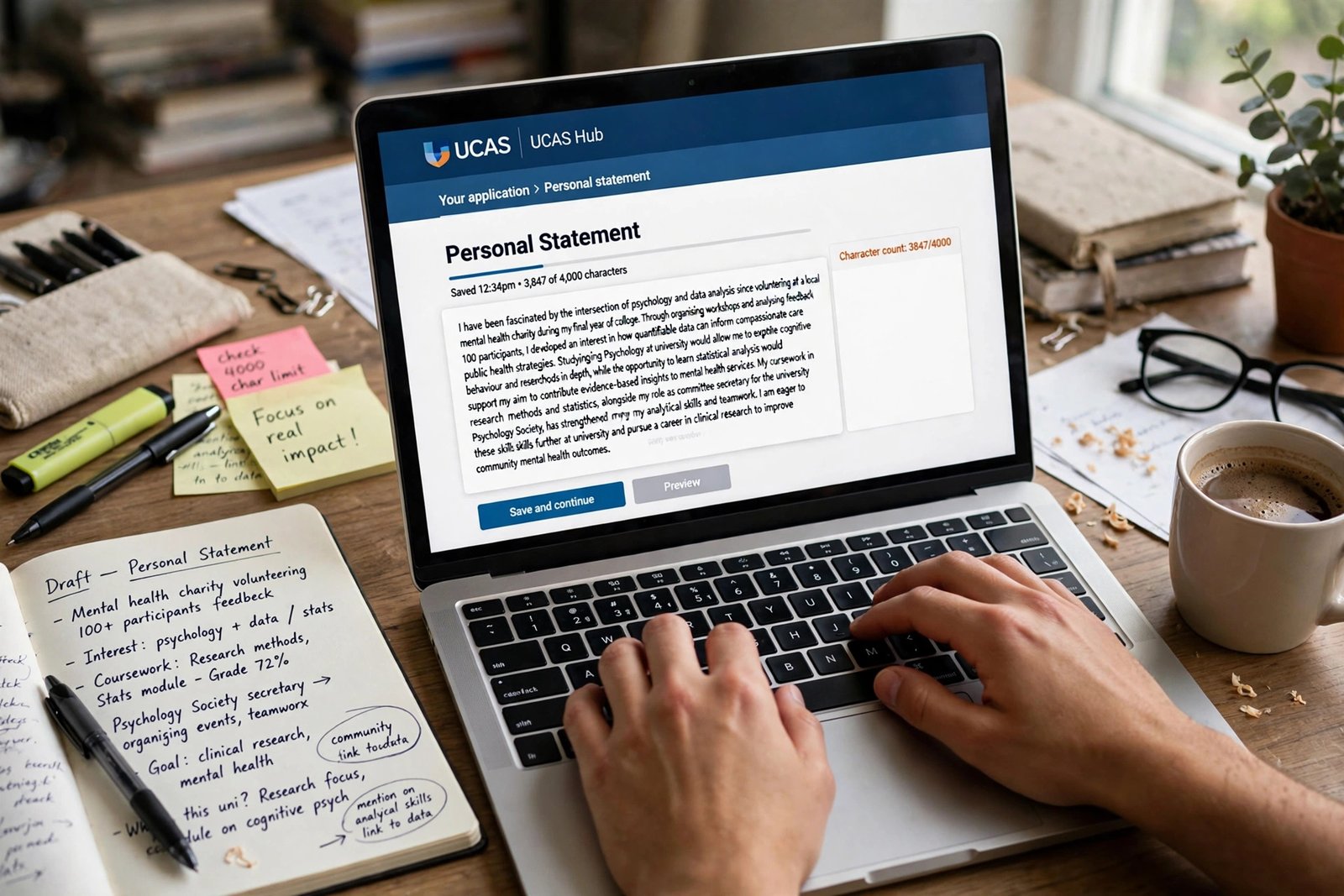
How to Write a Standout Personal Statement on a Budget
Your personal statement is 4,000 characters that can decide your university future — and the myth says you need expensive consultants, private-school polish, or exotic work experience to write a good one. Nonsense. Admissions tutors read thousands of statements; the ones that stand out aren’t the most expensive, they’re the most genuine — specific, reflective, and clearly written by a real person who actually cares about the subject. And every resource you need is free. This guide shows how to write a standout statement on a zero budget, what tutors actually look for, and the mistakes that sink applications.
What Tutors Actually Want (It’s Not What You Think)
Forget “standing out” through gimmicks — tutors want evidence of academic fit: that you understand what the course involves, that your interest is genuine and specific, and that you can think. The UCAS structure change (from 2025, three structured questions instead of one free essay) actually helps: 1. Why do you want to study this course? 2. How have your qualifications and studies prepared you? 3. What else have you done to prepare, and why are these experiences useful? Each wants specifics, not adjectives — and UCAS’s own statement-writing guide walks through answering each one well. “I am passionate about biology” is noise; “reading Zimmer’s Parasite Rex changed how I think about evolution, which led me to…” is signal. The difference is evidence — every claim about yourself needs an example attached.
The budget truth: nothing in a great statement costs money. Tutors explicitly say they don’t expect expensive programmes — they expect reflection on whatever you have done. A Saturday job, caring responsibilities, a library book that fascinated you, a free online lecture — all valid, all free, all powerful if you reflect on them. The reflection is the product; the experience is just raw material. A student who worked in a care home and can articulate what it taught them about psychology outperforms one who paid £2,000 for a “prestigious” summer school and writes about it vaguely. Every time.
The Free Toolkit (Everything Costs £0)
Research: know the course cold
Read the actual module lists for your chosen courses (free, on university websites) and reference specific modules or lecturers’ research — “I’m excited by your second-year module on behavioural economics” signals genuine interest that generic statements never do. UCAS’s free guides walk through the structure question by question.
Super-curriculars: free depth
Massive Open Online Courses (FutureLearn, Coursera — free tiers), university public lectures (many on YouTube), books from the library (ask librarians for subject reading lists — they love this), podcasts, and essay competitions (many free to enter, winning looks superb). Pick two or three and go deep — then write about what you thought, not just what you did.
Feedback: free editors
Teachers (ask early — they’re drowning in requests by December), school careers advisers, and the simple trick of reading it aloud (your ear catches what your eye misses). Never pay for “personal statement checking services” — teachers do it better and free.
AI: use with extreme care
AI tools can help brainstorm structure — but tutors and detection systems are increasingly alert to AI-generated statements, and detection is improving fast. A statement must sound like you; AI-polished generic prose is the opposite of standout. Use it as a thesaurus, never as an author.
The Structure That Works
Opening (10%): not a quote, not “from a young age” — start with the specific intellectual spark (a book, a lecture, a question that hooked you). Academic evidence (60%): the meat — what you’ve studied, read, and done beyond the curriculum, with reflection on each. Skills and experiences (20%): work, volunteering, responsibilities — framed through what they taught you (resilience, communication, time management), not listed like a CV. Closing (10%): forward-looking — what you want from the course, where the curiosity points next. Throughout: show, don’t tell; specific beats sweeping; and every paragraph should answer “so what?” — why does this evidence matter for this course?
Draft brutally: write 6,000 characters of raw material, then cut to 4,000 — the cutting is where quality appears. Most first drafts are 70% throat-clearing; the statement emerges in revision. And tailor where it counts: if applying to varied courses, the statement must serve all five choices — keep it subject-focused, not university-focused (save the university-specific love for interviews and open-day conversations).
Tailoring for Competitive Courses
Medicine, dentistry, veterinary, law, and Oxbridge demand extra layers. Medicine/dentistry/vet: work experience is genuinely expected (not the expensive kind — GP shadowing, care work, volunteering all count; reflect on what each taught you about the profession’s realities, including the unglamorous parts). Admissions tests (UCAT, BMAT where still used) matter enormously — prepare properly. Law: no specific experience needed, but evidence of analytical thinking, debate, and precise writing helps — essay competitions and debating shine here. Oxbridge: the statement feeds the interview — every claim is potential interview material, so write only what you can defend in depth, and show genuine academic curiosity beyond the syllabus (the interview probes thinking, not knowledge). For all competitive courses: apply strategically across the five choices (a mix of aspirational and safer options), meet the early October deadline, and remember that rejected-from-Oxbridge is not rejected-from-a-great-education — the system is designed with excellent alternatives.
Mistakes That Sink Statements
The classics, seen thousands of times: opening with a quote (tutors groan — it’s the most overused device in existence); “passionate” without proof (the word appears in most statements; evidence appears in few); listing without reflecting (ten activities, zero insight — three activities with deep reflection wins); exaggeration (tutors interview on statements — every claim is a potential question; lies collapse under gentle probing); negativity or excuses (the statement is a sales document, not a confessional); ignoring the course (writing about yourself without connecting to what you’ll study); and leaving it late (rushed statements read rushed — start drafting in summer, revise through autumn). Proofread obsessively — a typo doesn’t reject you, but carelessness in a document about your academic seriousness is a bad look.
One Norfolk-specific note: don’t assume your background is a disadvantage — tutors actively value diverse routes, and rural/limited-opportunity contexts are understood, not penalised. What matters is what you did with what you had. Skills built independently (a language learned alone, a project pursued without prompting) signal exactly the self-direction universities want. And when the offers arrive, understand the practical side too — the official student finance guidance explains loans, repayments, and what the numbers really mean before you commit.
A standout personal statement on a tight budget isn’t a compromise — it’s the natural product of the process done right: specific evidence, genuine reflection, course knowledge, and ruthless revision. All free. The students who pay for polish usually buy generic; the students who think hard write memorable. Be the second kind.
Frequently Asked Questions
How long should a personal statement be?
4,000 characters (including spaces) or 47 lines, whichever comes first — UCAS enforces it strictly. Draft long, then cut ruthlessly; the revision is where quality appears.
Do I need expensive work experience to stand out?
No — tutors value reflection over price tags. A part-time job, caring responsibilities, or a library book engaged with deeply all beat expensive programmes described vaguely. It’s what you thought, not what you paid.
Can I use AI to help write my statement?
For brainstorming and structure, cautiously — but the final words must be yours. Detection is improving, tutors prize authentic voice, and generic AI prose is the opposite of standout.
Should I mention extracurriculars like sport and music?
Briefly, and only framed through transferable skills or genuine relevance — tutors care far more about subject engagement than well-roundedness. One reflective paragraph beats a list.