
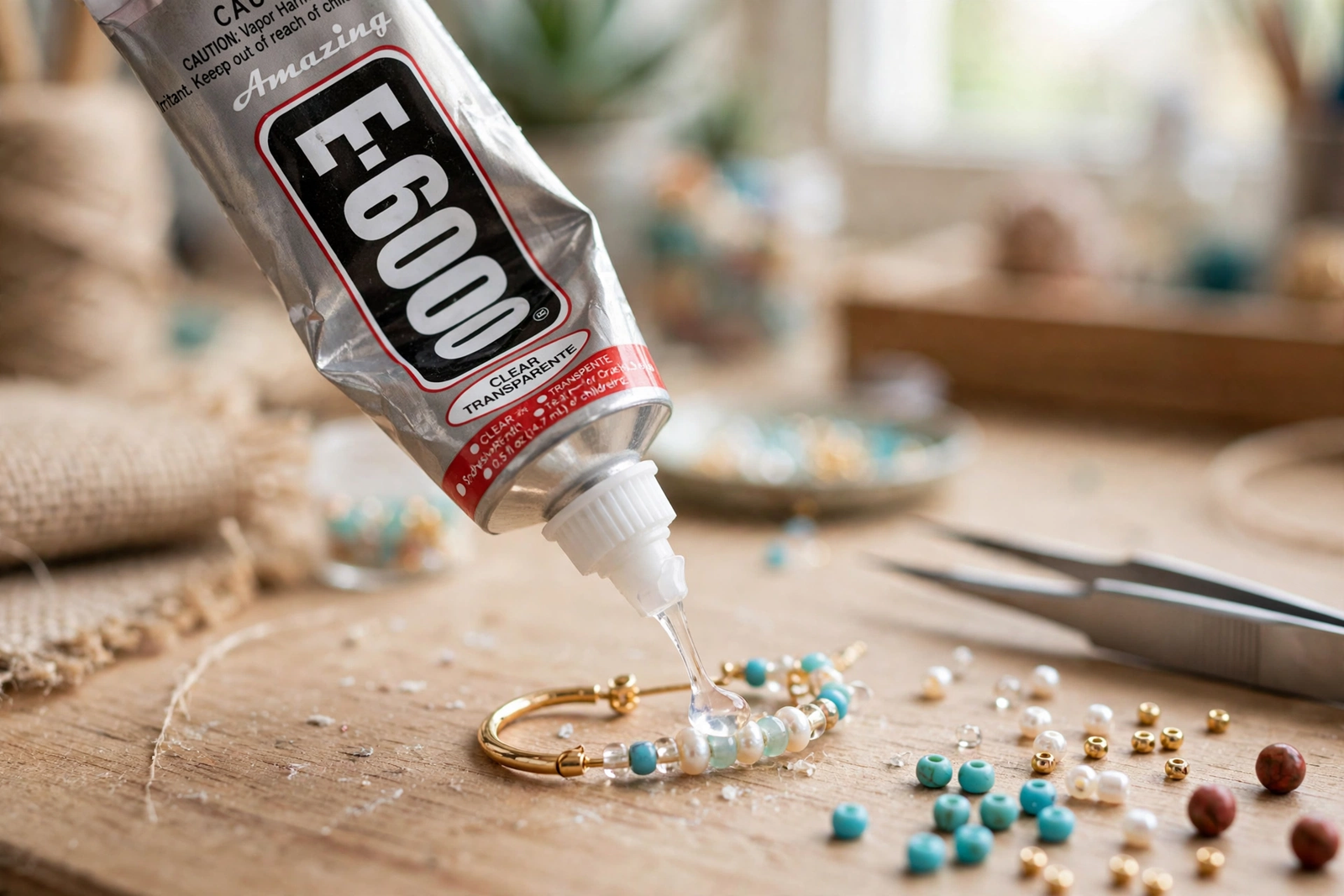
How Long does E6000 Take to Dry? Complete Answer
E6000 is the industrial-strength craft adhesive that shows up everywhere — jewellery making, phone repairs, shoe fixes, model building, and general household repairs. It is famous for bonding almost anything: metal, glass, wood, fabric, ceramics, and many plastics. But it is equally famous for a strong solvent smell and a cure time that catches people out. Use something before it has fully cured and the bond can fail. Here is the full drying timeline and how to get it right.
E6000 Drying Times at a Glance
| Stage | Typical time | What it means |
|---|---|---|
| Skin forms | ~10 minutes | The surface goes tacky; parts should already be positioned |
| Initial set | 30–60 minutes | Do not move or stress the parts |
| Handling strength | 4–8 hours | Light handling is OK; no load or flexing |
| Functional cure | ~24 hours | Most everyday uses are fine |
| Full cure | 24–72 hours | Maximum strength and chemical resistance |
These figures come from E6000’s official product page from Eclectic Products, combined with the technical data sheet guidance: full cure is quoted as 24–72 hours depending on conditions. For anything structural, load-bearing, or exposed to water, always wait the full 72 hours.
Dry vs Cured: An Important Difference
People use “dry” and “cured” interchangeably, but with E6000 they mean different things. Drying is the solvent evaporating from the surface — that is the 10-minute skinning you see. Curing is the slower chemical process through the full thickness of the adhesive as the remaining solvent escapes and the polymer chains lock together, giving E6000 its famous flexibility and strength.
This is why a repair can feel solid after an hour but still fail if stressed: the outside is dry while the inside is still soft. The 24–72 hour window is the cure, not the dry, and it is the number that matters for strength. The same principle applies to other sealants and adhesives — see how long silicone adhesive takes to dry and how long caulk takes to dry for their timelines.
5 Factors That Affect E6000 Drying Time
- Thickness of application. The single biggest factor. A thin smear between two flat surfaces cures far faster than a thick bead filling a gap, because solvent must migrate out through the adhesive. Thick applications can need the full 72 hours.
- Temperature. E6000 cures best around 18–25°C. Cold rooms slow solvent evaporation dramatically — a repair done in an unheated garage in winter can take twice as long. Gentle warmth helps; direct high heat does not.
- Airflow and ventilation. Moving air carries solvent vapour away from the joint and speeds curing. A still, enclosed space slows it. (Ventilation matters for safety too — see below.)
- Humidity. Very humid air slows evaporation slightly. Normal indoor humidity is fine; a damp shed is not ideal.
- The materials being bonded. Porous materials like wood and fabric wick solvent away and cure a little faster. Non-porous pairings like glass-to-metal trap solvent in the joint and need the longer end of the range.
How to Apply E6000 for the Best Bond
- Prepare the surfaces. Clean both parts thoroughly — grease, dust, and old adhesive are the main causes of bond failure. A wipe with rubbing alcohol on a lint-free cloth is ideal. Lightly roughening very smooth surfaces with fine sandpaper improves grip.
- Ventilate. Work in a well-ventilated area or outdoors. E6000 contains perchloroethylene (tetrachloroethylene), a strong solvent — tetrachloroethylene on Wikipedia details why its vapours demand respect.
- Apply sparingly. More is not better. A thin, even layer gives a stronger, faster-curing bond than a thick squeeze. For most repairs, a 1–2 mm film is plenty.
- Assemble within 10 minutes. You have roughly the skinning window to position parts. Press them together firmly to spread the adhesive and squeeze out air.
- Clamp or support. Hold or clamp the parts for at least the first 30–60 minutes. Painter’s tape, elastic bands, or small clamps all work — the goal is zero movement while the initial set forms.
- Leave it alone. Resist the urge to test the bond. Mark the time and walk away for 24 hours minimum.
How to Speed Up Drying (Safely)
- Apply thin layers. Two thin applications cure faster and stronger than one thick one.
- Warm the room to around 20–25°C. A normally heated room is perfect; do not use hairdryers or heat guns on the joint.
- Improve airflow with an open window or a fan nearby (not blowing directly onto the work, which can skin the surface prematurely and trap solvent underneath).
- Consider E6000 Plus for time-sensitive jobs — the low-odour formula is designed to cure faster than the original.
- Do not try to rush curing with ovens, radiators, or direct heat. It risks bubbling the adhesive, weakening the bond, and creating a fire or fume hazard.
Safety: Ventilation Really Matters
E6000’s strength comes with a serious solvent load. Always use it in a well-ventilated area, avoid breathing the vapours, and wear nitrile gloves — it bonds skin unpleasantly well. Keep it away from children and pets, and store the tube upright with the cap tight; a partially used tube kept cool lasts far longer. Note that E6000 is not rated for food-contact surfaces, and you should check the manufacturer’s technical data sheet before using it for aquariums or anything involving drinking water.
E6000 vs E6000 Plus vs Common Alternatives
| Adhesive | Full cure | Key traits |
|---|---|---|
| E6000 (original) | 24–72 hours | Extremely strong, flexible, waterproof; strong solvent odour |
| E6000 Plus | Faster (often ~24 hours) | Low-odour, no perchloroethylene; slightly less aggressive bond |
| Silicone adhesive | 24–48 hours | Flexible and waterproof but lower tensile strength |
| Two-part epoxy | 24 hours typical | Rigid, very strong; poor on flexible materials |
| Super glue (cyanoacrylate) | Minutes–24 hours | Fast and strong on small rigid parts; brittle, poor gap-filling |
Choose E6000 when you need a tough, flexible, waterproof bond between dissimilar materials and can afford to wait. Choose something else when you need instant results or a rigid joint.
Removing E6000
Made a mistake? E6000 can be removed, but it fights back. Soften it with heat from a hairdryer, then scrape gently with a plastic tool. Acetone-based nail polish remover or adhesive removers help dissolve residue — test on a hidden spot first, as acetone attacks many plastics and finishes. For a full walkthrough on a related job, see our guide to removing old silicone caulk, which covers the same score, soften, and scrape principles.
Frequently Asked Questions
How long does E6000 take to dry completely?
E6000 skins over in about 10 minutes and reaches handling strength in 4–8 hours, but full cure takes 24–72 hours depending on thickness, temperature, and ventilation. Wait the full period before putting the repair under load.
Can you speed up E6000 drying time?
Yes, modestly: apply thin layers, cure at around 20–25°C, and ensure good airflow. Do not use direct heat sources like hairdryers on the joint or ovens — they can bubble the adhesive and weaken the bond.
Is E6000 waterproof after drying?
Yes, fully cured E6000 is waterproof and washer/dryer safe (it is widely used on fabric and shoes). It must be fully cured first — water exposure during the curing window will ruin the bond.
Why does E6000 smell so strong?
The smell comes from perchloroethylene, the solvent that keeps the adhesive liquid in the tube. It evaporates as the adhesive cures, which is why ventilation is essential. E6000 Plus is the low-odour alternative without that solvent.
Can E6000 be used on fabric and shoes?
Yes — it is one of the most popular adhesives for shoe repairs, rhinestones on costumes, and fabric crafts, because it stays flexible after curing instead of going brittle. Apply thinly, clamp, and allow the full 72-hour cure for items that flex.
How should you store an opened tube of E6000?
Squeeze out air, cap tightly, and store upright in a cool place. A blob of petroleum jelly on the nozzle threads stops the cap gluing itself shut. Stored well, an opened tube lasts months; stored badly, the nozzle seals permanently within weeks.